


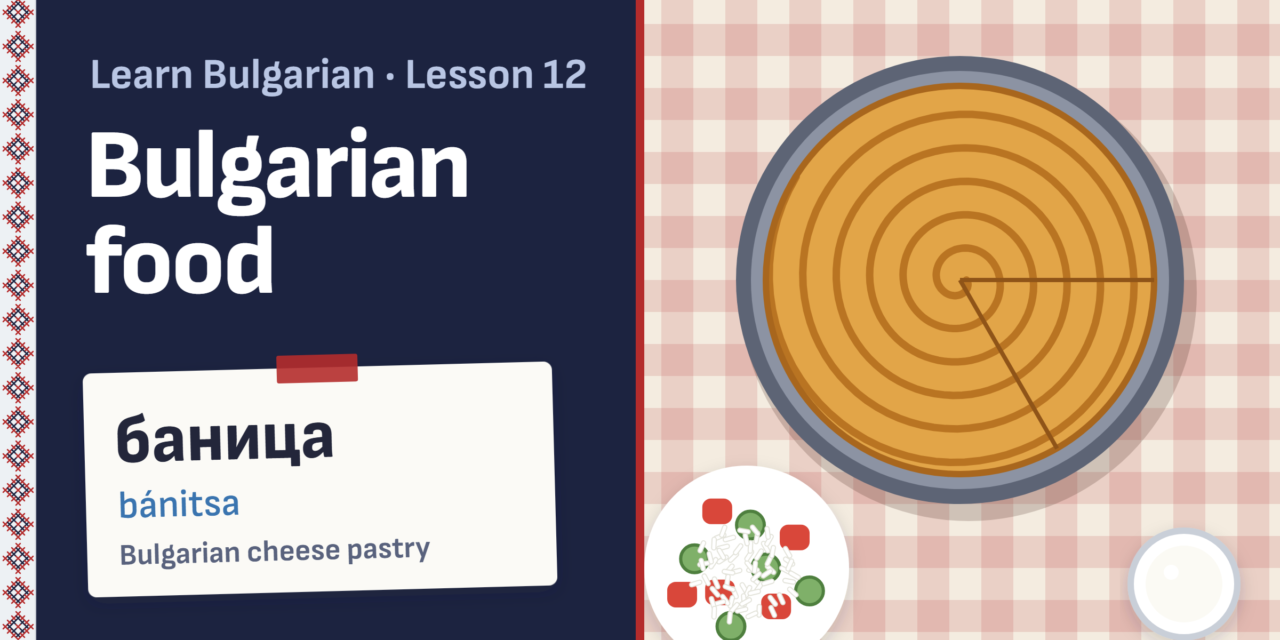
Traditional Bulgarian food rests on yogurt, white cheese and fresh vegetables. The three Bulgarian dishes almost every visitor meets first are шопска салата (shópska saláta), the shopska salad of chopped vegetables under grated cheese; баница (bánitsa), a flaky cheese pastry; and таратор (taratór), a cold yogurt soup. This lesson gives you the key dish names of Bulgarian cuisine, a banitsa recipe in simple steps, and the phrases you need at the table. Every Bulgarian word has its pronunciation in brackets, with the stressed vowel marked by an accent. Still slow with Cyrillic? Keep the Bulgarian alphabet lesson open in another tab.
PART 1 · BULGARIAN DISHES
1. Traditional Bulgarian food and cuisine: 14 food names on every menu
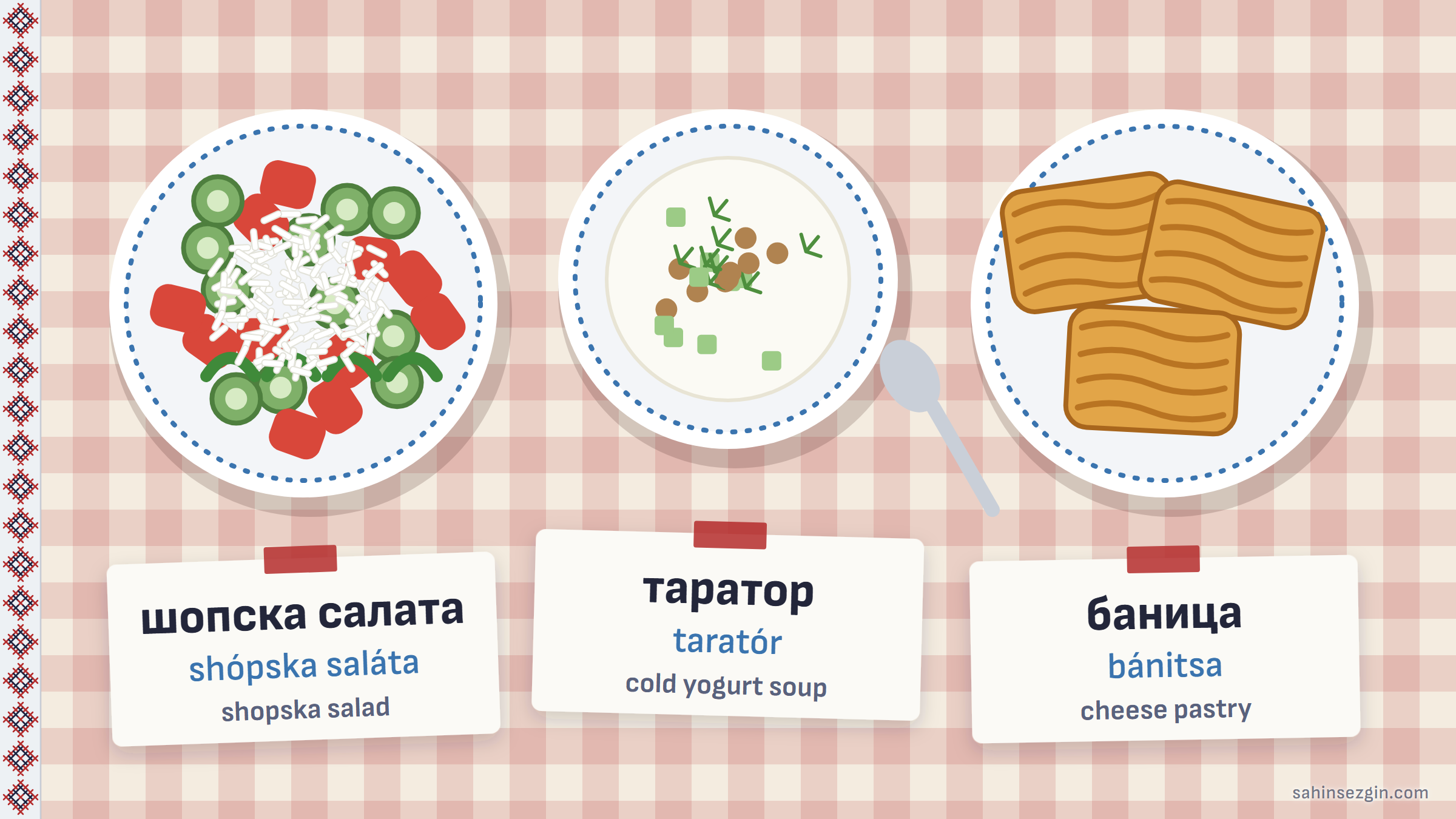
Traditional Bulgarian food is hearty Balkan home cooking, and you taste it first in the dairy: yogurt and white cheese turn up at nearly every meal. In summer people drink таратор (taratór), a chilled soup of yogurt, cucumber and dill, often with walnuts. Bread gets a spread of лютеница (lyútenitsa), a red relish of roasted peppers and tomatoes. Bulgarian yogurt, кисело мляко (kíselo mlyáko), is a point of national pride: one of the bacteria that ferment it is called Lactobacillus bulgaricus, after the country. The table collects 14 Bulgarian food names you will spot on any menu.
| Bulgarian | Pronunciation | English |
|---|---|---|
| шопска салата | shópska saláta | shopska salad |
| снежанка | snezhánka | yogurt and cucumber salad (“Snow White”) |
| баница | bánitsa | cheese and egg filo pastry |
| таратор | taratór | cold yogurt and cucumber soup |
| боб чорба | bop chorbá | bean soup |
| кебапче | kebápche | grilled finger of minced meat |
| мешана скара | méshana skára | mixed grill |
| мусака | musaká | potato and minced meat bake |
| миш-маш | mísh-másh | peppers and tomatoes scrambled with egg and cheese |
| луканка | lukánka | flat dry-cured sausage |
| лютеница | lyútenitsa | pepper and tomato relish |
| кисело мляко | kíselo mlyáko | yogurt (“sour milk”) |
| сирене | sírene | white cheese, like feta |
| тиквеник | tíkvenik | sweet pumpkin filo pie |
Shopska salad: what goes into шопска салата (shópska saláta)
People like to say shopska salad wears the colours of the Bulgarian flag: white cheese, green cucumber and pepper, red tomato. The name comes from the шопи (shópi), the people of the region around Sofia. Tomatoes are домати (domáti) and cucumbers are краставици (krástavitsi). Add чушки (chúshki, peppers); everything is chopped into chunky pieces, and сирене (sírene) is grated over the top so thickly that it almost hides them. Onion and parsley often go in too, and the dressing is sunflower oil with vinegar. If you know Greek salad, this is a close relative, only with a snowy layer of grated cheese instead of a block of feta. It is ordered at the start of the meal, often with a glass of ракия (rakíya, fruit brandy).
2. Bulgarian dishes with Balkan roots: кюфте (kyufté), сарми (sarmí), баклава (baklavá)
Many Bulgarian dishes have Balkan roots: centuries of Ottoman rule left Turkish words in the kitchen, and the same food is shared across the region. If you have eaten kofta or köfte, you already know кюфте (kyufté). Watch for two false friends. Кебапче (kebápche) is not meat on a skewer but a finger of spiced minced meat from the grill. Мусака (musaká) is not the Greek aubergine moussaka either: the Bulgarian one is made with potatoes and minced meat under a yogurt and egg topping. Чорба (chorbá) means any soup, and шкембе чорба (shkembé chorbá) is tripe soup, a famous late night cure.
| Bulgarian | Pronunciation | English |
|---|---|---|
| кюфте | kyufté | grilled meatball |
| сарми | sarmí | stuffed cabbage or vine leaves |
| гювеч | gyuvéch | stew baked in a clay pot |
| шкембе чорба | shkembé chorbá | tripe soup |
| айрян | ayryán | salted yogurt drink |
| баклава | baklavá | baklava |
Letter trap: in кюфте (kyufté) the letter Ю ю (yu) is one letter for the sound “yu”.
PART 2 · BANITSA RECIPE
3. Banitsa recipe: ingredients for баница (bánitsa), the Bulgarian cheese pastry
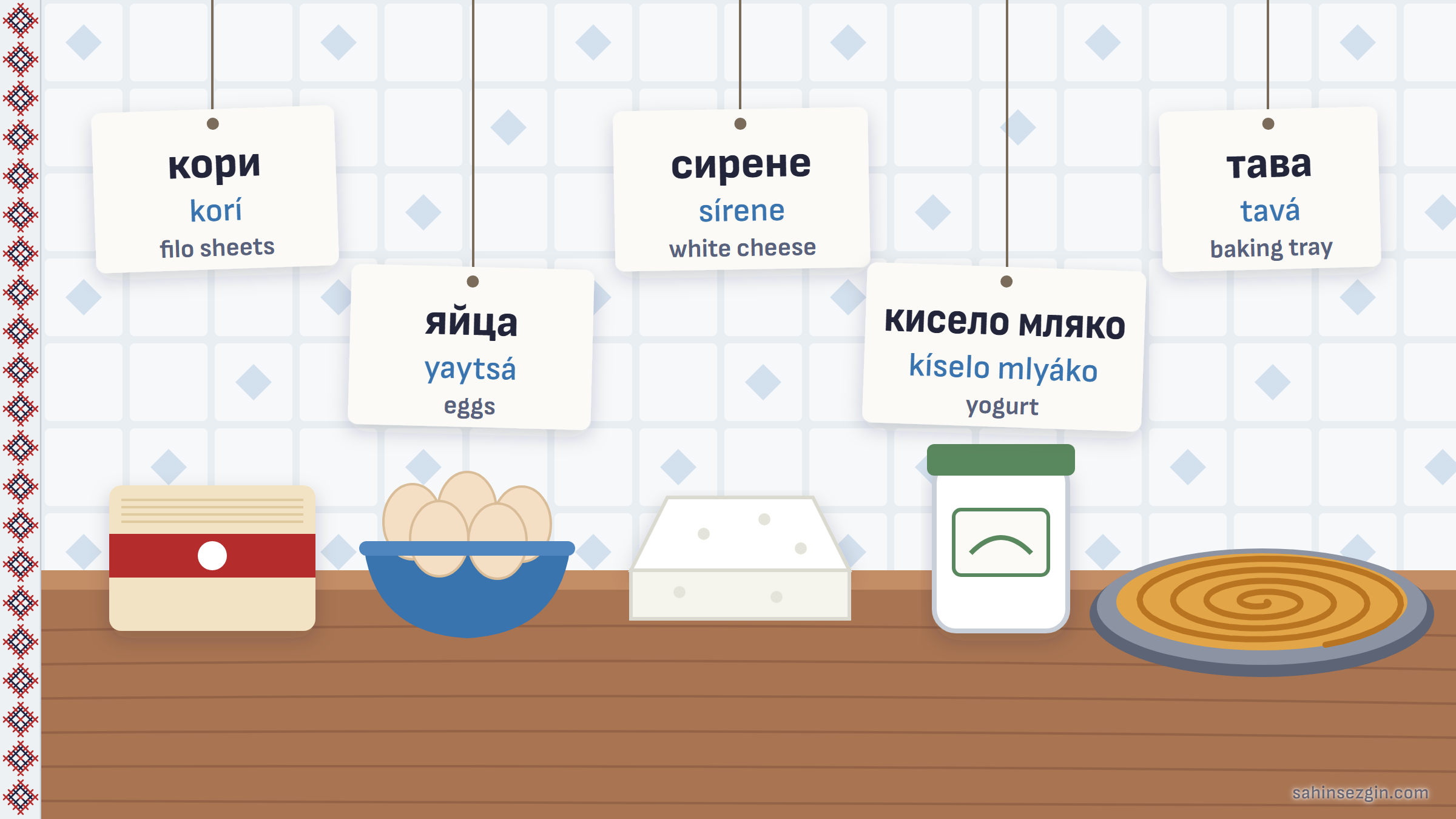
A basic banitsa recipe needs four essentials: кори (korí, filo sheets), яйца (yaytsá, eggs), сирене (sírene) and кисело мляко (kíselo mlyáko). Banitsa is Bulgaria’s breakfast pastry, a cheese pie close to Greek tiropita or Turkish börek: thin sheets of dough layered with an egg and yogurt filling full of crumbled white cheese. Bakeries sell it warm from early morning, often with a cup of айрян (ayryán). Notice the quantities: “one” changes with gender, so feminine чаша (chásha, cup) takes една (edná) while masculine пакет (pakét) takes един (edín), as in the Bulgarian noun gender lesson. This list fills one medium tray. Outside Bulgaria, feta and Greek yogurt are the closest swaps, and you may see the name spelled banica or banitza.
| Bulgarian | Pronunciation | English |
|---|---|---|
| един пакет кори | edín pakét korí | one pack of filo (400 g) |
| четири яйца | chétiri yaytsá | four eggs |
| 400 грама сирене | chétiristotin gráma sírene | 400 g white cheese |
| една чаша кисело мляко | edná chásha kíselo mlyáko | one cup of yogurt |
| половин чаша олио | polovín chásha ólio | half a cup of oil |
| една лъжичка сода | edná lăzhíchka sóda | one teaspoon of baking soda |
4. How to make banitsa step by step: whisk, crumble, bake
To make banitsa, layer filo sheets with the egg and cheese filling, then bake. Bulgarian recipes give each step in the imperative, just as an English cookbook says “whisk, add, bake”. These verbs are the informal “you” form, and most carry the stress on the last syllable: печи (pechí), bake. Яйцата (yaytsáta) means “the eggs”: the article ‑та (ta) is glued to the end of the noun instead of standing in front of it, as you saw in the asking for directions in Bulgarian lesson. Bakers also roll the filled sheets into a spiral, вита баница (víta bánitsa), or add спанак (spanák, spinach) to the cheese.
| Bulgarian | Pronunciation | English |
|---|---|---|
| Разбий яйцата с киселото мляко. | razbíy yaytsáta s kíseloto mlyáko. | Whisk the eggs with the yogurt. |
| Добави содата и олиото. | dobávi sódata i ólioto. | Add the soda and the oil. |
| Натроши сиренето. | natroshí síreneto. | Crumble the cheese. |
| Смеси всичко. | smési fsíchko. | Mix everything. |
| Намажи тавата с олио. | namazhí taváta s ólio. | Grease the tray. |
| Сложи кора и малко от сместа. | slozhí korá i málko ot smésta. | Add a sheet and some filling. |
| Повтори до края. | povtorí do kráya. | Repeat to the end. |
| Печи 40 минути на 200 градуса. | pechí chetirídeset minúti na dvésta gradúsa. | Bake 40 minutes at 200°C (about 390°F). |
New Year’s banitsa with късмети (kăsméti), little fortunes
On New Year’s Eve many Bulgarian families hide small paper notes between the layers of the banitsa. They are called късмети (kăsméti); one is a късмет (kăsmét), “luck”. Each note carries a wish for the year ahead, such as health, travel or a new job. The notes are wrapped in foil so they stay dry, then tucked between the sheets before baking. At midnight the pastry is cut, and everyone reads the note in their own slice out loud.
PART 3 · AT THE TABLE
5. Bulgarian food phrases at the table: Добър апетит! (dobắr apetít!) and “I’m full”
Bulgarian food starts with a wish: Добър апетит! (dobắr apetít!), “good appetite”, said before the first bite. The host answers Да ти е сладко! (da ti e sládko!), “may it be sweet to you”, or Да ви е сладко! (da vi e sládko!) to several guests. To praise the food, say Много е вкусно! (mnógo e fkúsno!); in вкусно (fkúsno) the в (v) before к (k) comes out as “f”. When you have had enough, the phrase depends on who speaks: сит (sít, full) is an adjective, and adjectives add ‑а (a) for a woman. A man says Сит съм (sít săm), a woman Сита съм (síta săm). Expect a second helping anyway.
| Bulgarian | Pronunciation | English |
|---|---|---|
| Добър апетит! | dobắr apetít! | Enjoy your meal! |
| Да ти е сладко! | da ti e sládko! | Enjoy! (the host) |
| Много е вкусно! | mnógo e fkúsno! | It’s delicious! |
| Искаш ли още? | ískash li óshte? | Would you like more? |
| Още малко, моля. | óshte málko, mólya. | A little more, please. |
| Благодаря, сит съм. | blagodaryắ, sít săm. | Thanks, I’m full. (man) |
| Сита съм. | síta săm. | I’m full. (woman) |
6. Cheers in Bulgarian and invitations: Наздраве! (nazdráve!), хайде да (háyde da), нека (néka)
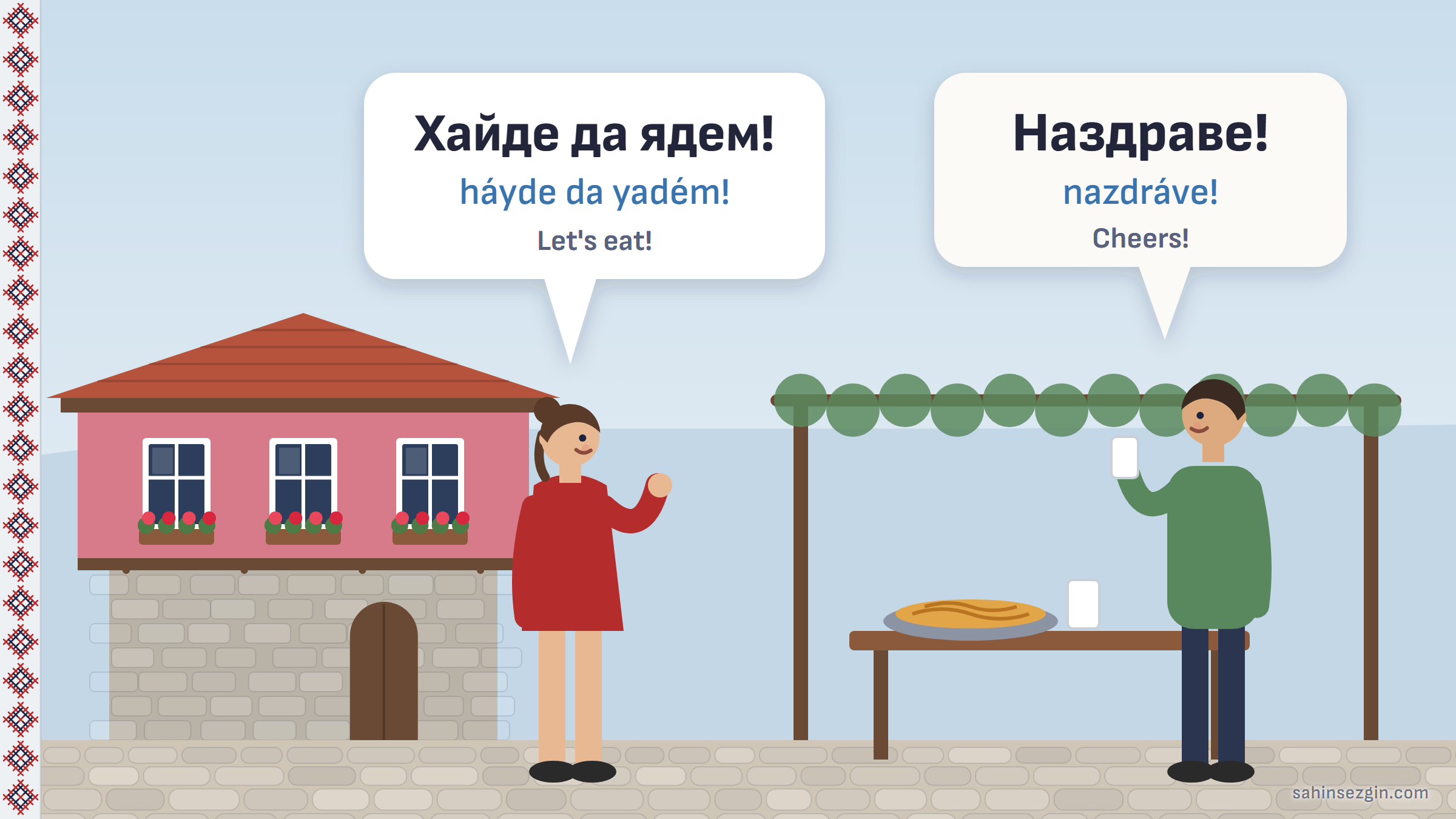
When glasses go up, say Наздраве! (nazdráve!), “to health”; you may remember it from the name day table in the Bulgarian names lesson. Bulgarians also say it after a sneeze, where English uses “bless you”. To invite someone, use хайде да (háyde da), “come on, let’s”, plus a verb in the “we” form: Хайде да ядем! (háyde da yadém!), let’s eat. Нека (néka) is softer, closer to “let me” or “let’s”: Нека те черпя (néka te chérpya), “let me treat you”.
| Bulgarian | Pronunciation | English |
|---|---|---|
| Наздраве! | nazdráve! | Cheers! (also: Bless you!) |
| Хайде да ядем! | háyde da yadém! | Let’s eat! |
| Нека да опитаме. | néka da opítame. | Let’s have a taste. |
| Заповядай на вечеря! | zapovyáday na vechérya! | Come for dinner! |
| Ела у нас в неделя. | elá u nás v nedélya. | Come over on Sunday. |
7. Bulgarian breakfast invitation dialogue: Sunday at Mila’s home
Alex has moved to Plovdiv and is still learning Bulgarian. Mila invites him for Sunday breakfast with warm banitsa and ayran. The dialogue is fictional: the first two lines are a phone call on Saturday, the rest happens at the table. Read each line aloud and guess the meaning before you look at the English. Then notice the endings: Alex says вкусна (fkúsna) about баница (bánitsa), a feminine noun, but вкусно (fkúsno) about всичко (fsíchko, everything), which is neuter.
| Bulgarian | Pronunciation | English |
|---|---|---|
| Mila: Алекс, ела у нас в неделя. Мама прави баница. | áleks, elá u nás v nedélya. máma právi bánitsa. | Alex, come over on Sunday. Mum is making banitsa. |
| Alex: С удоволствие! Да донеса ли нещо? | s udovólstvie! da donesá li néshto? | With pleasure! Shall I bring something? |
| Mila: Заповядай! Хайде да ядем. | zapovyáday! háyde da yadém. | Come in! Let’s eat. |
| Alex: Добър апетит! | dobắr apetít! | Enjoy your meal! |
| Mila: Да ти е сладко! Искаш ли айрян? | da ti e sládko! ískash li ayryán? | Enjoy! Some ayran? |
| Alex: Да, моля. Баницата е много вкусна! | da, mólya. bánitsata e mnógo fkúsna! | Yes, please. The banitsa is delicious! |
| Mila: Искаш ли още? | ískash li óshte? | Would you like more? |
| Alex: Благодаря, сит съм. Всичко беше много вкусно! | blagodaryắ, sít săm. fsíchko béshe mnógo fkúsno! | Thanks, I’m full. Everything was delicious! |
8. Bulgarian dishes and table phrases quiz: test yourself with 10 questions
Ten questions to review the lesson: dish names, recipe steps and table phrases. Pick an answer; the correct one is marked and a short explanation opens underneath. If you miss one, go back to the matching table and read the line aloud.
-
What is grated over шопска салата (shópska saláta)?
- Yellow cheese
- White cheese
- Walnuts
Answer
It is covered with сирене (sírene).
-
What is таратор (taratór)?
- A cold yogurt soup
- A meatball
- A dessert
Answer
Yogurt and cucumber, served chilled.
-
You order кебапче (kebápche). What arrives?
- Meat on a skewer
- A grilled finger of minced meat
- Meat broth
Answer
Spiced minced meat, grilled.
-
Which one means “one cup of yogurt”?
- един чаша кисело мляко (edín chásha kíselo mlyáko)
- една лъжичка кисело мляко (edná lăzhíchka kíselo mlyáko)
- една чаша кисело мляко (edná chásha kíselo mlyáko)
Answer
Чаша (chásha) is feminine, so една (edná).
-
The recipe says Печи (pechí). What do you do?
- Bake it
- Mix it
- Crumble it
Answer
Печи (pechí) means “bake”.
-
What does the host say as the guest starts eating?
- Наздраве! (nazdráve!)
- Сит съм. (sít săm.)
- Да ти е сладко! (da ti e sládko!)
Answer
“May it be sweet to you.”
-
How does Mila say she is full?
- Сит съм. (sít săm.)
- Сита съм. (síta săm.)
- Много е вкусно! (mnógo e fkúsno!)
Answer
A woman adds ‑а (a) to the adjective.
-
What do Bulgarians say after a sneeze?
- Наздраве! (nazdráve!)
- Добър апетит! (dobắr apetít!)
- Хайде да ядем! (háyde da yadém!)
Answer
Both “Cheers!” and “Bless you!”
-
You want to call a friend to the table. What do you say?
- Нека те черпя. (néka te chérpya.)
- Искаш ли още? (ískash li óshte?)
- Хайде да ядем! (háyde da yadém!)
Answer
Хайде да (háyde da) means “let’s”.
-
What are the късмети (kăsméti) in a New Year’s banitsa?
- Extra filo layers
- Paper notes with wishes
- Pieces of cheese
Answer
Each note holds a wish.
Frequently asked questions about Bulgarian cuisine
What is the most famous Bulgarian food?
Bulgarian cuisine is best known for шопска салата (shópska saláta), баница (bánitsa), таратор (taratór) and кебапче (kebápche).
What is banitsa made of?
Filo sheets, eggs, yogurt and crumbled white cheese. The filling is layered with the sheets and baked for about 40 minutes at 200°C (390°F).
How do you say “enjoy your meal” in Bulgarian?
Before eating you say Добър апетит! (dobắr apetít!). The host may answer Да ти е сладко! (da ti e sládko!).
How do you say cheers in Bulgarian?
Cheers is Наздраве! (nazdráve!). The same word is used when someone sneezes.
Audio: Lingua Libre (Wikimedia Commons), speaker Kiril kovachev, licensed under CC BY-SA 4.0. Recordings were converted to MP3.
Write a comment