


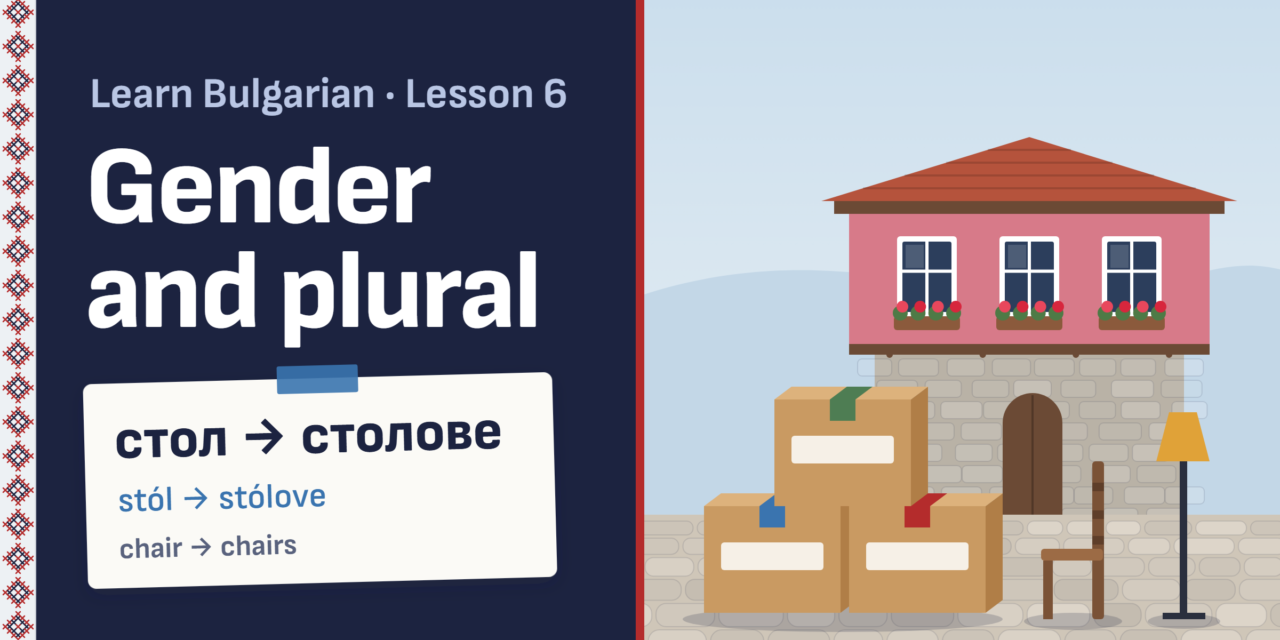
Bulgarian noun gender is easy to spot: every noun is masculine, feminine or neuter, and the last letter usually tells you which. Стол (stól, chair) ends in a consonant, so it is masculine; маса (mása, table) ends in ‑а (a), so it is feminine; легло (legló, bed) ends in ‑о (o), so it is neuter. The Bulgarian plural follows the gender: маси (mási, tables), легла (leglá, beds). Brackets show the pronunciation, with the stress marked. New to the letters? Start with the Bulgarian alphabet lesson.
PART 1 · GENDER
1. Bulgarian noun gender: look at the last letter
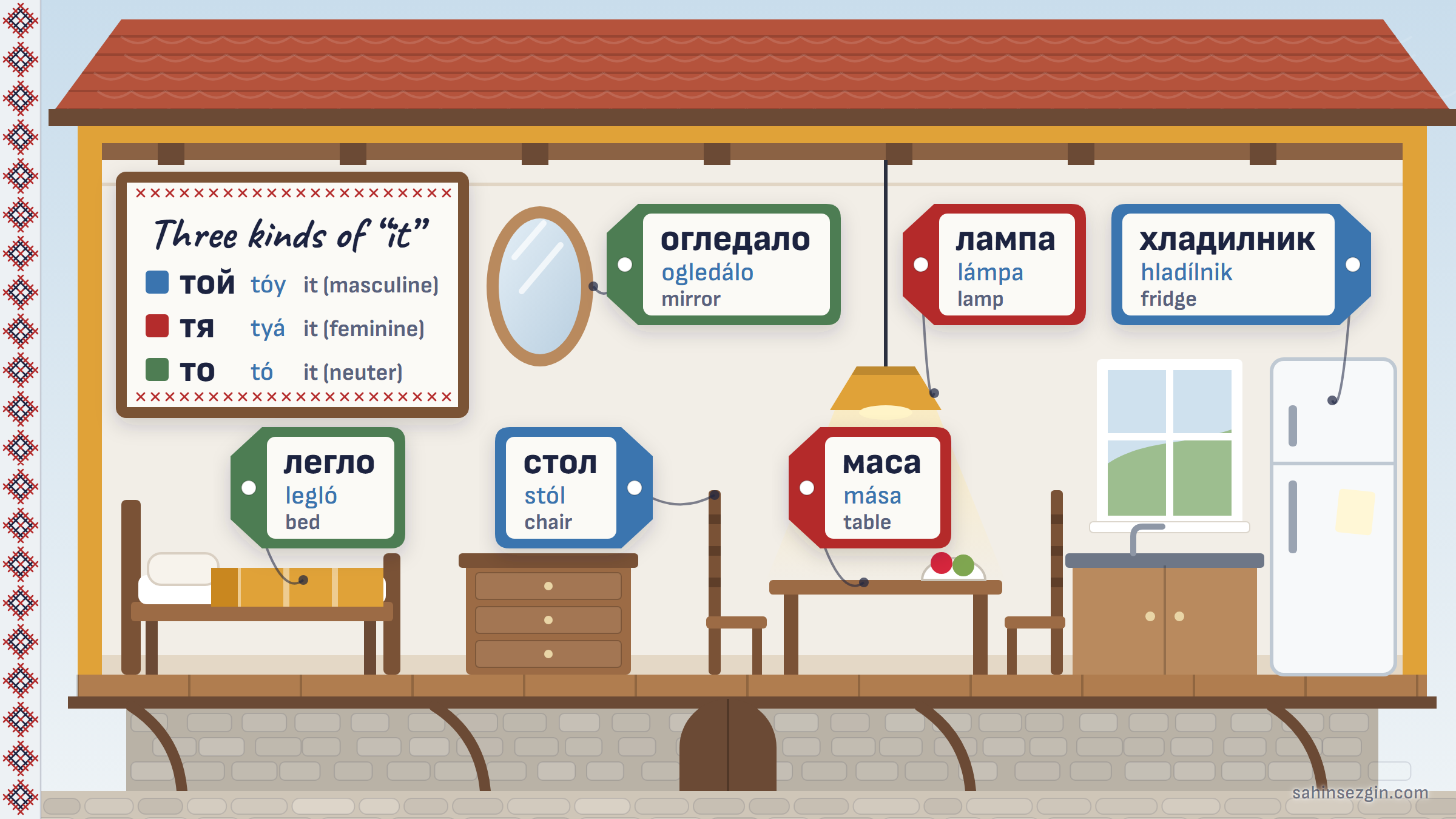
Bulgarian noun gender covers things, not only people: a table has a gender, and so does a chair, though in English both are “it”. For a thing you pick one of three words: той (tóy) for a masculine noun, тя (tyá) for a feminine one, то (tó) for a neuter one. They also mean “he” and “she”, and то (tó) means “it”. The last letter of the noun decides which.
| Bulgarian | Pronunciation | English |
|---|---|---|
| стол | stól | chair (masculine) |
| хладилник | hladílnik | fridge (masculine) |
| маса | mása | table (feminine) |
| кухня | kúhnya | kitchen (feminine) |
| легло | legló | bed (neuter) |
| кафе | kafé | coffee (neuter) |
The rule: a consonant at the end means masculine, ‑а (a) or ‑я (ya) feminine, ‑о (o) or ‑е (e) neuter. It matters because small words match the noun. About the table you say Тя е тук (tyá e túk), literally “she is here”, in English “it’s here”. “One” changes too: един стол (edín stól), една маса (edná mása), едно легло (ednó legló), as in the Bulgarian numbers lesson.
2. Bulgarian nouns around the house: 15 everyday words
Learn these Bulgarian nouns together with their gender; the plural gets much easier later.
| Bulgarian (masculine) | Pronunciation | English |
|---|---|---|
| прозорец | prozórets | window |
| шкаф | shkáf | cupboard |
| гардероб | garderóp | wardrobe |
| телевизор | televízor | TV set |
| нож | nósh | knife |
| килим | kilím | rug |
| Bulgarian (feminine) | Pronunciation | English |
|---|---|---|
| стая | stáya | room |
| врата | vratá | door |
| лампа | lámpa | lamp |
| печка | péchka | cooker |
| пералня | perálnya | washing machine |
| чаша | chásha | glass, cup |
| Bulgarian (neuter) | Pronunciation | English |
|---|---|---|
| огледало | ogledálo | mirror |
| одеяло | odeyálo | blanket |
| перде | perdé | curtain |
Two details catch English speakers. Гардероб (garderóp, wardrobe) is written with б (b) but ends in a p sound, because Bulgarian makes voiced consonants voiceless at the end of a word; нож (nósh, knife) ends in sh for the same reason, though ж (zh) sounds like the s in “pleasure”. Gender follows the written letter. And the English word tells you nothing: a window and a door are both “it”, yet прозорец (prozórets) is masculine and врата (vratá) feminine.
3. Loanwords in Bulgarian: компютър (kompyútăr) and телефон (telefón)
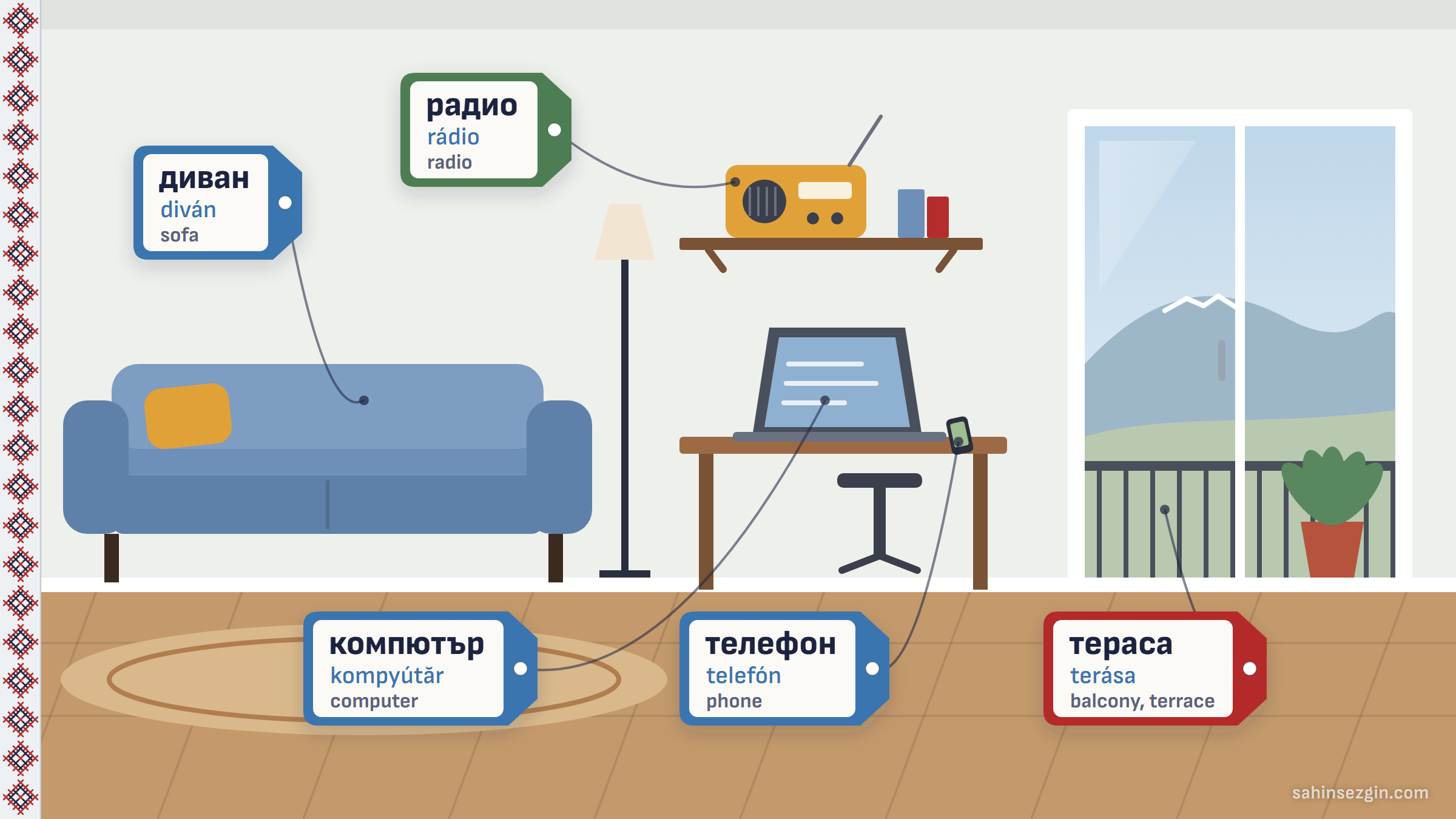
Loanwords in Bulgarian, many from French or English, fill a modern flat, and they follow the same last letter rule. You only need the stress and the gender.
| Bulgarian | Pronunciation | English |
|---|---|---|
| компютър | kompyútăr | computer (masculine) |
| телефон | telefón | phone (masculine) |
| диван | diván | sofa (masculine) |
| тоалетна | toalétna | toilet (feminine) |
| тераса | terása | balcony, terrace (feminine) |
| радио | rádio | radio (neuter) |
Watch the stress: телефон (telefón) is stressed at the end, unlike English “telephone”, and the last vowel of компютър (kompyútăr) sounds like the “a” in “about”. Some words only look English: магазин (magazín) is a shop, and кола (kolá) is a car. About a new sofa you say Той е нов (tóy e nóf, it’s new); about a balcony, Тя е голяма (tyá e golyáma, it’s big).
4. Noun gender exceptions: баща (bashtá) is masculine, нощ (nósht) is feminine
Noun gender exceptions follow a few patterns: words for men are masculine whatever the ending, some feminine nouns end in a consonant, and foreign words in ‑и (i) or ‑ю (yu) are neuter.
| Bulgarian | Pronunciation | English |
|---|---|---|
| баща | bashtá | father (masculine) |
| дядо | dyádo | grandfather (masculine) |
| комшия | komshíya | neighbour (masculine) |
| нощ | nósht | night (feminine) |
| сол | sól | salt (feminine) |
| такси | taksí | taxi (neuter) |
| меню | menyú | menu (neuter) |
The first three are words for men, and you would not call your grandfather “she” either. About бай Петър (báy pétăr), the neighbour in our story, you say Той е комшия (tóy e komshíya, he is a neighbour). Комшия (komshíya) is warm and colloquial; the neutral word is съсед (săsét). Нощ (nósht) and сол (sól) end in a consonant but are feminine, like abstract nouns ending in ‑ост (ost), such as радост (rádost, joy). Dictionaries mark gender as м. (m.), ж. (zh.) and ср. (sr.).
PART 2 · PLURAL
5. Bulgarian plural of feminine and neuter nouns: маси (mási) and легла (leglá)
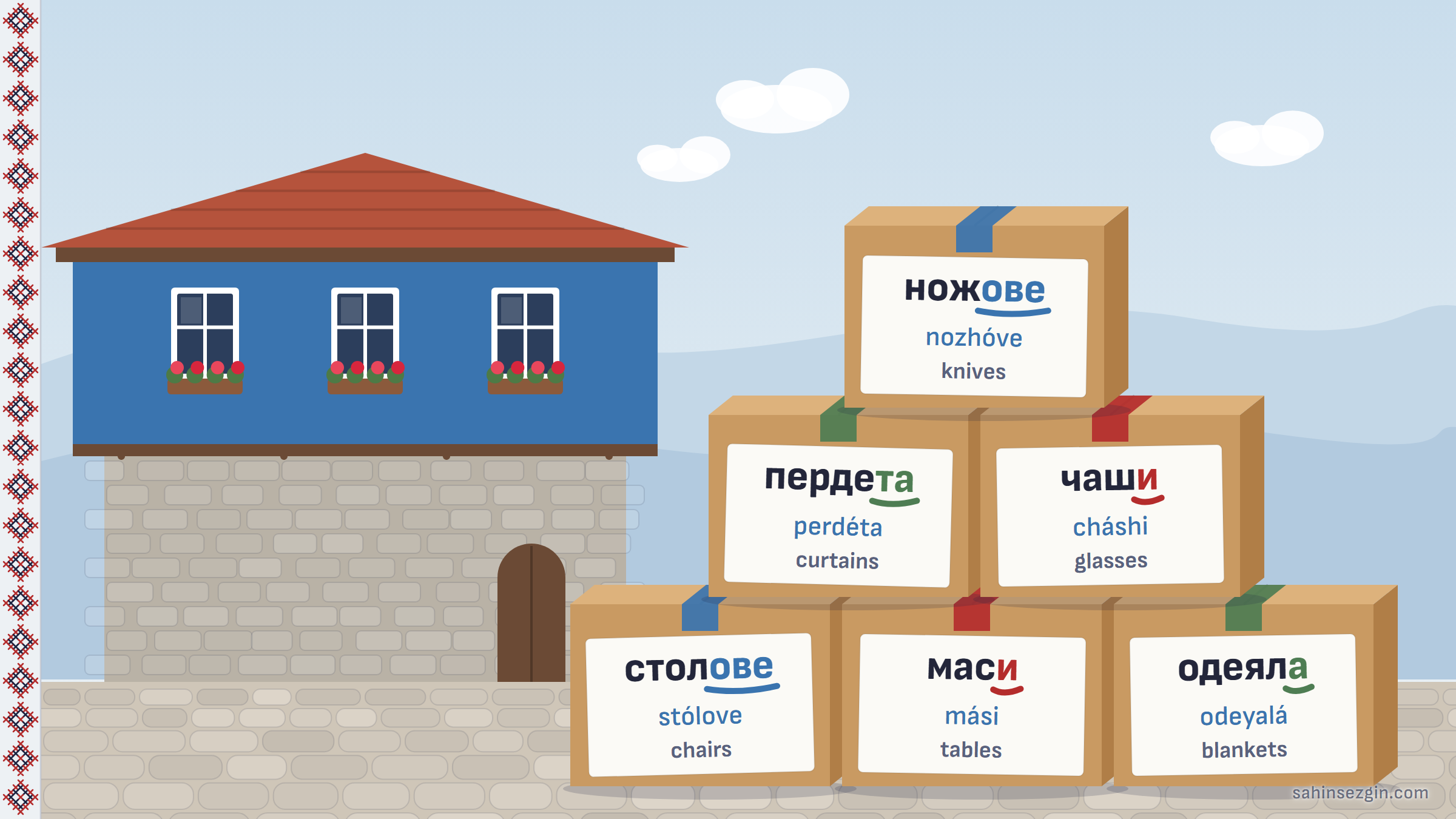
The Bulgarian plural uses four main endings, ‑и (i), ‑ове (ove), ‑а (a) and ‑та (ta), chosen by gender and by the word’s ending; English mostly adds ‑s. Feminine nouns are easy: the final ‑а (a) or ‑я (ya) becomes ‑и (i). Those ending in a consonant, like нощ (nósht, night), just add ‑и (i).
| Bulgarian (singular → plural) | Pronunciation | English |
|---|---|---|
| маса → маси | mása → mási | table → tables |
| стая → стаи | stáya → stái | room → rooms |
| лампа → лампи | lámpa → lámpi | lamp → lamps |
| врата → врати | vratá → vratí | door → doors |
| чаша → чаши | chásha → cháshi | glass → glasses |
| нощ → нощи | nósht → nóshti | night → nights |
Neuter nouns in ‑о (o) change it to ‑а (a): легло (legló) becomes легла (leglá). Most in ‑е (e) add ‑та (ta): перде (perdé) becomes пердета (perdéta). Такси (taksí) and меню (menyú) also take ‑та (ta). Дете (deté, child) is irregular: деца (detsá, children). Mind the stress: огледало (ogledálo, mirror) becomes огледала (ogledalá).
| Bulgarian (singular → plural) | Pronunciation | English |
|---|---|---|
| легло → легла | legló → leglá | bed → beds |
| огледало → огледала | ogledálo → ogledalá | mirror → mirrors |
| одеяло → одеяла | odeyálo → odeyalá | blanket → blankets |
| перде → пердета | perdé → perdéta | curtain → curtains |
| кафе → кафета | kafé → kaféta | coffee → coffees |
After a number Bulgarian uses the plural, as English does: две маси (dvé mási, two tables). The trap: masculine things take a special form in ‑а (a) after a number, so два стола (dvá stóla, two chairs).
6. Masculine nouns in the plural: one syllable or more
For masculine nouns in the plural, the length of the word picks the ending. Something will feel familiar: in English, knife becomes knives and the f turns into a v. Bulgarian has small sound changes like that when an ending is added. They are regular, and the stress can move: check the pronunciation column. The two groups below cover most masculine nouns; a few common words are irregular, such as брат (brát, brother), plural братя (brátya), and човек (chovék, person), plural хора (hóra, people).
Two or more syllables: add ‑и (i)
Longer masculine nouns simply add ‑и (i) at the end: телевизор (televízor, TV set) becomes телевизори (televízori). Some endings shift. Хладилник (hladílnik, fridge) ends in ‑к (k), which turns into ‑ци (tsi): хладилници (hladílnitsi). Words in ‑ец (ets) lose the е (e): прозорец (prozórets, window) becomes прозорци (prozórtsi). And the б (b) of гардероб (garderóp, wardrobe), heard as p at the end, is heard as b again once an ending follows: гардероби (garderóbi).
| Bulgarian (singular → plural) | Pronunciation | English |
|---|---|---|
| телевизор → телевизори | televízor → televízori | TV set → TV sets |
| гардероб → гардероби | garderóp → garderóbi | wardrobe → wardrobes |
| килим → килими | kilím → kilími | rug → rugs |
| хладилник → хладилници | hladílnik → hladílnitsi | fridge → fridges |
| прозорец → прозорци | prozórets → prozórtsi | window → windows |
One syllable: add ‑ове (ove)
Most one-syllable masculine nouns take ‑ове (ove). Around the house the group is small but used all the time. The stress varies: стол (stól, chair) becomes столове (stólove) with the stress staying put, while нож (nósh, knife) becomes ножове (nozhóve) with the stress moving to the middle. Here is your knife and knives: the sh at the end of нож turns back into zh before the ending, just as гардероб (garderóp) got its b back. English writes that change; Bulgarian only says it.
| Bulgarian (singular → plural) | Pronunciation | English |
|---|---|---|
| стол → столове | stól → stólove | chair → chairs |
| шкаф → шкафове | shkáf → shkáfove | cupboard → cupboards |
| нож → ножове | nósh → nozhóve | knife → knives |
PART 3 · PRACTICE
7. Renting a flat in Bulgarian: Alex moves to Plovdiv
Alex is spending a semester in Plovdiv and needs to rent a flat. Mila has found him one: her neighbour бай Петър (báy pétăr) rents out his furnished top floor. Бай (báy) is a friendly title for an older man, a bit like “uncle”. The dialogue is fiction. Има (íma) means “there is” or “there are”, няма (nyáma) “there isn’t”. Това е (tová e, this is) comes from the nice to meet you in Bulgarian lesson.
| Bulgarian | Pronunciation | English |
|---|---|---|
| Mila: Бай Петър, това е Алекс. Той е от Лондон. | báy pétăr, tová e áleks. tóy e ot lóndon. | Bay Petar, this is Alex. He’s from London. |
| Bay Petar: Добре дошъл! Заповядай! | dobré doshắl! zapovyáday! | Welcome! Come in! |
| Alex: Благодаря! Има ли легло? | blagodaryắ! íma li legló? | Thank you! Is there a bed? |
| Bay Petar: Има две легла и един гардероб. | íma dvé leglá i edín garderóp. | There are two beds and a wardrobe. |
| Alex: А има ли маса и столове? | a íma li mása i stólove? | And is there a table and chairs? |
| Bay Petar: Да, има една маса и столове. | dá, íma edná mása i stólove. | Yes, there’s a table and chairs. |
| Mila: Има и пердета, и килими. | íma i perdéta, i kilími. | There are curtains and rugs too. |
| Alex: Има ли пералня? | íma li perálnya? | Is there a washing machine? |
| Bay Petar: Няма. Но има хладилник и печка. | nyáma. no íma hladílnik i péchka. | No, there isn’t. But there’s a fridge and a cooker. |
| Alex: Чудесно! Благодаря! | chudésno! blagodaryắ! | Great! Thank you! |
| Bay Petar: Няма защо. Вече сме комшии! | nyáma zashtó. véche sme komshíi! | You’re welcome. We’re neighbours now! |
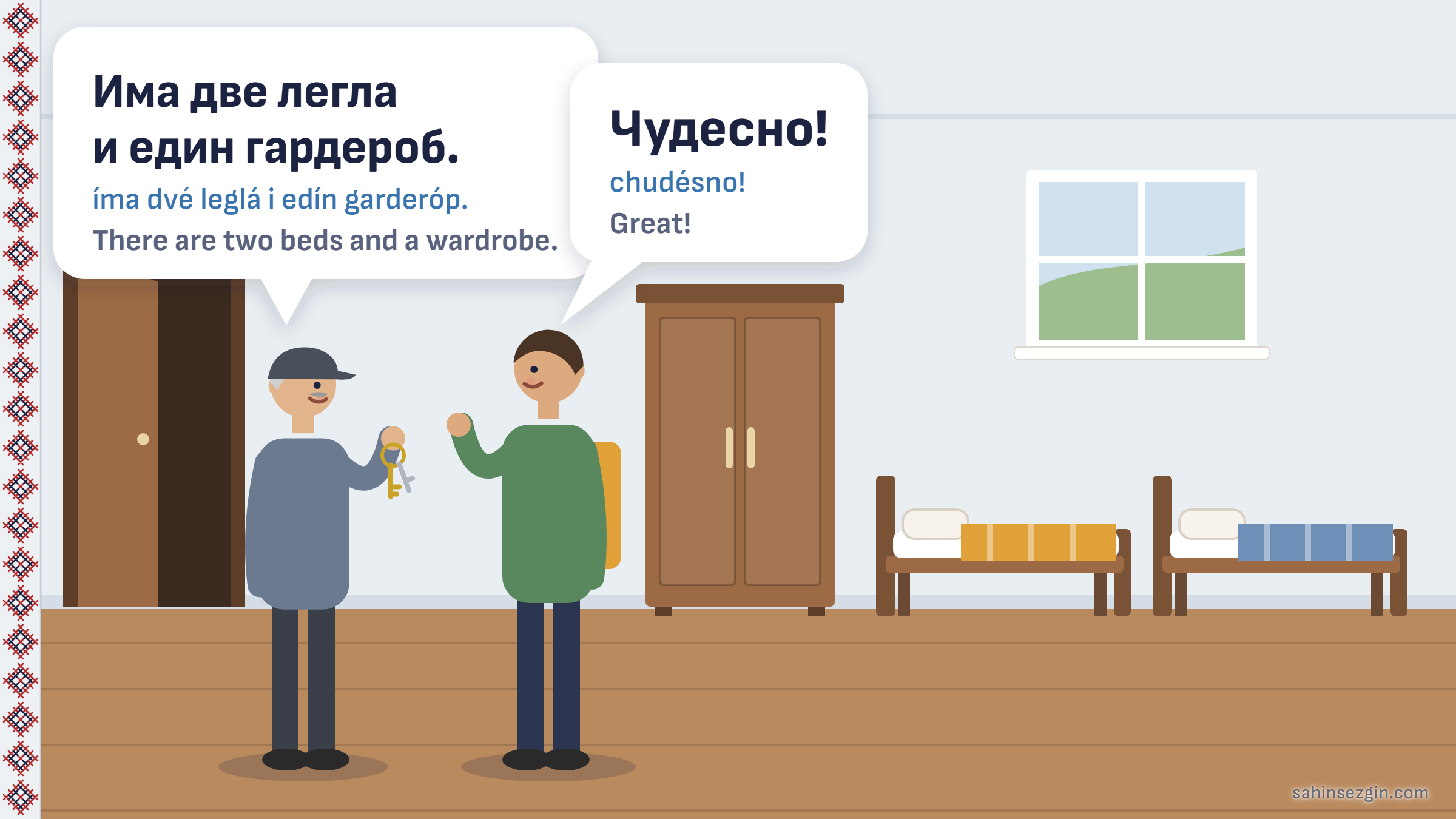
Две легла (dvé leglá) means two beds: легло (legló) is neuter, so the number is две (dvé) and the noun is plural. Гардероб (garderóp) is masculine, hence един (edín, one). Mila’s и … и (i … i) works like “both … and”. Комшии (komshíi, neighbours) is the plural of комшия (komshíya): it looks feminine, it is masculine, and it still takes ‑и (i).
8. Gender and plural quiz: test yourself with 10 questions
Ten questions on gender, plurals and the dialogue. Pick one answer; the right one is marked and a short explanation opens. If you miss one, go back to the matching table and try again. Eight correct answers mean you know the rules.
-
Which noun is masculine?
- маса (mása, table)
- стол (stól, chair)
- легло (legló, bed)
Answer
Стол (stól) ends in a consonant.
-
You are talking about a table. How do you say “it’s here”?
- Тя е тук. (tyá e túk.)
- Той е тук. (tóy e túk.)
- То е тук. (tó e túk.)
Answer
Маса (mása) is feminine, so тя (tyá).
-
What gender is компютър (kompyútăr, computer)?
- feminine
- neuter
- masculine
Answer
Masculine: it ends in a consonant.
-
What gender is комшия (komshíya, neighbour)?
- masculine
- feminine
- neuter
Answer
Masculine, because it describes a man.
-
What is the plural of маса (mása, table)?
- масове (másove)
- маси (mási)
- масета (máseta)
Answer
The final ‑а (a) becomes ‑и (i).
-
Стол (stól, chair) has one syllable. What is its plural?
- столи (stóli)
- стола (stóla)
- столове (stólove)
Answer
Most one-syllable masculine nouns take ‑ове (ove); стола (stóla) is the form used after a number: два стола (dvá stóla).
-
What is the plural of прозорец (prozórets, window)?
- прозорци (prozórtsi)
- прозорецове (prozóretsove)
- прозореца (prozóretsa)
Answer
It takes ‑и (i), and ‑ец (ets) loses its е (e).
-
What is the plural of перде (perdé, curtain)?
- перди (perdí)
- пердета (perdéta)
- пердове (perdóve)
Answer
Most neuter nouns in ‑е (e) add ‑та (ta).
-
How do you say “two beds”?
- два легла (dvá leglá)
- две легло (dvé legló)
- две легла (dvé leglá)
Answer
Легло (legló) is neuter, so две (dvé), with the plural noun.
-
What does Има и пердета, и килими. (íma i perdéta, i kilími.) mean?
- There are no curtains or rugs.
- There are curtains and rugs too.
- There is one curtain and one rug.
Answer
И … и (i … i) means “both … and”.
Frequently asked questions about Bulgarian nouns
How many genders are there in Bulgarian?
Three. A consonant at the end usually means masculine, ‑а (a) or ‑я (ya) feminine, ‑о (o) or ‑е (e) neuter. Words for men, such as баща (bashtá, father), are masculine.
How do you make nouns plural in Bulgarian?
Feminine nouns take ‑и (i). Longer masculine nouns take ‑и (i), most one-syllable ones ‑ове (ove). Neuter ‑о (o) becomes ‑а (a), and most neuter nouns in ‑е (e) add ‑та (ta).
Do Bulgarian nouns have cases?
Not really. Unlike Russian, Bulgarian nouns have no case endings: word order and small words such as на (na, of, to) do that job. Pronouns, and a vocative form for calling people, keep traces of the old cases.
Audio: Lingua Libre (Wikimedia Commons), speaker Kiril kovachev, licensed under CC BY-SA 4.0. Recordings were converted to MP3.
Write a comment