

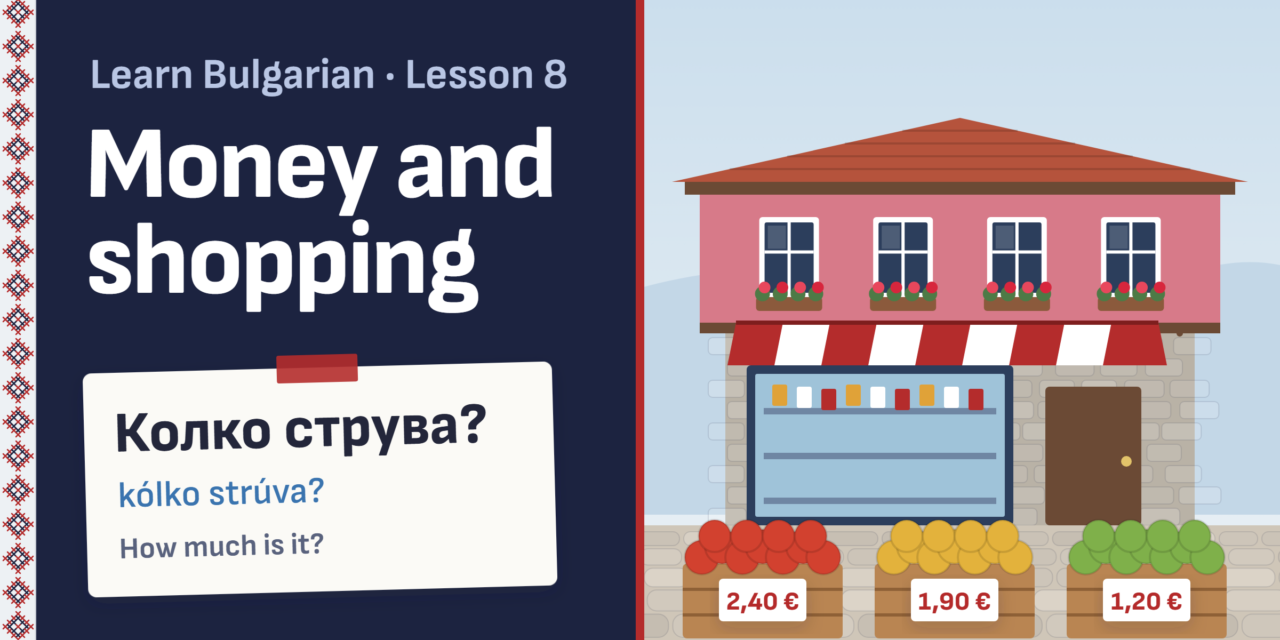
Bulgaria’s currency is the euro: it replaced the lev on 1 January 2026, and the Bulgarian lev to euro rate is fixed at 1 € = 1.95583 lev. In Bulgarian the euro is евро (évro). As of October 2026 you pay for everything in Bulgaria in euros. First the money, then the Bulgarian supermarket: asking “how much?” and “is there…?”, and paying at the till. Every Bulgarian word has its pronunciation in brackets, with an accent on the stressed vowel. For the letters themselves, see the Bulgarian alphabet lesson.
PART 1 · BULGARIA CURRENCY
1. Bulgaria currency today: from the lev to the euro in 2026
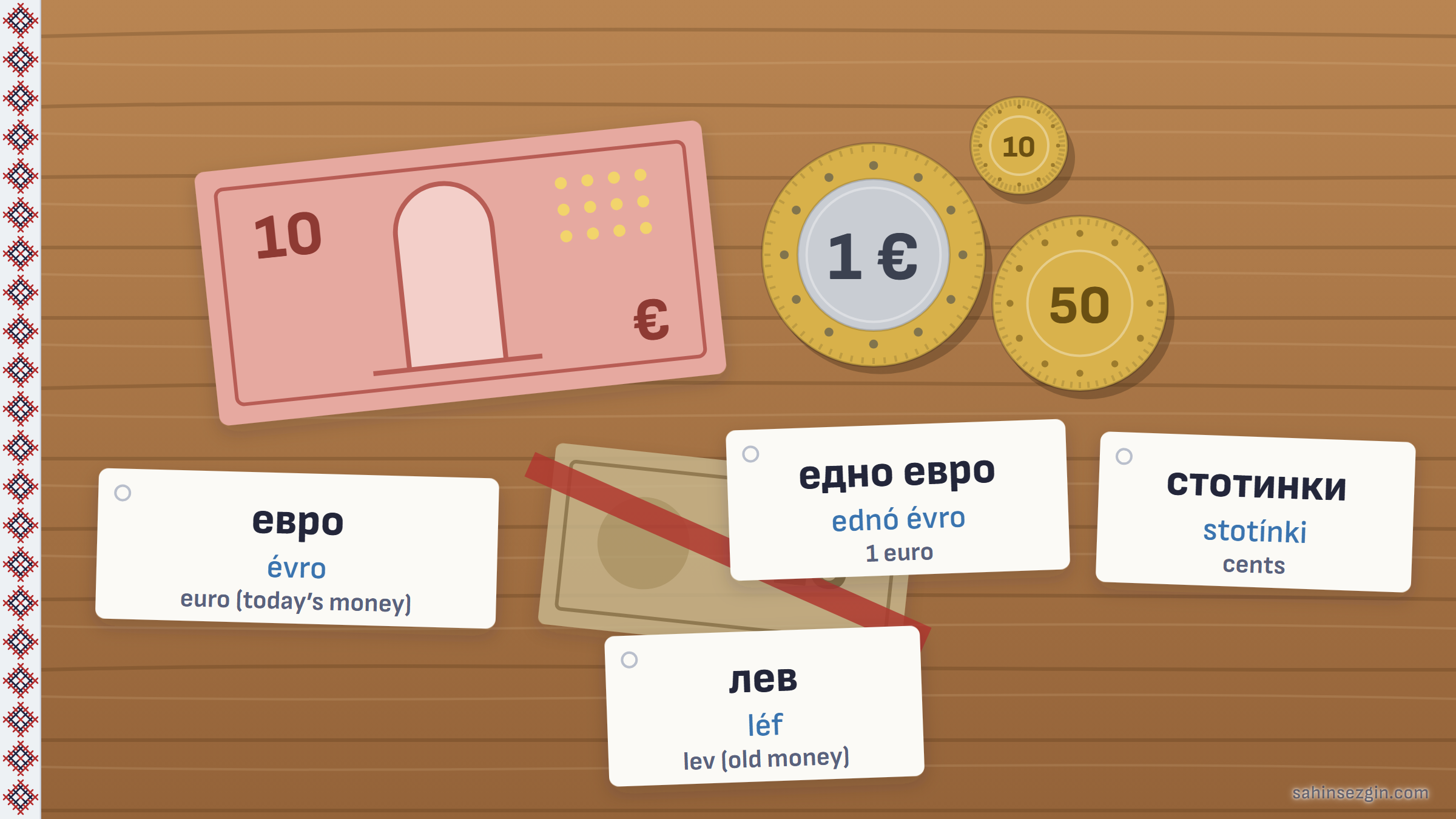
Bulgaria’s currency has been the euro since 1 January 2026, when the country joined the euro area as its 21st member. The conversion rate was locked in advance: 1 euro equals 1.95583 leva. During January both currencies worked for cash, but change was given in euros. Since 1 February 2026 the euro has been the only legal tender. Shops had to show prices in both currencies until 8 August 2026. If you spot лв. (lv.) on an old receipt, the price is in leva; halve it for a rough euro figure.
| Bulgarian | Pronunciation | English |
|---|---|---|
| евро | évro | euro (today’s currency) |
| стотинка | stotínka | cent (feminine) |
| стотинки | stotínki | cents |
| лев | léf | lev (the old currency) |
| два лева | dvá léva | two leva |
| карта | kárta | card, bank card |
| в брой | v bróy | in cash |
Coin tip: стотинка (stotínka) was the small unit of the lev, and Bulgaria kept the word for its euro cents. You may also hear цент (tsént). And лев (léf) really ends in an f sound: в (v) at the end of a word is said f.
Bulgarian lev to euro: converting and changing leftover leva
To convert Bulgarian lev to euro, divide the amount by 1.95583; for euro to lev, multiply by it. The Bulgarian National Bank (BNB) exchanges lev notes and coins for euros free of charge and with no deadline. Commercial banks and post offices exchanged for free until 30 June 2026; since July they may charge a fee, and they must keep offering the service at least until 31 December 2026. Shops no longer take leva, so change them before you go shopping.
| Leva | Euro (fixed rate) | Where to change it |
|---|---|---|
| 1 lev | 0.51 € | BNB or a bank |
| 10 leva | 5.11 € | BNB, free, no deadline |
| 20 leva | 10.23 € | BNB or a bank |
| 50 leva | 25.56 € | banks, until at least 31 Dec 2026 |
| 100 leva | 51.13 € | banks, a fee is possible |
2. Bulgaria’s currency out loud: prices in евро (évro) and стотинки (stotínki)
To say a price in Bulgaria’s currency, read euros first, then cents. A label says “4,50 €”: Bulgarians write a comma where English uses a decimal point. You met the numbers in the Bulgarian numbers lesson. Евро (évro) has no plural form: one euro and twenty euros use the same word. It is neuter, so “one” is едно (ednó). Стотинка (stotínka) is feminine: one cent is една стотинка (edná stotínka), and after other numbers you use стотинки (stotínki).
| Bulgarian | Pronunciation | English |
|---|---|---|
| едно евро | ednó évro | 1 euro (1,00 €) |
| двайсет евро | dváyset évro | 20 euros (20,00 €) |
| петдесет стотинки | peddesét stotínki | 50 cents (0,50 €) |
| четири евро и петдесет стотинки | chétiri évro i peddesét stotínki | 4 euros 50 cents (4,50 €) |
At the till people shorten prices, like “four fifty”: четири и петдесет (chétiri i peddesét). The video below shows every Bulgarian euro coin.
PART 2 · AT THE SUPERMARKET
3. Bulgarian supermarket words: bread, milk and cheese
In a Bulgarian supermarket such as Lidl, Kaufland, Billa or Fantastico, every shelf label is in Cyrillic. Watch out for letters that look English but are not: Х (h), Р (r), С (s), Н (n) and В (v). So хляб (hlyáp) is bread; its final б (b) is said like p. Сирене (sírene) is white brined cheese, кашкавал (kashkavál) is yellow cheese. Кисело мляко (kíselo mlyáko) means “sour milk” word for word, but it is yogurt. The table gives each gender, because the ending for “the” depends on it; the asking for directions in Bulgarian lesson explains how.
| Bulgarian | Pronunciation | English |
|---|---|---|
| хляб | hlyáp | bread (masculine) |
| мляко | mlyáko | milk (neuter) |
| кисело мляко | kíselo mlyáko | yogurt (neuter) |
| сирене | sírene | white brined cheese (neuter) |
| кашкавал | kashkavál | yellow cheese (masculine) |
| яйца | yaytsá | eggs (plural) |
| домати | domáti | tomatoes (plural) |
4. “Is there…?” in Bulgarian: има (íma) and няма (nyáma) on the shelf
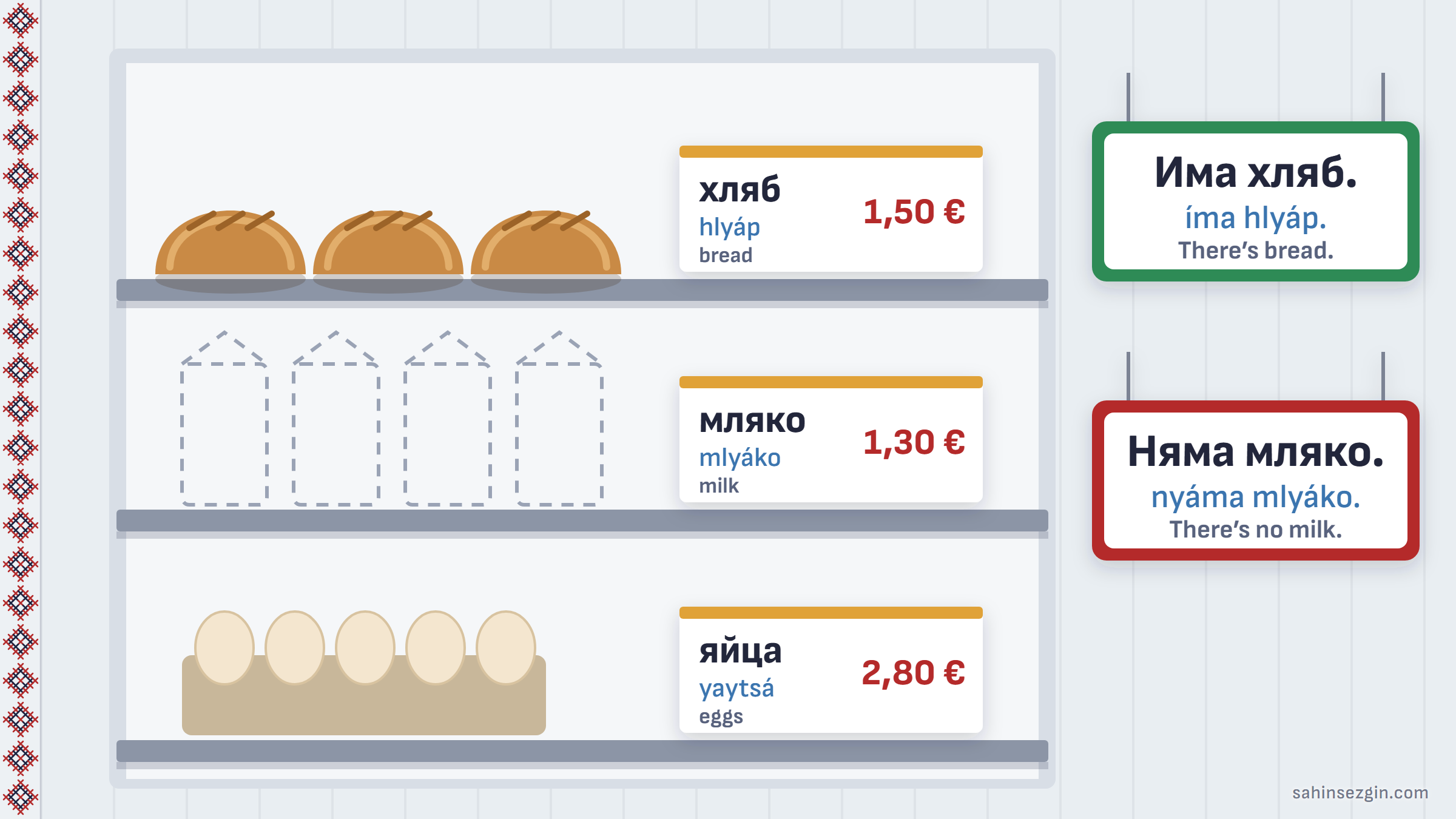
English says “there is” and “there isn’t”. Bulgarian uses one word each: има (íma) and няма (nyáma). It stays the same for plurals: Има яйца. (íma yaytsá.) “There are eggs.” For a question, add ли (li) after the verb. It does the job of “do” in “do you have”, but it comes after the word you ask about. You met it in the nice to meet you in Bulgarian lesson.
| Bulgarian | Pronunciation | English |
|---|---|---|
| Има хляб. | íma hlyáp. | There’s bread. |
| Няма мляко. | nyáma mlyáko. | There’s no milk. |
| Има ли сирене? | íma li sírene? | Is there any white cheese? |
| Да, има. | dá, íma. | Yes, there is. |
| Не, няма. | né, nyáma. | No, there isn’t. |
Saying “not”: не (ne) and нямам (nyámam)
To make a verb negative, Bulgarian puts не (ne) in front of it: искам (ískam, I want) becomes не искам (ne ískam, I don’t want). There is no helper like the English “don’t”; the small word is enough. Има (íma) is the exception. It never combines with не (ne); you replace it with the single word няма (nyáma). The personal form works the same way: имам (ímam) means “I have”, нямам (nyámam) “I don’t have”.
| Bulgarian (positive → negative) | Pronunciation | English |
|---|---|---|
| искам → не искам | ískam → ne ískam | I want → I don’t want |
| имам → нямам | ímam → nyámam | I have → I don’t have |
| има → няма | íma → nyáma | there is → there isn’t |
Trap: не има (ne íma) sounds wrong to a Bulgarian ear; say няма (nyáma). No bag with you? Нямам торбичка. (nyámam torbíchka.) “I don’t have a bag.”
PART 3 · AT THE CHECKOUT
5. How much in Bulgarian: Колко струва? (kólko strúva?)
“How much is it?” in Bulgarian is Колко струва? (kólko strúva?). Колко (kólko) means “how much”, струва (strúva) “it costs”. For a plural item the verb is plural too: струват (strúvat). When you point at a particular item, the noun takes “the” on its end, so bread becomes хлябът (hlyábăt). If you can’t find something, say търся (tắrsya, I’m looking for). In евтино (éftino, cheap) the в (v) is said f before the т (t).
| Bulgarian | Pronunciation | English |
|---|---|---|
| Колко струва? | kólko strúva? | How much is it? |
| Колко струва хлябът? | kólko strúva hlyábăt? | How much is the bread? |
| Колко струват доматите? | kólko strúvat domátite? | How much are the tomatoes? |
| Колко е общо? | kólko e óbshto? | How much is it altogether? |
| Търся сирене. | tắrsya sírene. | I’m looking for white cheese. |
| Евтино е. | éftino e. | It’s cheap. |
6. Cash or card in Bulgaria: paying at the till, discount and receipt
Most supermarkets and chain stores take cards; at a market stall or a small kiosk, keep some cash. To pay by card, ask Мога ли да платя с карта? (móga li da platyắ s kárta?); мога (móga) is “I can” and платя (platyắ) is “pay”. Pay in cash and your change comes back as ресто (résto). A red shelf label usually says намаление (namalénie): a discount. The receipt is касова бележка (kásova belézhka), literally a “till note”.
| Bulgarian | Pronunciation | English |
|---|---|---|
| намаление | namalénie | discount, sale |
| торбичка | torbíchka | shopping bag |
| касова бележка | kásova belézhka | receipt |
| ресто | résto | change |
| Мога ли да платя с карта? | móga li da platyắ s kárta? | Can I pay by card? |
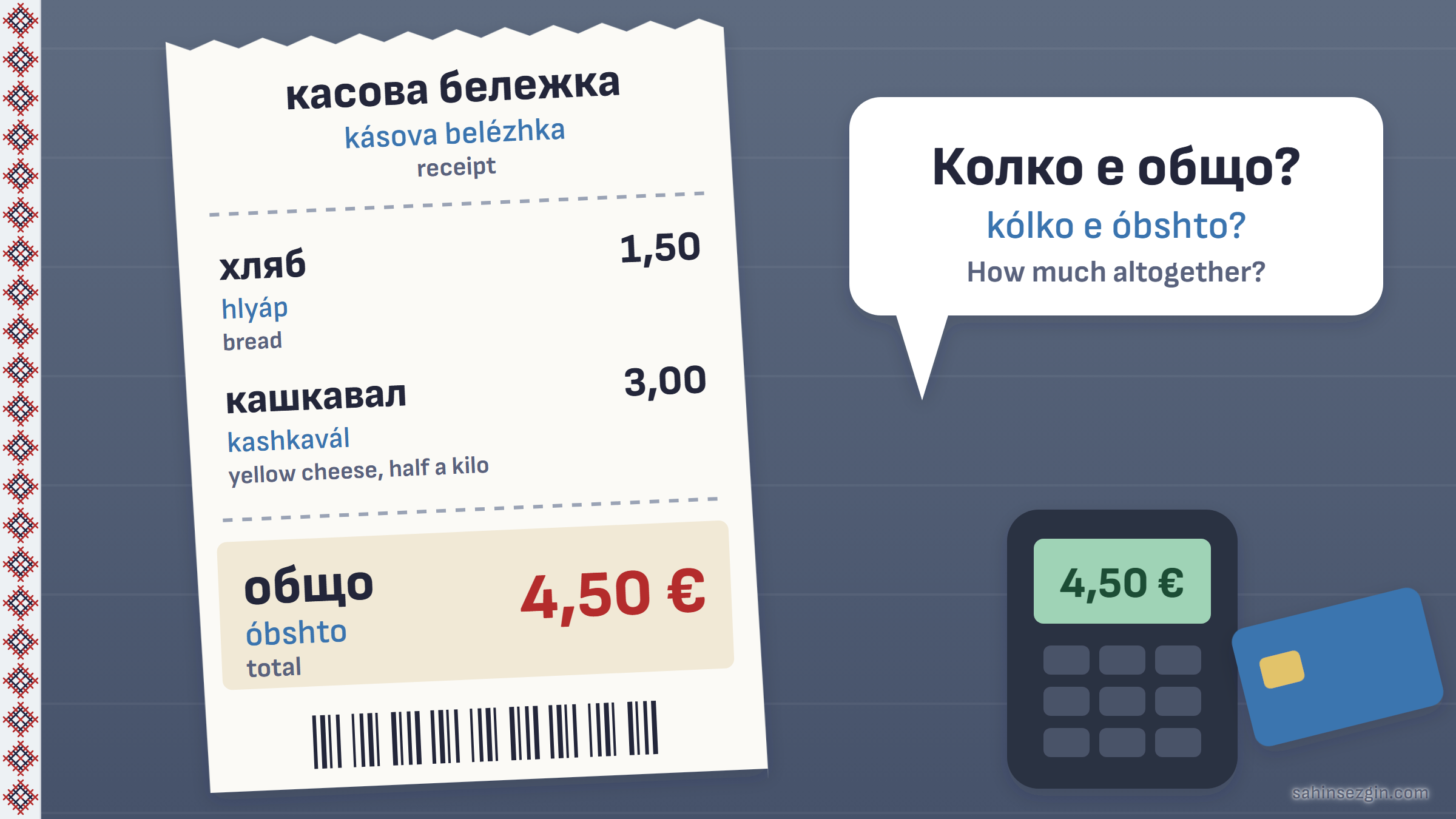
7. Shopping dialogue in Bulgarian: Alex buys breakfast in Plovdiv
Alex, an English speaker, is spending a few months in Plovdiv. One morning he walks to the small shop on his street, and Mila from Plovdiv is at the till. The dialogue is fictional. Alex says what he wants, asks whether they have it, checks the price and pays by card.
| Bulgarian | Pronunciation | English |
|---|---|---|
| Mila: Добър ден! Какво търсите? | dóbăr dén! kakvó tắrsite? | Hello! What are you looking for? |
| Alex: Търся хляб и сирене. | tắrsya hlyáp i sírene. | I’m looking for bread and white cheese. |
| Mila: Хляб има, ето го. | hlyáp íma, éto go. | We have bread, here it is. |
| Alex: А сирене има ли? | a sírene íma li? | And is there any white cheese? |
| Mila: Сирене няма, но има кашкавал. | sírene nyáma, no íma kashkavál. | There’s no white cheese, but there’s yellow cheese. |
| Alex: Колко струва кашкавалът? | kólko strúva kashkaválăt? | How much is the yellow cheese? |
| Mila: Шест евро за килограм. | shést évro za kilográm. | Six euros a kilo. |
| Alex: Половин килограм, моля. | polovín kilográm, mólya. | Half a kilo, please. |
| Mila: Заповядайте. Нещо друго? | zapovyádayte. néshto drúgo? | Here you are. Anything else? |
| Alex: Не, благодаря. Колко е общо? | né, blagodaryắ. kólko e óbshto? | No, thank you. How much is it altogether? |
| Mila: Четири евро и петдесет стотинки. | chétiri évro i peddesét stotínki. | Four euros fifty. |
| Alex: Мога ли да платя с карта? | móga li da platyắ s kárta? | Can I pay by card? |
| Mila: Да, разбира се. Торбичка искате ли? | dá, razbíra se. torbíchka ískate li? | Yes, of course. Would you like a bag? |
| Alex: Не, благодаря. Довиждане! | né, blagodaryắ. dovízhdane! | No, thank you. Goodbye! |
The sums add up: 1,50 € for bread plus 3 € for half a kilo of cheese. In ето го (éto go), го (go) is “it”, meaning the bread.
8. Bulgarian money and supermarket quiz: test yourself with 10 questions
Ten questions mix the currency, “there is” and “there isn’t”, product names and prices at the till. Pick an answer to see the correct one and a short explanation. If you miss one, go back to that table and read the words out loud.
-
You are in a Bulgarian shop in October 2026. Which currency do you pay with in cash?
- Leva
- Euros
- Either one
Answer
Euros. Leva worked alongside the euro only in January 2026.
-
The label says 0,50 €. How do you say it?
- петдесет евро (peddesét évro)
- пет стотинки (pét stotínki)
- петдесет стотинки (peddesét stotínki)
Answer
Петдесет стотинки (peddesét stotínki), 50 cents. The others are 50 euros and 5 cents.
-
How do you ask “Is there any bread?”
- Има ли хляб? (íma li hlyáp?)
- Не има хляб? (ne íma hlyáp?)
- Колко хляб? (kólko hlyáp?)
Answer
Има ли хляб? (íma li hlyáp?) The question word ли (li) comes right after има (íma).
-
The cashier answers Няма. (nyáma.) What does she mean?
- There is.
- It’s expensive.
- There isn’t any.
Answer
There isn’t any. Няма (nyáma) is “there isn’t”, има (íma) is “there is”.
-
Which is correct for “I don’t want milk”?
- Не искам мляко. (ne ískam mlyáko.)
- Мляко искам не. (mlyáko ískam ne.)
- Няма искам мляко. (nyáma ískam mlyáko.)
Answer
Не искам мляко. (ne ískam mlyáko.) Не (ne) goes directly in front of the verb.
-
Which product is кисело мляко (kíselo mlyáko)?
- Milk
- Yogurt
- White cheese
Answer
Yogurt. Milk is мляко (mlyáko), white cheese is сирене (sírene).
-
Which is correct for “How much are the tomatoes?”
- Колко струва доматите? (kólko strúva domátite?)
- Колко струват доматите? (kólko strúvat domátite?)
- Колко струват домат? (kólko strúvat domát?)
Answer
Колко струват доматите? (kólko strúvat domátite?) The item is plural, so the verb is too: струват (strúvat).
-
A red shelf label says намаление (namalénie). What does it tell you?
- The product is sold out
- The product is discounted
- Cash only
Answer
It is a discount. Sold out would be няма (nyáma), and cash is в брой (v bróy).
-
You want to pay by card. What do you ask?
- Мога ли да платя с карта? (móga li da platyắ s kárta?)
- Мога ли да платя в брой? (móga li da platyắ v bróy?)
- Имам ли карта? (ímam li kárta?)
Answer
Мога ли да платя с карта? (móga li da platyắ s kárta?) В брой (v bróy) means in cash; the third option means “Do I have a card?”
-
In the dialogue, how does Alex ask for the total?
- Колко струва кашкавалът? (kólko strúva kashkaválăt?)
- Нещо друго? (néshto drúgo?)
- Колко е общо? (kólko e óbshto?)
Answer
Колко е общо? (kólko e óbshto?) Общо (óbshto) means “altogether”.
Frequently asked questions about Bulgaria and the euro
What currency does Bulgaria use?
The euro. Bulgaria adopted it on 1 January 2026, replacing the Bulgarian lev.
How much is 1 euro in Bulgarian lev?
The fixed rate is 1 euro = 1.95583 leva. As of October 2026 the Bulgarian National Bank still changes leva into euros free of charge, with no deadline.
Can you still pay with Bulgarian lev?
No. Since 1 February 2026 cash payments are made only in euros.
Audio: Lingua Libre (Wikimedia Commons), speaker Kiril kovachev, licensed under CC BY-SA 4.0. Recordings were converted to MP3.
Write a comment