

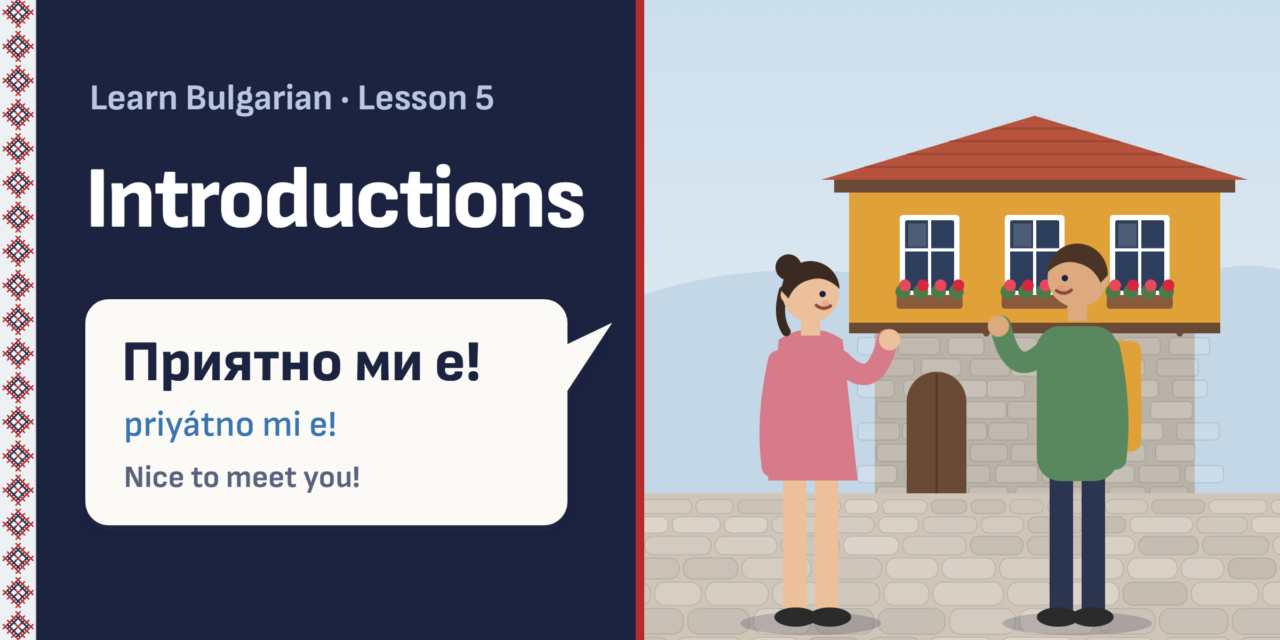
To say nice to meet you in Bulgarian, use Приятно ми е (priyátno mi e). The usual reply is И на мен (i na mén, me too). First come Как се казваш? (kák se kázvash?, what is your name?) and Откъде си? (otkădé si?, where are you from?). You answer Казвам се Алекс (kázvam se áleks, my name is Alex) and От Англия съм (ot ángliya săm, I am from England). Brackets show pronunciation, with stress marked by an accent; letters are in the Bulgarian alphabet lesson.
PART 1 · MEETING PEOPLE
1. What is your name in Bulgarian, and how to say nice to meet you
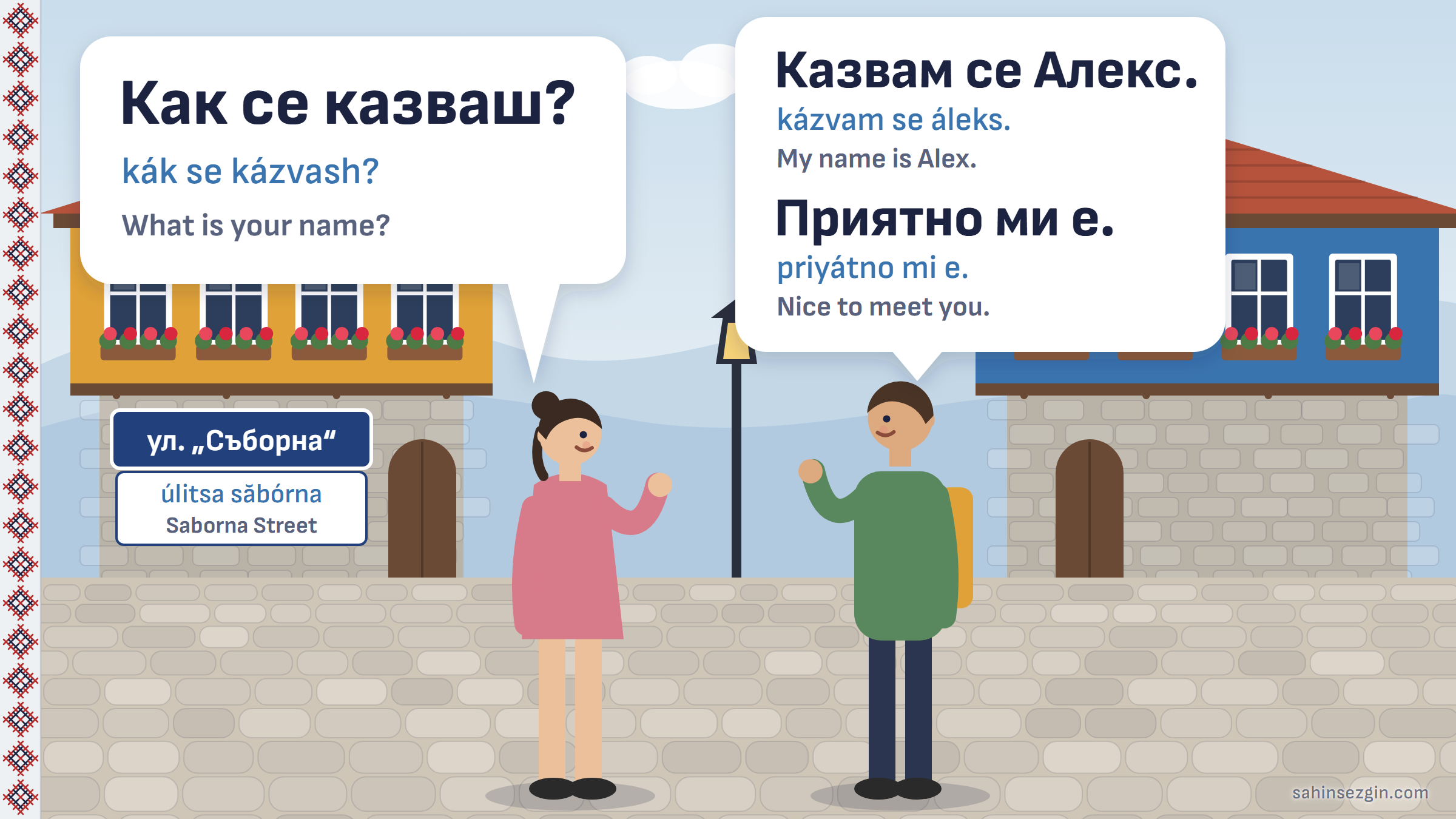
What is your name in Bulgarian depends on who you ask: Как се казваш? (kák se kázvash?) is for friends, Как се казвате? (kák se kázvate?) for older people and strangers. The table follows a real first conversation, from the names to nice to meet you.
| Bulgarian | Pronunciation | English |
|---|---|---|
| Как се казваш? | kák se kázvash? | What is your name? (informal) |
| Как се казвате? | kák se kázvate? | What is your name? (polite) |
| Казвам се Алекс. | kázvam se áleks. | My name is Alex. |
| Аз съм Мила. | ás săm míla. | I am Mila. |
| Приятно ми е. | priyátno mi e. | Nice to meet you. |
| И на мен. | i na mén. | Me too. |
| Откъде си? | otkădé si? | Where are you from? |
| От Англия съм. | ot ángliya săm. | I am from England. |
| Говоря малко български. | govóryă málko bălgárski. | I speak a little Bulgarian. |
The first two rows show a difference English lost when thou and you merged: Bulgarian still has a friendly “you” and a polite one. When unsure, be polite. Word by word, Казвам се (kázvam se) means “I call myself”.
2. My name is in Bulgarian: a five-sentence self-introduction
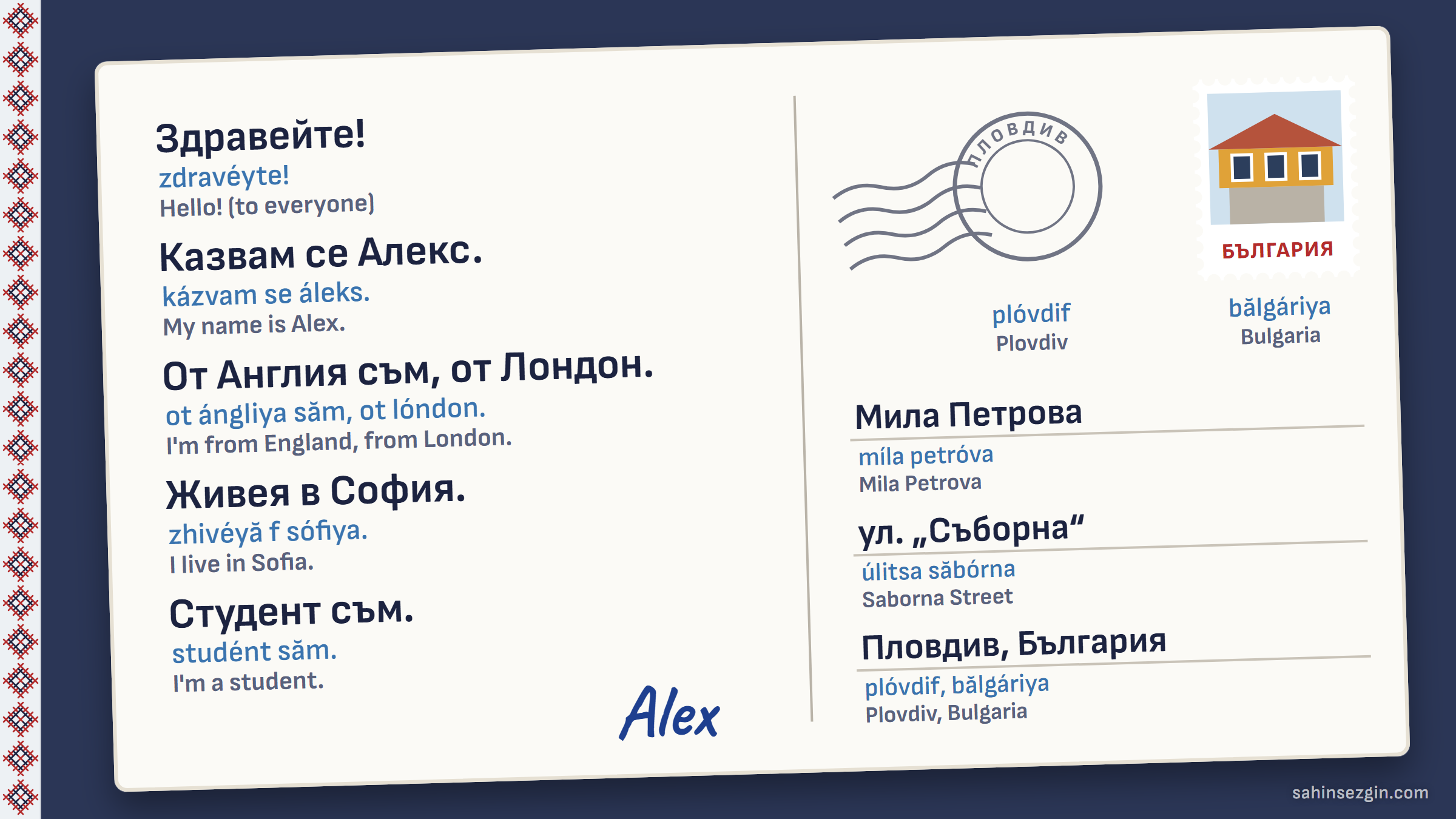
To say my name is in Bulgarian, use Казвам се (kázvam se) plus your name. These five lines cover the first minute of most meetings; swap in your own name and cities.
| Bulgarian | Pronunciation | English |
|---|---|---|
| Здравейте! | zdravéyte! | Hello! (polite or to a group) |
| Казвам се Алекс. | kázvam se áleks. | My name is Alex. |
| От Англия съм, от Лондон. | ot ángliya săm, ot lóndon. | I am from England, from London. |
| Живея в София. | zhivéyă f sófiya. | I live in Sofia. |
| Уча български, защото баба ми е от Пловдив. | úchă bălgárski, zashtóto bába mi e ot plóvdif. | I am learning Bulgarian because my grandmother is from Plovdiv. |
Здравейте (zdravéyte) greets a group or a stranger; to one friend you say Здравей (zdravéy), as in the hello in Bulgarian lesson. In Живея в София (zhivéyă f sófiya) the little word в (v) means “in” and sounds like f before с (s). In баба ми (bába mi, my grandmother) the word for “my” comes after the noun, so it is literally “grandmother my”.
Saying your job with съм (săm)
To say what you do, put the job next to съм (săm, I am). Bulgarian has no word for “a”, so Учител съм (uchítel săm) is literally “teacher I am”. Many job titles have a separate form for women, usually ending in ‑ка (ka): a woman says Лекарка съм (lékarka săm, I am a doctor). If you are retired, пенсионер (pensionér, pensioner) is the word you will need most often.
| Bulgarian | Pronunciation | English |
|---|---|---|
| учител / учителка | uchítel / uchítelka | teacher (man / woman) |
| лекар / лекарка | lékar / lékarka | doctor (man / woman) |
| студент / студентка | studént / studéntka | student (man / woman) |
| пенсионер / пенсионерка | pensionér / pensionérka | pensioner (man / woman) |
PART 2 · GRAMMAR
3. Bulgarian verb to be съм (săm): I am, you are, she is
The Bulgarian verb to be is съм (săm), and good news for English speakers: it works much like English am, are and is. It changes with the person, it always stays in the sentence, and it links a person to a name, a job or a place. You have met it in От Англия съм (ot ángliya săm). The pronoun is often dropped, since the verb form itself already shows who is speaking.
| Bulgarian | Pronunciation | English |
|---|---|---|
| аз съм | ás săm | I am |
| ти си | tí si | you are (one friend) |
| той е, тя е, то е | tóy e, tyá e, tó e | he is, she is, it is |
| ние сме | níe sme | we are |
| вие сте | víe ste | you are (polite or plural) |
| те са | té sa | they are |
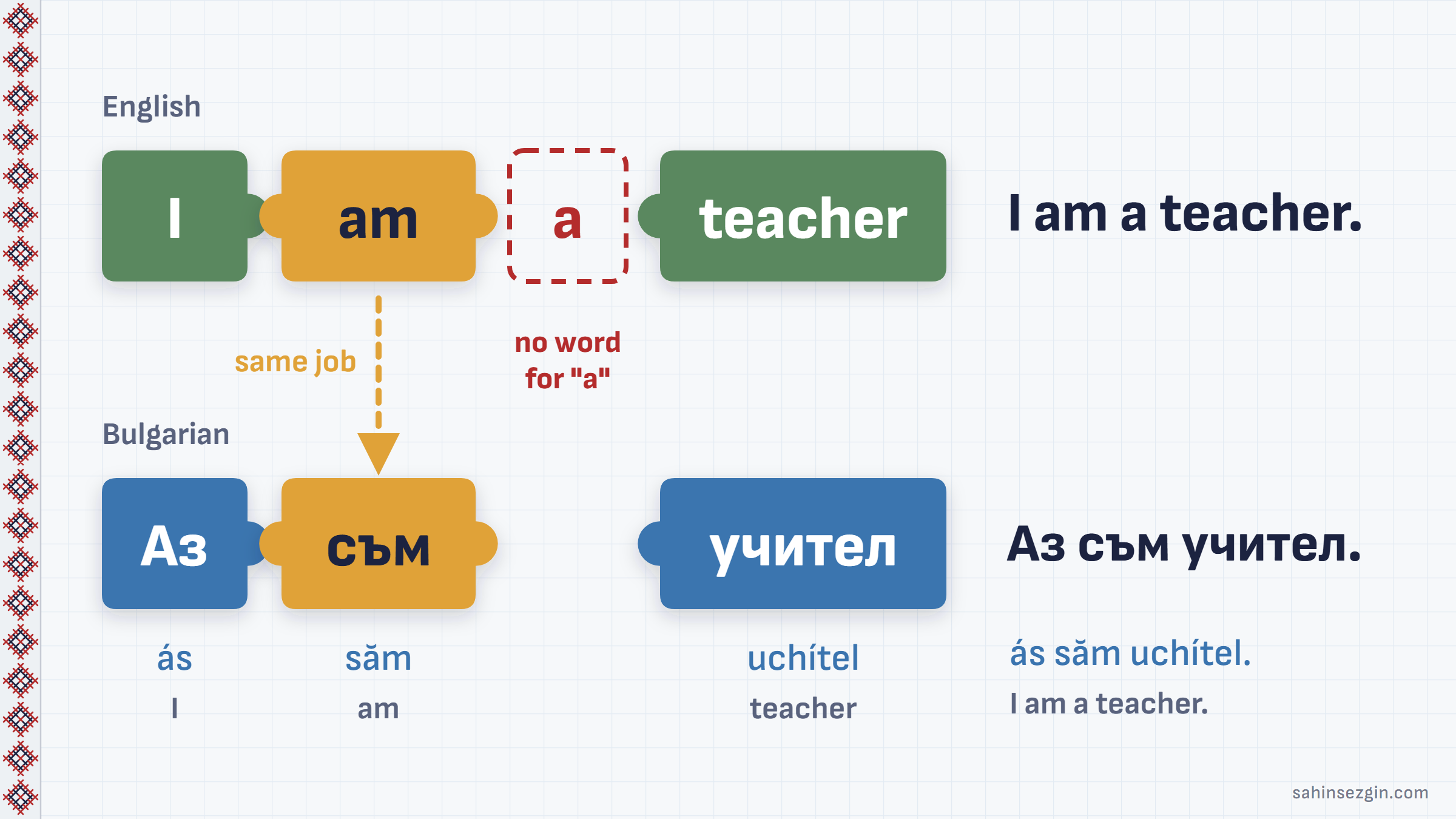
If you know some Russian, watch out. Russian drops “to be” in the present: я студент (ya studént). Bulgarian keeps it: Аз съм студент (ás săm studént, I am a student). Without съм (săm) the sentence sounds broken.
Word order and the negative
The third person form е (e) never disappears: Тя е лекарка (tyá e lékarka) is “she is a doctor”. Съм (săm) and its relatives are unstressed and cannot open a sentence. You may drop аз (ás, I), but then the verb moves behind the noun: Учител съм (uchítel săm) is right, Съм учител (săm uchítel) is wrong. For the negative, не (ne, not) goes in front and the stress jumps onto the verb: Не съм учител (ne sắm uchítel).
| Bulgarian | Pronunciation | English |
|---|---|---|
| Учител съм. | uchítel săm. | I am a teacher. |
| Ние сме приятели. | níe sme priyáteli. | We are friends. |
| Не съм учител. | ne sắm uchítel. | I am not a teacher. |
| Тя не е тук. | tyá ne é túk. | She is not here. |
4. Bulgarian yes/no questions with ли (li): how they compare to English
English makes a yes/no question by moving words or adding do: “You are a student” becomes “Are you a student?”, and “You speak English” becomes “Do you speak English?”. Bulgarian does neither. It keeps the statement as it is and adds one small word, ли (li), right after the word you are asking about. Think of it as a spoken question mark. You do not need a helper like do.
| Bulgarian | Pronunciation | English |
|---|---|---|
| Студент ли си? | studént li si? | Are you a student? |
| Англичанин ли си? | anglichánin li si? | Are you English? (to a man) |
| Говориш ли английски? | govórish li anglíyski? | Do you speak English? |
| Ти ли си Мила? | tí li si míla? | Are YOU Mila? |
| Мила ли си? | míla li si? | Are you MILA? |
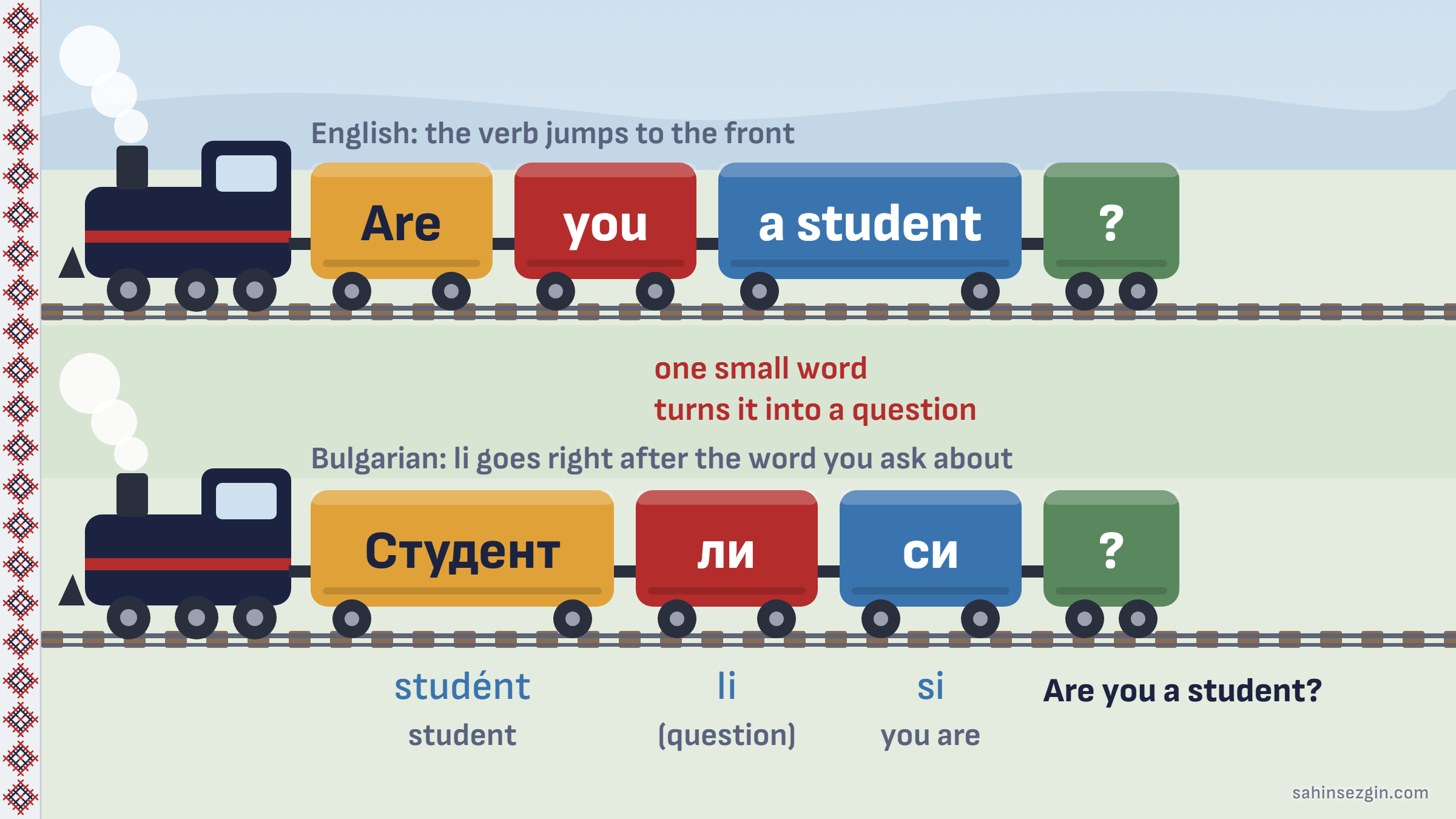
Where ли (li) goes changes the meaning
In Ти ли си Мила? (tí li si míla?) the question sits on “you”: is it you, and not someone else? In Мила ли си? (míla li si?) it sits on the name. English does this with the voice: “Are YOU Mila?” against “Are you MILA?”. With a verb, ли (li) follows the verb, and it never starts a sentence. Casual speech sometimes drops it and uses rising intonation, like “You’re a student?”. For polite speech, си (si) becomes сте (ste): Студент ли сте? (studént li ste?)
5. Where are you from in Bulgarian: question words that don’t need ли (li)
Where are you from in Bulgarian is just Откъде си? (otkădé si?), with no ли (li). If a question already has a word like who, where or when, it usually does not need ли: the question word itself marks the question, so ли would do the same job twice. As in English, the question word goes first: Къде е Мила? (kădé e míla?) is “Where is Mila?”. Откъде (otkădé) is от (ot, from) plus къде (kădé, where), glued into one word.
| Bulgarian | Pronunciation | English |
|---|---|---|
| кой | kóy | who |
| какво | kakvó | what |
| къде | kădé | where |
| откъде | otkădé | where from |
| кога | kogá | when |
| как | kák | how |
| защо | zashtó | why |
6. Introducing someone in Bulgarian: Това е (tová e) and Запознайте се (zapoznáyte se)
To introduce a friend, say Това е (tová e, this is). The е (e) is the “is” from the verb table: Това е Мила (tová e míla), “This is Mila”. Запознай се (zapoznáy se, meet) is said to one person; Запознайте се (zapoznáyte se) to two people or politely. For a more formal nice to meet you, say Радвам се да се запознаем (rádvam se da se zapoznáem) instead of Приятно ми е (priyátno mi e).
| Bulgarian | Pronunciation | English |
|---|---|---|
| Това е Мила. | tová e míla. | This is Mila. |
| Запознайте се. | zapoznáyte se. | Meet each other. |
| Радвам се да се запознаем. | rádvam se da se zapoznáem. | I am glad to meet you. |
PART 3 · PRACTICE
7. Bulgarian conversation practice: Alex meets Mila in Plovdiv
Alex, a Londoner living in Sofia, visits Plovdiv, where his grandmother grew up. He meets Mila, then the old neighbour Bay Petar. The characters are made up.
| Bulgarian | Pronunciation | English |
|---|---|---|
| Mila: Здравей! Аз съм Мила. А ти как се казваш? | zdravéy! ás săm míla. a tí kák se kázvash? | Hi! I am Mila. And what is your name? |
| Alex: Казвам се Алекс. Приятно ми е. | kázvam se áleks. priyátno mi e. | My name is Alex. Nice to meet you. |
| Mila: И на мен. Откъде си? | i na mén. otkădé si? | Me too. Where are you from? |
| Alex: От Англия съм, от Лондон. | ot ángliya săm, ot lóndon. | I am from England, from London. |
| Mila: Англичанин ли си? | anglichánin li si? | Are you English? |
| Alex: Да. Баба ми е от Пловдив. | dá. bába mi e ot plóvdif. | Yes. My grandmother is from Plovdiv. |
| Mila: Браво! Това е бай Петър. Той е наш съсед. | brávo! tová e bay pétăr. tóy e nash săsét. | Great! This is Bay Petar. He is our neighbour. |
| Bay Petar: Добре дошъл, момче! | dobré doshắl, momché! | Welcome, lad! |
| Alex: Благодаря! Приятно ми е. | blagodaryắ! priyátno mi e. | Thank you! Nice to meet you. |
In Англичанин ли си? (anglichánin li si?) the word ли (li) comes straight after “English”, the word Mila is asking about. Бай (bay) before a name is a warm title for an older man, close to “uncle”. Добре дошъл (dobré doshắl, welcome) is the form for a man; Mila would hear добре дошла (dobré doshlá).
8. Bulgarian introductions quiz: test yourself with 10 questions
Ten short questions check what you learned. Pick one answer for each; the right one is marked at once and a short note explains why. The order follows the lesson: meeting phrases first, then съм (săm), then ли (li) and the question words.
-
How do you ask “What is your name?” informally?
- Откъде си? (otkădé si?)
- Как се казваш? (kák se kázvash?)
- Къде е Мила? (kădé e míla?)
Answer
The others ask where you are from and where Mila is.
-
What does Приятно ми е (priyátno mi e) mean?
- Nice to meet you.
- See you later.
- Thank you.
Answer
The usual reply is И на мен (i na mén, me too).
-
Which sentence says “I am a teacher” without the word for “I”?
- Съм учител. (săm uchítel.)
- Учител си. (uchítel si.)
- Учител съм. (uchítel săm.)
Answer
Съм (săm) cannot start a sentence.
-
How do you say “We are friends”?
- Ние сте приятели. (níe ste priyáteli.)
- Ние сме приятели. (níe sme priyáteli.)
- Ние са приятели. (níe sa priyáteli.)
Answer
Сте (ste) is “you are”, са (sa) is “they are”.
-
Which is correct for “Are you a student?”
- Ли студент си? (li studént si?)
- Студент си ли? (studént si li?)
- Студент ли си? (studént li si?)
Answer
Ли (li) follows the word you ask about.
-
Which question does not need ли (li)?
- Откъде си? (otkădé si?)
- Студент си? (studént si?)
- Говориш английски? (govórish anglíyski?)
Answer
It already has a question word.
-
What does къде (kădé) mean?
- when
- how
- where
Answer
“When” is кога (kogá), “how” is как (kák).
-
You want to ask “Are YOU Mila?”, with the question on “you”. Which sentence fits?
- Ти ли си Мила? (tí li si míla?)
- Мила ли си? (míla li si?)
Answer
Ли (li) follows ти (tí, you).
-
What does Това е Мила (tová e míla) mean?
- Where is Mila?
- This is Mila.
- Mila is not here.
Answer
Това е (tová e) means “this is”.
-
How do you say “I am from England”?
- Англия съм. (ángliya săm.)
- В Англия съм. (v ángliya săm.)
- От Англия съм. (ot ángliya săm.)
Answer
От (ot) means “from”; в (v) means “in”.
Frequently asked questions: my name is and nice to meet you in Bulgarian
How do you say “what is your name” in Bulgarian?
Informally Как се казваш? (kák se kázvash?), politely Как се казвате? (kák se kázvate?). To say my name is, answer Казвам се (kázvam se) plus your name.
How do you say “I am English” or “I am American” in Bulgarian?
A man says Англичанин съм (anglichánin săm), a woman Англичанка съм (anglichánka săm). An American man says Американец съм (amerikánets săm). To give your age, see the Bulgarian numbers lesson.
Does every Bulgarian question need ли (li)?
No. It is only for yes/no questions such as Студент ли си? (studént li si?). Questions with къде (kădé, where) and other question words usually do without it.
How do you say nice to meet you in Bulgarian?
Nice to meet you in Bulgarian is Приятно ми е (priyátno mi e). The usual reply is И на мен (i na mén, me too).
Audio: Lingua Libre (Wikimedia Commons), speaker Kiril kovachev, licensed under CC BY-SA 4.0. Recordings were converted to MP3.
Write a comment