

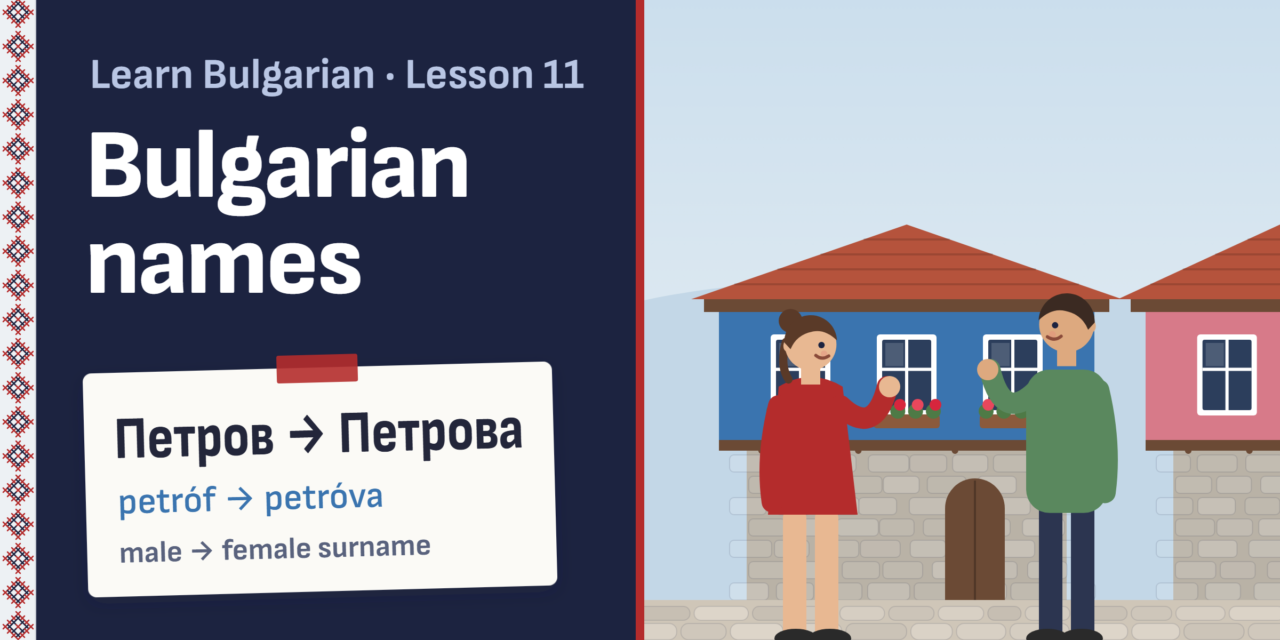
The most common Bulgarian names are Мария (maríya) for women and Георги (geórgi) and Иван (iván) for men, and most Bulgarian last names end in -ов (of) for men and -ова (ova) for women: Петров (petróf), Петрова (petróva). Below: Bulgarian female names, then Bulgarian male names, both with meanings, and Bulgarian surnames, the father’s name, calling people by name and name days. Pronunciation is in brackets, stress marked with an accent. For Cyrillic, see the Bulgarian alphabet lesson.
PART 1 · FEMALE AND MALE NAMES
1. Bulgarian female names: 16 common girl names and what they mean
Among Bulgarian female names, Мария (maríya) comes first, with about 100,000 women in National Statistical Institute (NSI) figures for the end of 2024. Иванка (ivánka) and Елена (eléna) follow with roughly 47,000 each, names you hear mostly among older women. Babies get different names: in 2024 the top name for newborn girls was Виктория (viktóriya). Almost every female name ends in -а (a) or -я (ya), the feminine ending from the Bulgarian noun gender lesson.
| Bulgarian | Pronunciation | English meaning and origin |
|---|---|---|
| Мария | maríya | Mary (the Virgin Mary) |
| Иванка | ivánka | female form of Ivan |
| Елена | eléna | from the Greek Helene |
| Йорданка | yordánka | from Yordan (the river Jordan) |
| Гергана | gergána | female form of Georgi |
| Десислава | desisláva | old Bulgarian name from the Middle Ages |
| Милена | miléna | from mil, “dear” |
| Надежда | nadézhda | “hope” |
| Вяра | vyára | “faith” |
| Светлана | svetlána | related to “light” |
| Веселина | veselína | related to “cheerful” |
| Росица | rosítsa | from rosá, “dew” |
| Калина | kalína | guelder rose, a shrub with red berries |
| Цветелина | tsvetelína | from tsvéte, “flower” |
| Снежана | snezhána | from snyak, “snow” |
| Виктория | viktóriya | Latin “victory” |
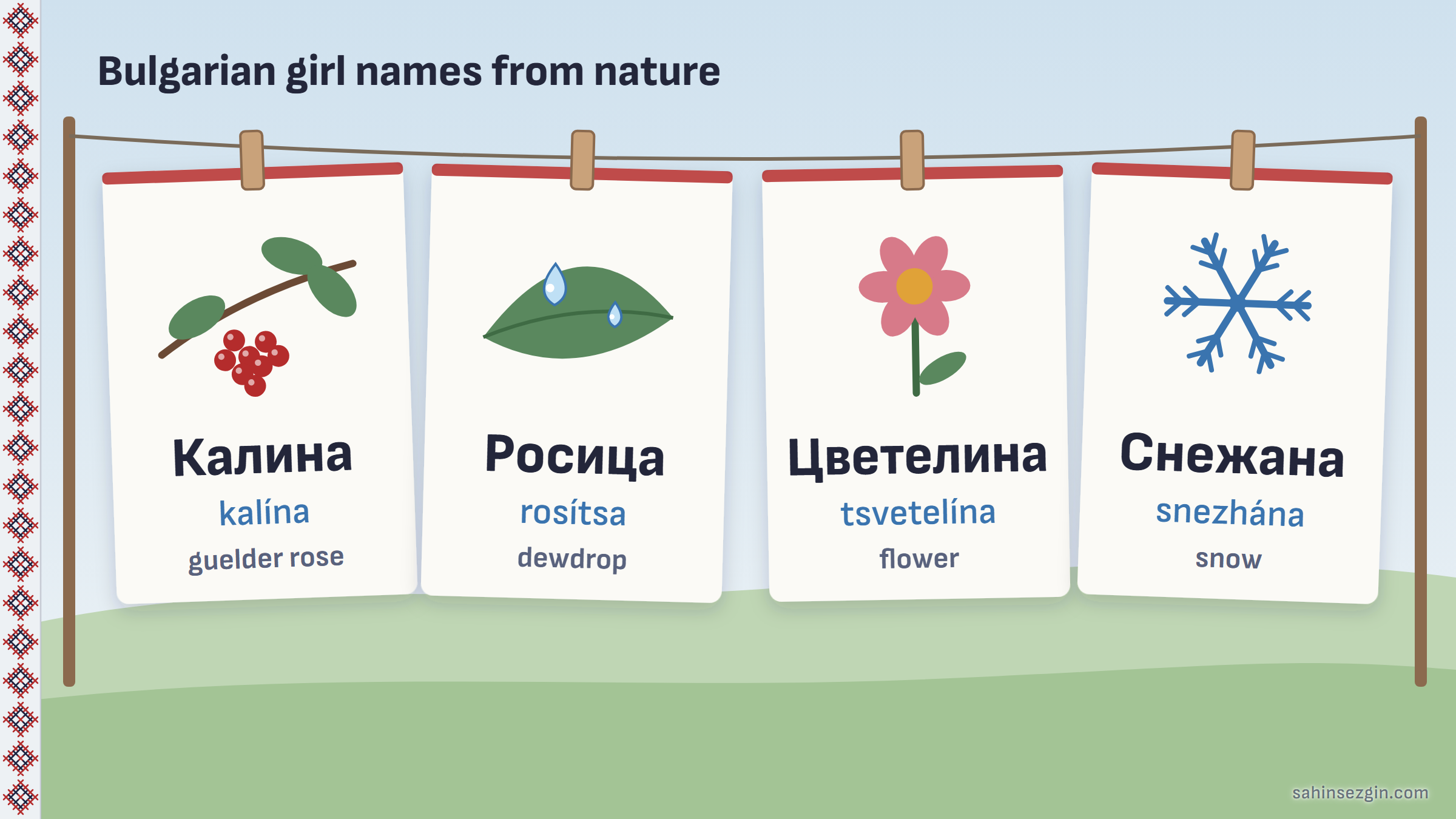
Bulgarian girl names from nature: Калина (kalína), Росица (rosítsa), Цветелина (tsvetelína)
Four names on the list come from nature, and all four are Slavic. Калина (kalína) is the guelder rose, a shrub that keeps its red berries into winter. Росица (rosítsa) brings to mind morning dew, and Снежана (snezhána) snow. People with flower names such as Цветелина (tsvetelína) celebrate on Цветница (tsvétnitsa), Palm Sunday, so the date moves every year. English has Rose, Lily and Daisy, so the idea feels familiar.
2. Bulgarian male names: 16 common boy names and their meanings
The most common Bulgarian male names in the same NSI data are Георги (geórgi), about 141,000 men, then Иван (iván) with 128,000 and Димитър (dimítăr) with 103,000. Most male names come from Christian saints, so the roots are Greek or Hebrew: Иван is the Bulgarian John, and Петър (pétăr) is Peter, “stone”. Slavic names carry an everyday Bulgarian word inside: Пламен (plámen) suggests a flame, Огнян (ognyán) fire. Among newborn boys, Георги was first again.
| Bulgarian | Pronunciation | English meaning and origin |
|---|---|---|
| Георги | geórgi | Greek “farmer” (George) |
| Иван | iván | Hebrew “God is gracious” (John) |
| Димитър | dimítăr | from the Greek Demetrios |
| Петър | pétăr | Greek “stone” (Peter) |
| Николай | nikoláy | Greek “victory of the people” (Nicholas) |
| Христо | hrísto | from the name of Christ |
| Тодор | tódor | Greek Theodoros, “gift of God” |
| Стоян | stoyán | from stoyá, “to stand, to stay” |
| Васил | vasíl | Greek “royal” (Basil) |
| Стефан | stéfan | Greek “crown” (Stephen) |
| Атанас | atanás | Greek “immortal” (Athanasius) |
| Борис | borís | the 9th century ruler Boris I |
| Калоян | kaloyán | after the medieval tsar Kaloyan |
| Пламен | plámen | related to plámăk, “flame” |
| Огнян | ognyán | from ógăn, “fire” |
| Александър | aleksándăr | Greek Alexandros (Alexander) |
Nicknames for common Bulgarian names: Гошо (gósho), Митко (mítko), Пешо (pésho)
Common Bulgarian names usually have a short form, and friends rarely use the full one. Георги (geórgi) is Георги at work, but his friends call him Гошо (gósho). Димитър (dimítăr) turns into Митко (mítko), Петър (pétăr) into Пешо (pésho). A short form may keep just one syllable, so two names can look unrelated, like Bob for Robert or Bill for William. Papers carry the full name; use the short form once the person offers it.
| Bulgarian (full name → short form) | Pronunciation | English |
|---|---|---|
| Георги → Гошо | geórgi → gósho | Georgi |
| Димитър → Митко | dimítăr → mítko | Dimitar |
| Петър → Пешо | pétăr → pésho | Petar |
| Тодор → Тошо | tódor → tósho | Todor |
PART 2 · SURNAMES AND FATHER’S NAMES
3. Bulgarian surnames: -ов (of) for men, -ова (ova) for women
Most Bulgarian surnames, or last names, add -ов (of) or -ев (ef) to a man’s first name. Петров (petróf) first meant “Petar’s”, one of Petar’s line. The key rule: the surname agrees with gender. The Petrovs’ son is Петров (petróf), their daughter Петрова (petróva), with -а (a) added. Note the sound: в (v) at the end of a word sounds like f. Russian does the same (Ivanov, Ivanova).
Иванов (ivánof), Георгиев (georgíef) and Петров (petróf) are among the most common Bulgarian surnames.
| Bulgarian (male → female) | Pronunciation | Root |
|---|---|---|
| Иванов → Иванова | ivánof → ivánova | Ivan |
| Георгиев → Георгиева | georgíef → georgíeva | Georgi |
| Петров → Петрова | petróf → petróva | Petar |
| Николов → Николова | nikólof → nikólova | Nikola |
| Христов → Христова | hrístof → hrístova | Hristo |
| Тодоров → Тодорова | tódorof → tódorova | Todor |
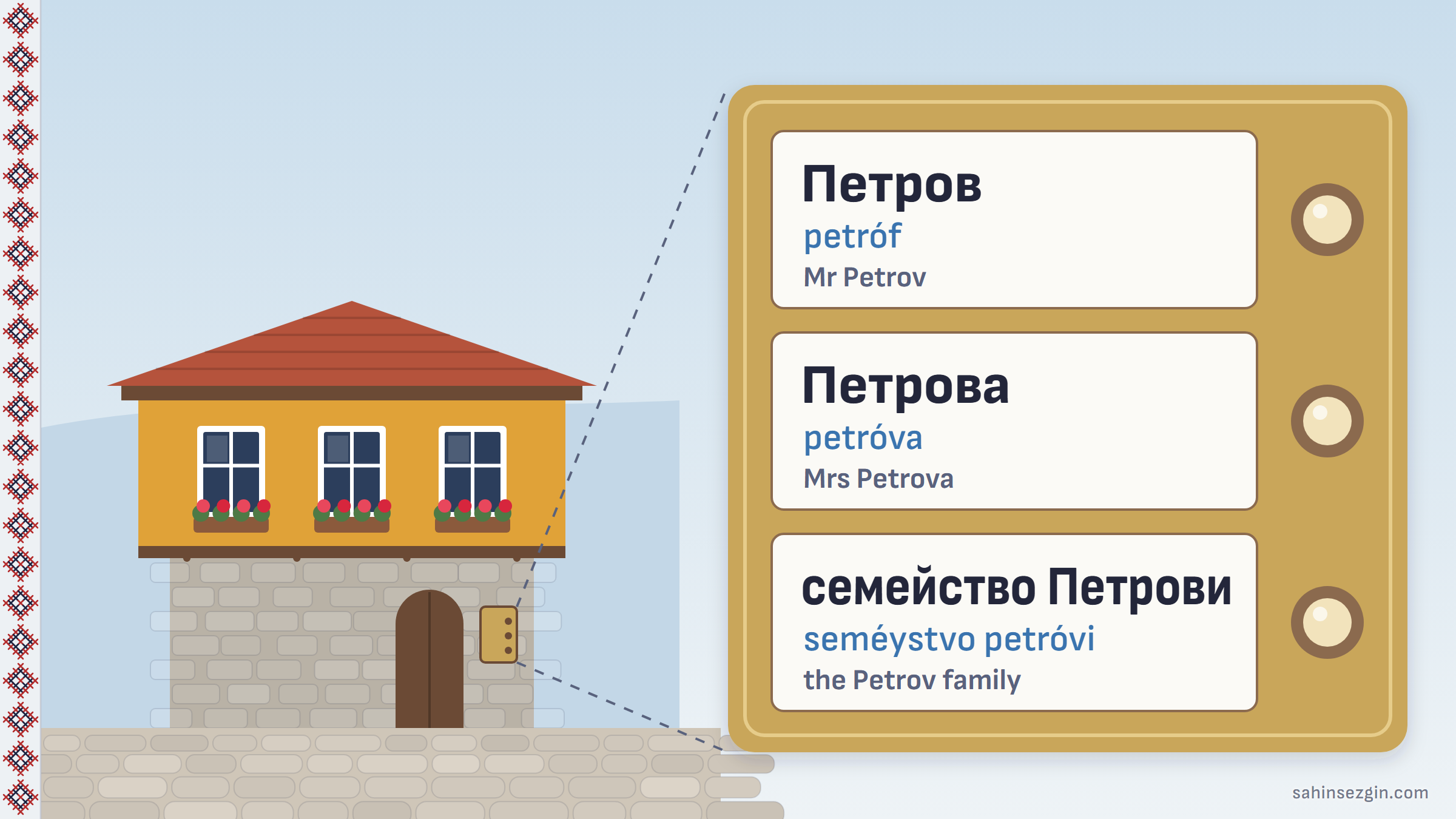
For the whole family the surname goes plural: -ов (of) becomes -ови (ovi), -ев (ef) becomes -еви (evi). Семейство Петрови (seméystvo petróvi) is “the Petrov family”. Surnames in -ски (ski) keep their form: семейство Стамболийски (seméystvo stambolíyski).
Last names ending in -ски (ski) and family names from Turkish words
Last names ending in -ски (ski), for women -ска (ska), form the second big group and often point to a place. Стамболийски (stambolíyski) means “from Stambol”, the old Bulgarian name for Istanbul; Aleksandar Stamboliyski was prime minister after the First World War. Some family names come from Turkish words of Ottoman times, a trade or a nickname: Uzunov from uzun, “tall”. Bulgarian Turks often have surnames built the same way, so Mehmedov and Mehmedova can be brother and sister.
4. How full Bulgarian names work: first name, father’s name and family name
Full Bulgarian names have three parts: the given name, име (íme), the father’s name, бащино име (báshtino íme), and the family name, фамилия (famíliya). The father’s name takes surname endings: a boy whose father is Иван (iván) gets Иванов (ivánof), a girl Иванова (ivánova). It sits on ID cards and may go in the “middle name” box of English forms, but it is rarely used in conversation, unlike Russian “Ivan Petrovich”. Asking names is in the nice to meet you in Bulgarian lesson.
| Bulgarian | Pronunciation | English |
|---|---|---|
| име | íme | first name, name |
| бащино име | báshtino íme | father’s name (middle name) |
| фамилия | famíliya | surname, last name |
One family: the father, Ivan, is the son of Petar; the surname Georgiev stays for the children, and only the daughter adds -а (a).
| Bulgarian | Pronunciation | English |
|---|---|---|
| Иван Петров Георгиев | iván petróf georgíef | father: Ivan, son of Petar |
| Стоян Иванов Георгиев | stoyán ivánof georgíef | son: Stoyan, son of Ivan |
| Мария Иванова Георгиева | maríya ivánova georgíeva | daughter: Maria, daughter of Ivan |
History note: in the winter of 1984-1985 the names of Bulgaria’s Turks were forcibly changed to Bulgarian names, a campaign officially called the Възродителен процес (văzrodítelen protsés, “Revival Process”). A 1990 law let people take back their original names.
PART 3 · CALLING PEOPLE AND NAME DAYS
5. Calling someone by name in Bulgarian: Иване! (iváne!) and господин (gospodín)
Calling out to a man often changes his name. A consonant ending adds -е (e): Иван (iván) becomes Иване! (iváne!). Names in -ър (ăr) such as Петър (pétăr) drop the ă: Петре! (pétre!). Names ending in a vowel stay: Георги! (geórgi!) Women’s names take the same -о (o) calling ending as мамо (mámo) below, as in Марийо (maríyo), but on a name it can sound rude, so use a woman’s name unchanged.
With strangers and older people, use господин (gospodín) or госпожа (gospozhá) plus the surname, like Mr and Mrs. Children call their parents тате (táte) and мамо (mámo).
6. Bulgarian name days: how to say Честит имен ден! (chestít ímen dén!)
For many Bulgarians a name day, имен ден (ímen dén), matters as much as a birthday. On the feast of your saint the phone keeps ringing, and the person celebrating treats everyone else. To congratulate, say Честит имен ден! (chestít ímen dén!) and wish them health.
| Bulgarian | Pronunciation | English |
|---|---|---|
| имен ден | ímen dén | name day |
| Честит имен ден! | chestít ímen dén! | Happy name day! |
| Да си жив и здрав! | da si zhíf i zdráf! | Live long and stay healthy! (to a man) |
| Наздраве! | nazdráve! | Cheers! |
| Днес аз черпя. | dnés as chérpya. | Today it’s my treat. |
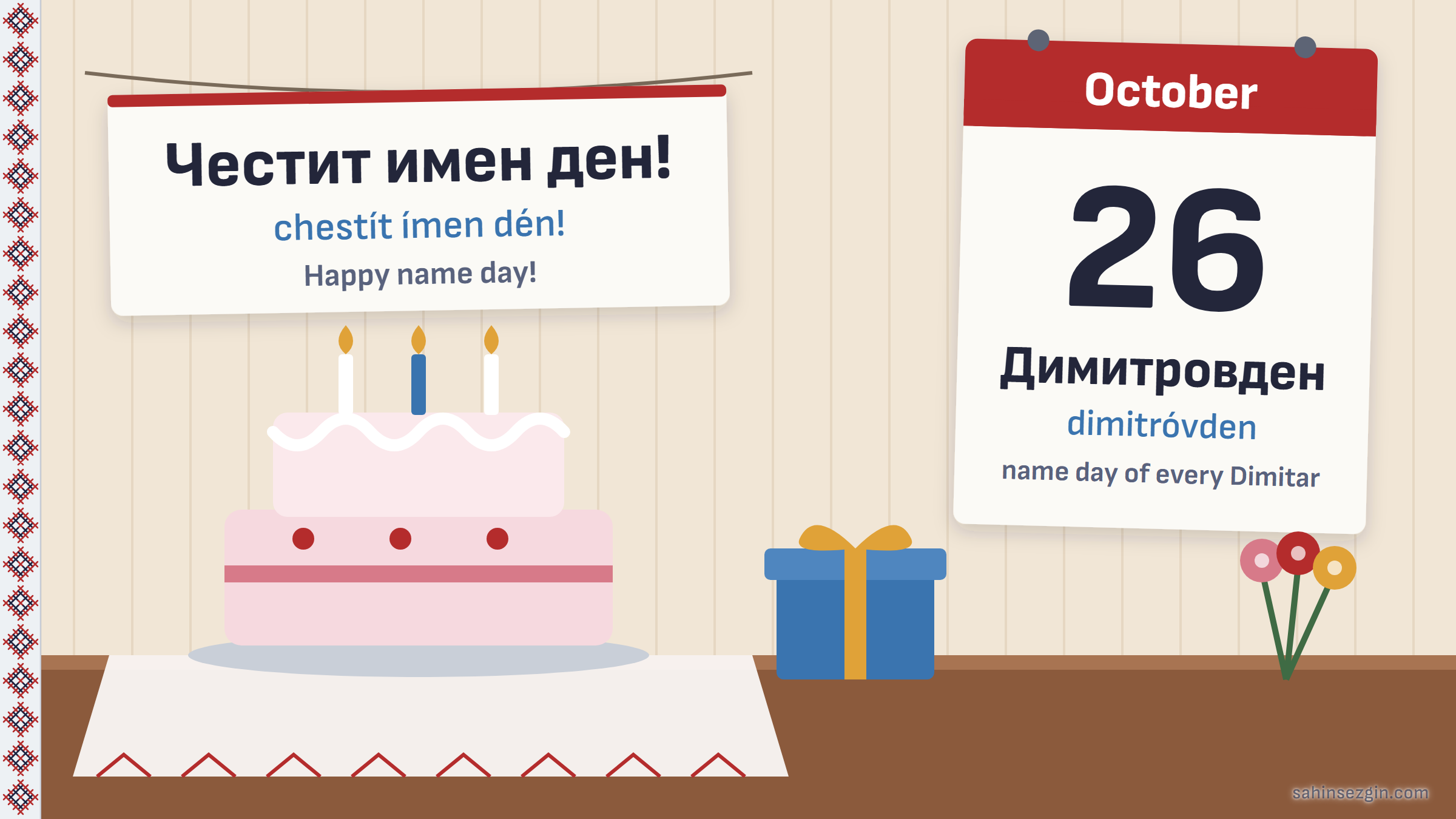
Name days follow the Orthodox church calendar. On 6 May every Георги (geórgi) and Гергана (gergána) celebrates Гергьовден (gergyóvden), St George’s Day, which is also a public holiday, the Day of Bravery and the Bulgarian Army. On 26 October Димитровден (dimitróvden) belongs to every Dimitar, in December Никулден (nikúlden) to every Nikolay, and Christmas to every Hristo.
| Bulgarian | Pronunciation | Name day |
|---|---|---|
| Георги, Гергана | geórgi, gergána | 6 May (St George’s Day) |
| Мария | maríya | 15 August (Dormition of the Virgin) |
| Димитър | dimítăr | 26 October |
| Николай | nikoláy | 6 December |
| Христо | hrísto | 25 December (Christmas) |
7. Name day dialogue: Alex congratulates Mila’s father
Alex is in Plovdiv on 26 October, and Mila has invited him home for her father Dimitar’s name day. The dialogue and its people are fiction. Watch how each speaker addresses the others: Alex is polite with господин Петров (gospodín petróf), while Mila uses her father’s short name, Митко (mítko), but calls him тате (táte). Notice that the host, not the guest, pours the drinks: that is the name day custom.
| Bulgarian | Pronunciation | English |
|---|---|---|
| Mila: Алекс, днес е Димитровден. Баща ми има имен ден. | áleks, dnés e dimitróvden. bashtá mi íma ímen dén. | Alex, today is Dimitrovden. It’s my dad’s name day. |
| Alex: Как се казва баща ти? | kák se kázva bashtá ti? | What’s your dad’s name? |
| Mila: Димитър Петров. Всички му казват Митко. | dimítăr petróf. fsíchki mu kázvat mítko. | Dimitar Petrov. Everyone calls him Mitko. |
| Mila: Тате, това е Алекс, приятел от Лондон. | táte, tová e áleks, priyátel ot lóndon. | Dad, this is Alex, a friend from London. |
| Alex: Честит имен ден, господин Петров! Това е за вас. | chestít ímen dén, gospodín petróf! tová e za vás. | Happy name day, Mr Petrov! This is for you. |
| Dimitar: Благодаря, Алекс! Заповядай, влез! | blagodaryắ, áleks! zapovyáday, vlés! | Thank you, Alex! Come in, please! |
| Dimitar: Днес аз черпя. Наздраве! | dnés as chérpya. nazdráve! | Today it’s my treat. Cheers! |
| Alex: Наздраве! Здраве и щастие! | nazdráve! zdráve i shtástie! | Cheers! Health and happiness! |
8. Names and surnames quiz: test yourself with 10 questions
Ten questions in mixed order: female and male names, the women’s surname, the father’s name, calling forms and name days. Pick an answer to see a short explanation. If you miss one, go back to that table and say the name out loud.
-
Which of these is a female name?
- Стоян (stoyán)
- Росица (rosítsa)
- Пламен (plámen)
Answer
It ends in the feminine -а (a).
-
What is Mr Petrov’s daughter’s surname?
- Петрова (petróva)
- Петров (petróf)
- Петрови (petróvi)
Answer
A woman’s surname adds -а (a).
-
A doorbell says семейство Петрови (seméystvo petróvi). Who lives there?
- Mr Petrov’s daughter
- Someone called Petar
- The Petrov family
Answer
Петрови (petróvi) is the plural surname.
-
Which part of Иван Петров Георгиев (iván petróf georgíef) is the father’s name?
- Иван (iván)
- Петров (petróf)
- Георгиев (georgíef)
Answer
The middle part: his father was Petar.
-
How do you call out to Ivan?
- Иванова! (ivánova!)
- Ивани! (iváni!)
- Иване! (iváne!)
Answer
A consonant ending adds -е (e).
-
How do you congratulate a friend on their name day?
- Приятен път! (priyáten pắt!)
- Честит имен ден! (chestít ímen dén!)
- Добро утро! (dobró útro!)
Answer
It means “Happy name day!”.
-
Георги (geórgi) celebrates his name day on which public holiday?
- Liberation Day (3 March)
- Day of Bravery and the Bulgarian Army (6 May)
- Unification Day (6 September)
Answer
Гергьовден (gergyóvden) falls on 6 May.
-
The name Калина (kalína) comes from which plant?
- Rose
- Tulip
- Guelder rose
Answer
A shrub with red berries.
-
Which female name is the most widespread in Bulgaria?
- Мария (maríya)
- Виктория (viktóriya)
- Снежана (snezhána)
Answer
About 100,000 women carry it.
-
Митко (mítko) is the short form of which name?
- Тодор (tódor)
- Димитър (dimítăr)
- Петър (pétăr)
Answer
Митко (mítko) comes from Димитър (dimítăr).
Frequently asked questions about Bulgarian last names and first names
Why do Bulgarian last names end in -ov and -ova?
Most were made by adding -ов (of) to an ancestor’s name, and the surname follows gender: Петров (petróf) for a man, Петрова (petróva) for a woman.
What are the most common Bulgarian names?
Мария (maríya) for women, and Георги (geórgi), Иван (iván) and Димитър (dimítăr) for men (NSI, end of 2024).
Do Bulgarian women change their last name when they marry?
Only if they want to. As of October 2026, the Family Code lets each spouse keep their own last name, take the other’s or add it to their own. The father’s name does not change.
Do Bulgarians have middle names?
Yes, the father’s name. It is on documents but rarely used in speech.
Audio: Lingua Libre (Wikimedia Commons), speaker Kiril kovachev, licensed under CC BY-SA 4.0. Recordings were converted to MP3.
Write a comment