


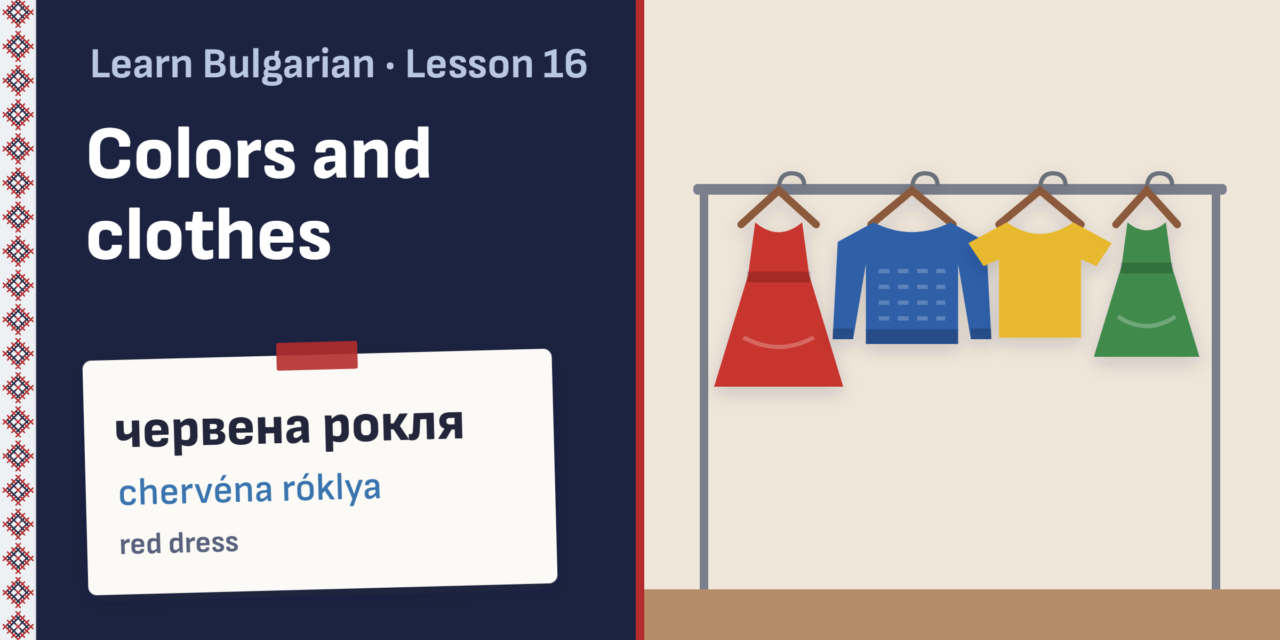
Colors in Bulgarian start with three everyday words: red is червен (chervén), blue is син (sín) and white is бял (byál). In this lesson you will learn the 11 basic colors, see how each color changes its ending to match the noun, and pick up the clothing words you need in a Bulgarian shop. Unlike English, a Bulgarian color is not fixed: a red sweater, a red dress and a red jacket use three different forms. Pronunciation follows each Bulgarian word in brackets, stress marked. If Cyrillic is still new to you, start with the Bulgarian alphabet lesson.
PART 1 · COLORS
1. Colors in Bulgarian from red to purple: 11 words to know
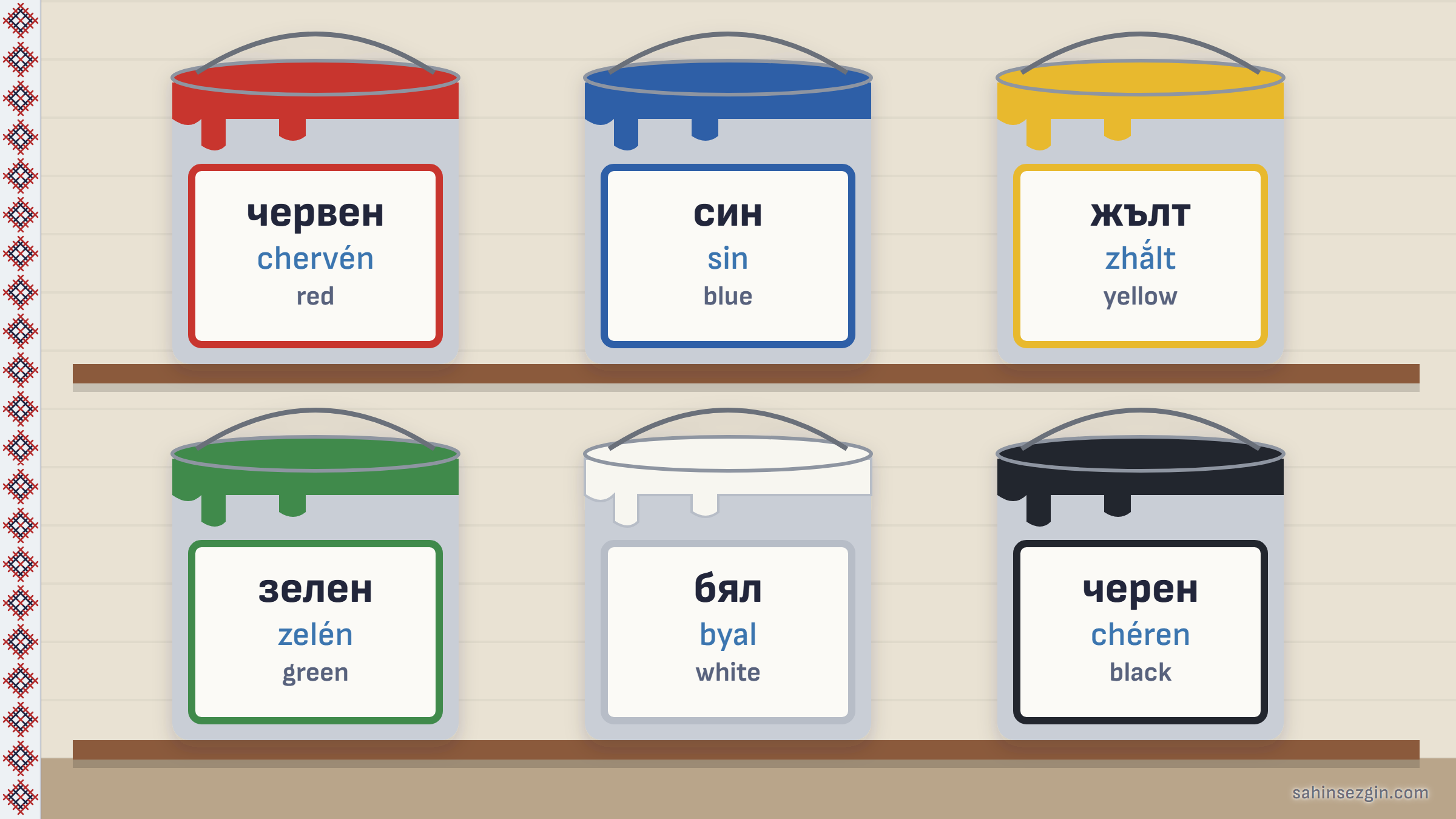
Colors in Bulgarian are adjectives, and the word for color itself is цвят (tsvyát), plural цветове (tsvetové). The table lists each color in its dictionary form, the masculine one. Watch the Cyrillic letters that look English but sound different: in син (sín) the letter С (s) is an “s” and Н (n) is an “n”, and in червен (chervén) the letter Р (r) is an “r”. A final в (v) sounds like “f”, so кафяв (kafyáf, brown) ends in an “f” sound. To ask about a color, say Какъв цвят е? (kakắf tsvyát e?), “What color is it?” The answer can be just the color: Червен е (chervén e), “It’s red.”
| Bulgarian | Pronunciation | English |
|---|---|---|
| червен | chervén | red |
| син | sín | blue |
| бял | byál | white |
| черен | chéren | black |
| зелен | zelén | green |
| жълт | zhắlt | yellow |
| кафяв | kafyáf | brown |
| сив | síf | gray |
| розов | rózof | pink |
| оранжев | oránzhef | orange |
| лилав | liláf | purple |
Bulgarian flag colors: бяло (byálo) and червено (chervéno)
The Bulgarian flag has three horizontal stripes, white on top, green in the middle and red at the bottom, and Bulgarians describe it in one sentence: Знамето е бяло, зелено и червено. (známeto e byálo, zeléno i chervéno.) Notice that every color in that sentence ends in ‑о (o). That is because знаме (známe, flag) is a neuter noun, and the colors take the neuter ending to match it. Green, зелен (zelén), becomes зелено (zeléno), and white, бял (byál), becomes бяло (byálo). The rule: a color always matches the noun it describes; the full pattern is in section 2.
Light and dark shades: светъл (svétăl) and тъмен (tắmen)
For shades you need two adjectives: светъл (svétăl) means “light” and тъмен (tắmen) means “dark”. In front of a color they end in ‑о (o) and join it into one word: тъмносин (tămnosín) is “dark blue” and светлосин (svetlosín) is “light blue“. In the same way тъмнозелен (tămnozelén) is “dark green“. English writes these as two words, Bulgarian as one. Talking about your favorite color is easy too: Любимият ми цвят е зелен. (lyubímiyat mi tsvyát e zelén.) means “My favorite color is green.” The question is Кой е любимият ти цвят? (kóy e lyubímiyat ti tsvyát?)
2. Bulgarian adjectives change with the noun: four forms of every color
Bulgarian adjectives, colors included, take one of four forms depending on the gender and number of the noun. In English “red” never changes; in Bulgarian it is червен (chervén) with a masculine noun, червена (chervéna) with a feminine noun, червено (chervéno) with a neuter noun and червени (chervéni) with a plural. It works like Spanish rojo and roja. The rule builds on noun genders from the Bulgarian gender and plural lesson: a noun ending in a consonant is usually masculine, one ending in ‑а (a) or ‑я (ya) is feminine, one ending in ‑о (o) or ‑е (e) is neuter. The table shows one color with four pieces of clothing.
| Bulgarian | Pronunciation | English |
|---|---|---|
| червен пуловер | chervén pulóver | red sweater (masculine) |
| червена рокля | chervéna róklya | red dress (feminine) |
| червено яке | chervéno yáke | red jacket (neuter) |
| червени обувки | chervéni obúfki | red shoes (plural) |
Irregular colors: син (sín) and черен (chéren)
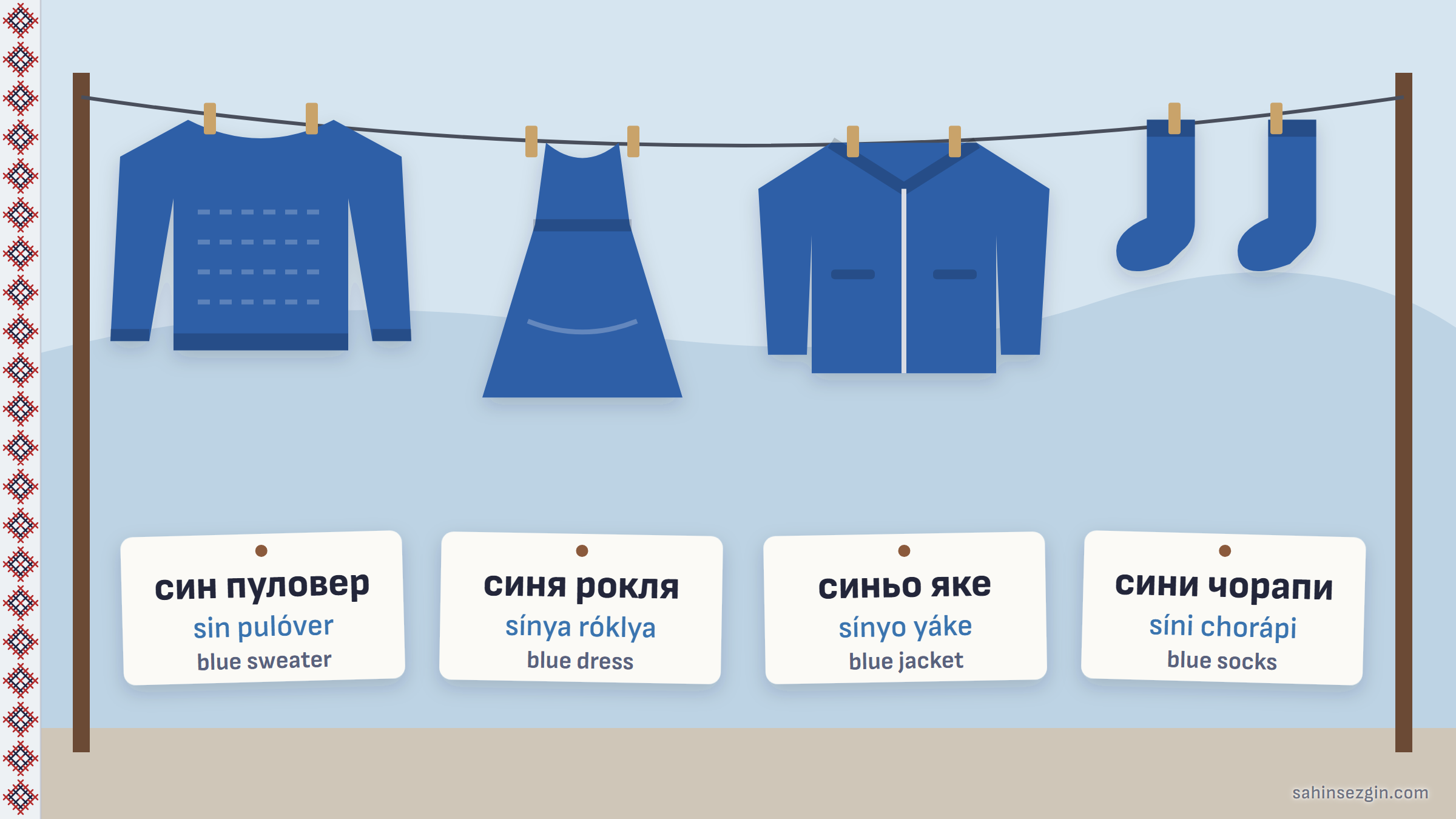
Blue, син (sín), and black, черен (chéren), bend the rule a little. Син is a “soft” adjective: the feminine is синя (sínya), the neuter синьо (sínyo) and the plural сини (síni), so ‑я (ya) replaces ‑а (a) and ‑ьо (yo) replaces ‑о (o). Черен drops the е (e) in the middle once an ending is added: черна (chérna), черно (chérno), черни (chérni). The same drop happens in тъмен (tắmen) and светъл (svétăl): тъмна (tắmna), светла (svétla). White has its own surprise: бял (byál), бяла (byála), бяло (byálo), but the plural is бели (béli), with е instead of я.
| Bulgarian | Pronunciation | English |
|---|---|---|
| син → синя → синьо → сини | sín → sínya → sínyo → síni | blue |
| черен → черна → черно → черни | chéren → chérna → chérno → chérni | black |
| бял → бяла → бяло → бели | byál → byála → byálo → béli | white |
| жълт → жълта → жълто → жълти | zhắlt → zhắlta → zhắlto → zhắlti | yellow |
PART 2 · CLOTHES
3. Clothes in Bulgarian: дрехи (dréhi) and everyday clothing words
Clothes in Bulgarian are дрехи (dréhi), and several clothing words will look familiar. Пуловер (pulóver) is a sweater, close to English “pullover”. Панталон (pantalón) means trousers, like old English “pantaloons”, but careful: in Bulgarian it is a singular, masculine noun, while English “trousers” is plural. Яке (yáke) is a jacket and палто (paltó) a coat; both are neuter. Шал (shál) is a scarf. The color has to match the gender, so the table groups masculine and neuter words; feminine and plural words follow.
| Bulgarian | Pronunciation | English |
|---|---|---|
| пуловер | pulóver | sweater (masculine) |
| панталон | pantalón | trousers (masculine) |
| шал | shál | scarf (masculine) |
| яке | yáke | jacket (neuter) |
| палто | paltó | coat (neuter) |
Feminine clothing words: рокля (róklya) and friends
A dress in Bulgarian is рокля (róklya), a feminine noun. A shirt, риза (ríza), a skirt, пола (polá), and a T‑shirt, тениска (téniska), are feminine too. They all end in ‑а (a) or ‑я (ya), so their gender is easy to guess. The color comes before them in its feminine form: бяла риза (byála ríza) is “a white shirt” and черна пола (chérna polá) “a black skirt”. Тениска comes from “tennis”. A hat, шапка (shápka), is also feminine, so “a red hat” is червена шапка (chervéna shápka).
| Bulgarian | Pronunciation | English |
|---|---|---|
| рокля | róklya | dress |
| риза | ríza | shirt |
| пола | polá | skirt |
| тениска | téniska | T‑shirt |
| шапка | shápka | hat |
Shoes in Bulgarian: why обувки (obúfki) is plural
Shoes in Bulgarian are обувки (obúfki), and the word is usually plural, just like in English, because shoes come in pairs. The singular обувка (obúfka) means one single shoe. Socks, чорапи (chorápi), and jeans, дънки (dắnki), work the same way, and here Bulgarian matches English nicely: “jeans” is plural in both languages. Because these nouns are plural, the color takes the plural ending ‑и (i): черни обувки (chérni obúfki) “black shoes”, сини дънки (síni dắnki) “blue jeans”. To say what you are wearing, use the verb нося (nósya): Нося черни обувки (nósya chérni obúfki), “I’m wearing black shoes.”
Memory trick: look at the end of the noun. If it ends in ‑а (a) or ‑я (ya), the color ends in ‑а (a) or ‑я (ya) too; if the noun ends in ‑о (o) or ‑е (e), the color takes ‑о (o); if the noun is plural, the color ends in ‑и (i). For example зелена шапка (zeléna shápka), зелено палто (zeléno paltó), зелени чорапи (zeléni chorápi).
4. “The red dress” in Bulgarian: червената рокля (chervénata róklya)
“A red dress” in Bulgarian is червена рокля (chervéna róklya), and “the red dress” is червената рокля (chervénata róklya). Bulgarian has no separate word for “the”; it adds an ending to the word instead, as you saw in the this, that and directions lesson. When an adjective comes first, the ending moves to the adjective, not the noun: рокля (róklya) stays the same and червена (chervéna) becomes червената (chervénata). The ending depends on gender: masculine ‑ият (iyat), feminine ‑та (ta), neuter ‑то (to), plural ‑те (te). The table shows all four with the same color.
| Bulgarian | Pronunciation | English |
|---|---|---|
| червеният пуловер | chervéniyat pulóver | the red sweater |
| червената рокля | chervénata róklya | the red dress |
| червеното яке | chervénoto yáke | the red jacket |
| червените обувки | chervénite obúfki | the red shoes |
With blue the ending attaches to the soft forms: синият (síniyat), синята (sínyata), синьото (sínyoto), сините (sínite). With white, the е (e) of the plural also appears in the masculine: белият пуловер (béliyat pulóver) but бялата риза (byálata ríza). In writing, the masculine ending shortens to ‑ия (iya) when the phrase is not the subject: Купувам червения пуловер (kupúvam chervéniya pulóver), “I’m buying the red sweater.” The key point: the ending appears only once, on the first word. Червената рокля (chervénata róklya) is correct; червената роклята (chervénata róklyata) is wrong.
PART 3 · SHOPPING AND QUIZ
5. Asking for your size in Bulgarian: Какъв размер? (kakắf razmér?)
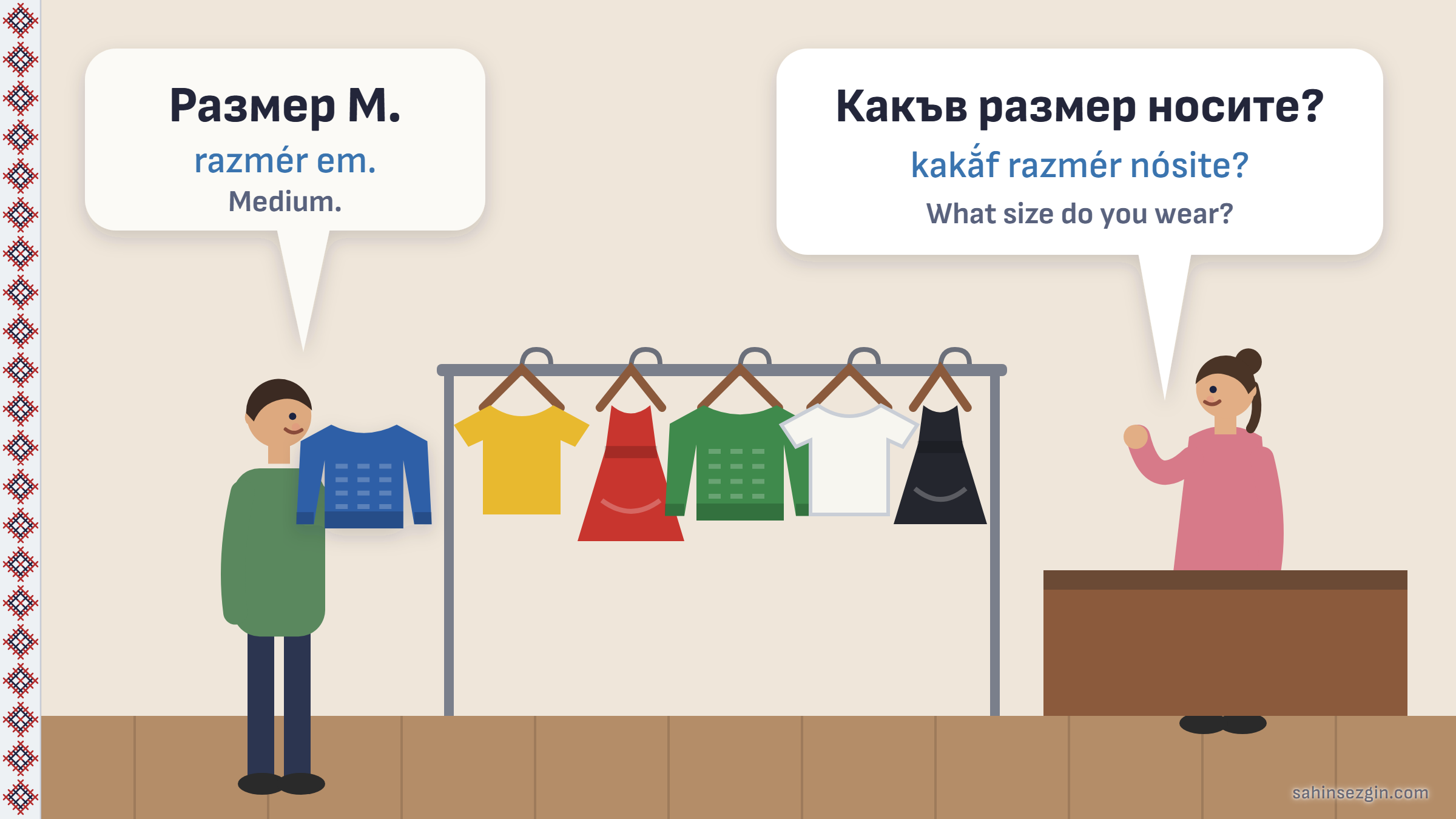
Size in Bulgarian is размер (razmér), and a shop assistant will ask Какъв размер носите? (kakắf razmér nósite?), “What size do you wear?” Letter sizes are written in Latin letters but read the Bulgarian way: M is “em”, S is “es”, L is “el”. For shoes Bulgarians say номер (nómer) instead: Номер 42 (nómer chetiríyset i dvé); in speech forty is shortened to четирийсет (chetiríyset), while in writing you will see четиридесет (chetirídeset). You met the numbers in the Bulgarian numbers lesson. To try something on, say Може ли да го пробвам? (mózhe li da go próbvam?), “Can I try it on?” Го (go) means “it” for a masculine or neuter item; for a feminine item use я (ya): Може ли да я пробвам? (mózhe li da ya próbvam?) If it is too big, ask for по-малък (pó-málăk), “a smaller one”. Below, Alex shops for a blue sweater in Yana’s shop in Plovdiv.
| Bulgarian | Pronunciation | English |
|---|---|---|
| Yana: Здравейте! Мога ли да помогна? | zdravéyte! móga li da pomógna? | Hello! Can I help you? |
| Alex: Търся син пуловер. | tắrsya sín pulóver. | I’m looking for a blue sweater. |
| Yana: Какъв размер носите? | kakắf razmér nósite? | What size do you wear? |
| Alex: Размер M. Може ли да го пробвам? | razmér em. mózhe li da go próbvam? | Medium. Can I try it on? |
| Yana: Да, разбира се. Ето там. | da, razbíra se. éto tám. | Yes, of course. Over there. |
| Alex: Малко е голям. Имате ли по-малък? | málko e golyám. ímate li pó-málăk? | It’s a bit big. Do you have a smaller one? |
| Yana: Да, ето размер S. | da, éto razmér es. | Yes, here’s a small. |
6. Saying “nice” in Bulgarian: хубав (húbaf) and a shop conversation
The everyday word for “nice” or “pretty” in Bulgarian is хубав (húbaf). It is an adjective, so it agrees with the noun: хубава рокля (húbava róklya) “a nice dress”, хубаво яке (húbavo yáke) “a nice jacket”. The word красив (krasíf), “beautiful”, is used more for faces, cities and views; for clothes хубав sounds more natural. To say you like something, use Харесва ми (harésva mi), literally “it pleases me”, much like Spanish “me gusta”. When something suits someone, Bulgarians say Отива ти (otíva ti), “It suits you.” Alex has now tried on the small, and Mila gives her opinion at the shop door.
| Bulgarian | Pronunciation | English |
|---|---|---|
| Alex: Харесва ли ти синият пуловер? | harésva li ti síniyat pulóver? | Do you like the blue sweater? |
| Mila: Да, много е хубав. Синият цвят ти отива. | da, mnógo e húbaf. síniyat tsvyát ti otíva. | Yes, it’s very nice. Blue suits you. |
| Alex: А тази червена рокля? | a tázi chervéna róklya? | And this red dress? |
| Mila: Хубава е, но предпочитам зелената. | húbava e, no pretpochítam zelénata. | It’s nice, but I prefer the green one. |
In Mila’s last line the noun disappears: зелената (zelénata) means “the green one”. The noun was just mentioned, so Bulgarians drop it where English adds “one”. Тази (tázi) means “this” with a feminine noun. Предпочитам (pretpochítam) means “I prefer”; the д (d) in the middle sounds like “t” before the voiceless п (p). Try it with two colors: Предпочитам черния (pretpochítam chérniya), “I prefer the black one.”
7. Alex’s wardrobe quiz: test yourself with 10 questions
Ten questions check the colors, the clothing words and the rule that a color matches its noun. Choose an answer; the right one is highlighted and a short explanation opens below. If you miss one, go back to that section and read the tables aloud once more.
-
Which word means “yellow”?
- сив (síf)
- жълт (zhắlt)
- зелен (zelén)
Answer
Жълт (zhắlt) is yellow. Сив (síf) is gray and зелен (zelén) is green.
-
Рокля (róklya, dress) is feminine. How do you say “a red dress”?
- червен рокля (chervén róklya)
- червено рокля (chervéno róklya)
- червена рокля (chervéna róklya)
Answer
With a feminine noun the color takes ‑а (a): червена рокля (chervéna róklya).
-
What is яке (yáke)?
- A jacket
- A skirt
- A shirt
Answer
Яке (yáke) is a jacket and it is neuter. A skirt is пола (polá), a shirt is риза (ríza).
-
Which phrase means “blue socks”?
- синьо чорапи (sínyo chorápi)
- сини чорапи (síni chorápi)
- синя чорапи (sínya chorápi)
Answer
Чорапи (chorápi) is plural, so the color is plural too: сини (síni).
-
What does Какъв цвят е? (kakắf tsvyát e?) mean?
- What size is it?
- How much is it?
- What color is it?
Answer
Цвят (tsvyát) means color, so the question is “What color is it?”
-
Fill the gap: Знамето е бяло, зелено и … (známeto e byálo, zeléno i …) “The flag is white, green and red.”
- червен (chervén)
- червена (chervéna)
- червено (chervéno)
Answer
Знаме (známe, flag) is neuter, so the colors end in ‑о (o): червено (chervéno).
-
The assistant asks Какъв размер носите? (kakắf razmér nósite?). Which answer fits?
- Размер (razmér) M.
- Харесва ми. (harésva mi.)
- Тъмносин. (tămnosín.)
Answer
She is asking about your size, so the answer is a size: “Medium.”
-
How do you say “the red dress”?
- червена роклята (chervéna róklyata)
- червената рокля (chervénata róklya)
- червената роклята (chervénata róklyata)
Answer
The ending appears once, on the first word, which is the adjective: червената рокля (chervénata róklya).
-
Why is обувки (obúfki) used in the plural?
- Because it is feminine
- Because shoes come in pairs
- To sound more polite
Answer
Shoes come in pairs, so the word is usually plural; one shoe is обувка (obúfka).
-
Mila says Синият цвят ти отива (síniyat tsvyát ti otíva). What does she mean?
- I don’t like blue.
- The blue sweater is too big.
- Blue suits you.
Answer
Отива ти (otíva ti) means “it suits you”: Mila likes the sweater on Alex.
Frequently asked questions about colors in Bulgarian
What are the colors in Bulgarian?
The basic colors are червен (chervén) red, син (sín) blue, бял (byál) white, черен (chéren) black, зелен (zelén) green, жълт (zhắlt) yellow, кафяв (kafyáf) brown, сив (síf) gray, розов (rózof) pink, оранжев (oránzhef) orange and лилав (liláf) purple.
Why do Bulgarian colors have different endings?
Colors are adjectives and agree with the gender and number of the noun: червен (chervén) with a masculine noun, червена (chervéna) with a feminine one, червено (chervéno) with a neuter one and червени (chervéni) with a plural.
How do you say clothes in Bulgarian?
Clothes are дрехи (dréhi). A dress is рокля (róklya), shoes are обувки (obúfki) and a sweater is пуловер (pulóver).
How do you ask for your size in Bulgarian?
Ask Какъв размер носите? (kakắf razmér nósite?), “What size do you wear?” For shoes, use номер (nómer) instead of размер (razmér).
Audio: Lingua Libre (Wikimedia Commons), speaker Kiril kovachev, licensed under CC BY-SA 4.0. Recordings were converted to MP3.
Write a comment