


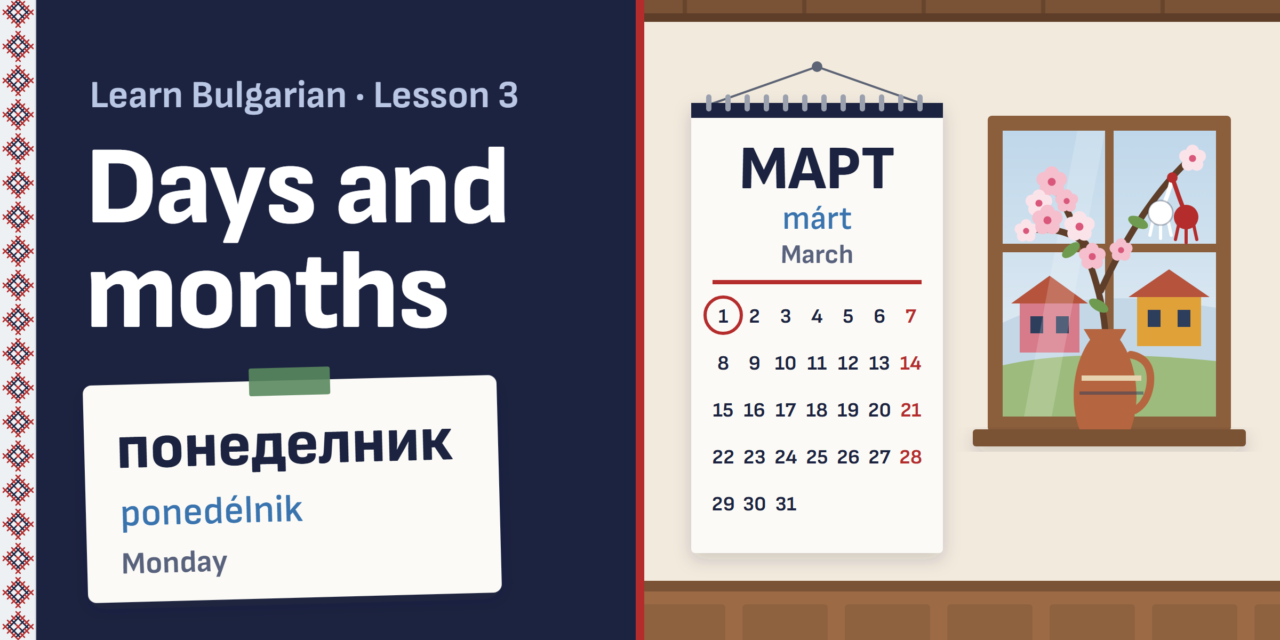
The days of the week in Bulgarian run from понеделник (ponedélnik, Monday) to неделя (nedélya, Sunday). The months in Bulgarian come from Latin, so they look familiar: юни (yúni) is June and октомври (októmvri) is October. The seasons are пролет (prólet, spring), лято (lyáto, summer), есен (ésen, autumn) and зима (zíma, winter). Every word has its pronunciation in brackets; an accent shows the stressed syllable. New to Cyrillic? Start with the Bulgarian alphabet lesson.
PART 1 · DAYS AND TIME
1. Days of the week in Bulgarian: Monday to Sunday with pronunciation
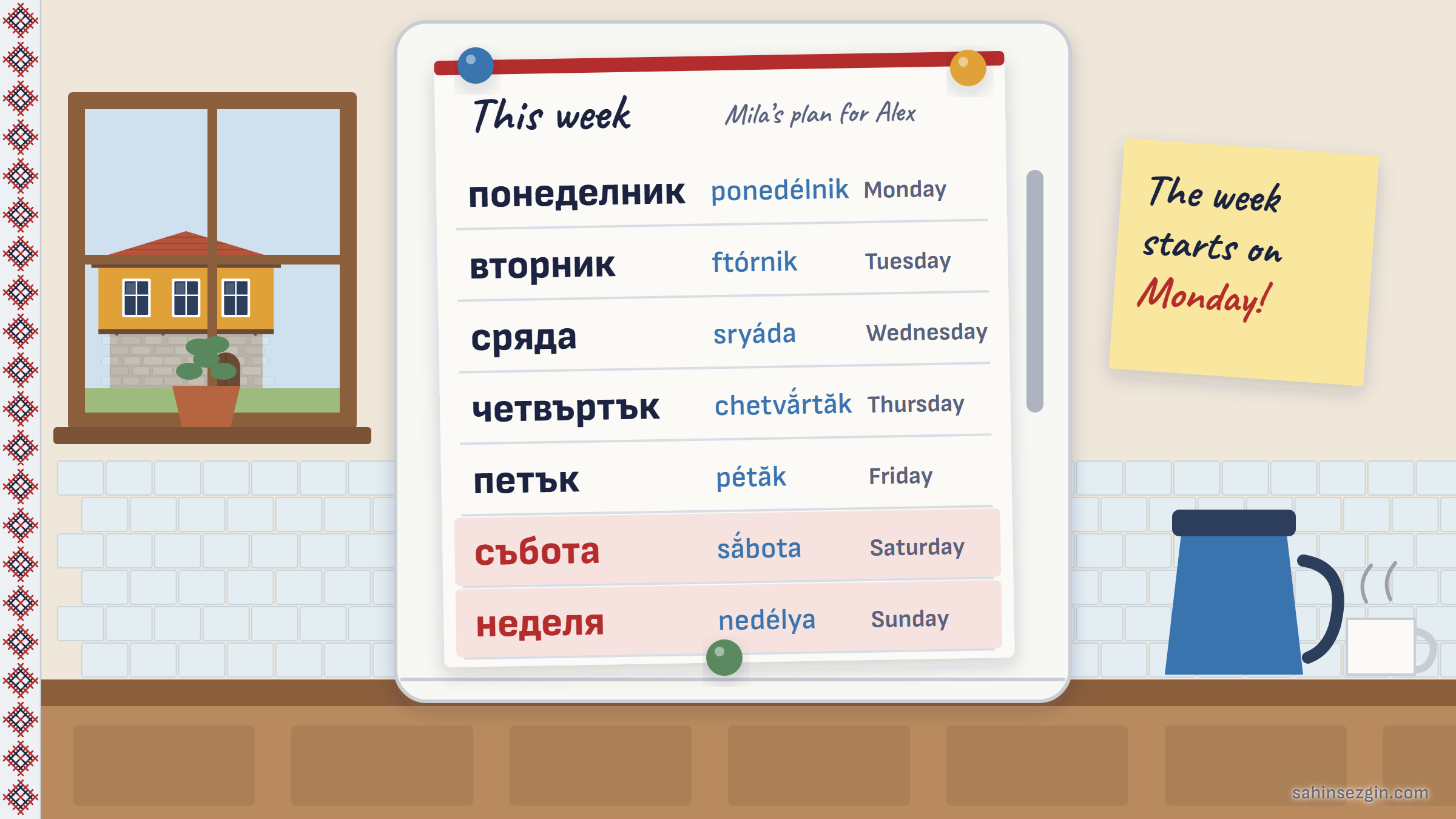
The seven days of the week in Bulgarian follow the European calendar, so the list opens with Monday. Read the pronunciation column out loud.
| Bulgarian | Pronunciation | English |
|---|---|---|
| понеделник | ponedélnik | Monday |
| вторник | ftórnik | Tuesday |
| сряда | sryáda | Wednesday |
| четвъртък | chetvắrtăk | Thursday |
| петък | pétăk | Friday |
| събота | sắbota | Saturday |
| неделя | nedélya | Sunday |
Unlike English, Bulgarian writes days and months with a small letter unless they open a sentence. Понеделник (ponedélnik) means “the day after Sunday”, and неделя (nedélya) once meant “the day of not working”. Three days are counted: вторник (ftórnik) is the second day, четвъртък (chetvắrtăk) the fourth, петък (pétăk) the fifth. Сряда (sryáda) shares a root with среда (sredá, middle), and събота (sắbota) comes from Sabbath.
Two sounds need care. In вторник (ftórnik) the в (v) is said f because it stands before т (t). The ъ (ă) in петък (pétăk) is a short, relaxed vowel, close to the “u” in “but”.
Shop doors list their работно време (rabótno vréme, opening hours) with short day names, and you read each one as the full word: пн-пт (ot ponedélnik do pétăk) means Monday to Friday.
| Bulgarian | Pronunciation | English |
|---|---|---|
| пн | ponedélnik | Mon, Monday |
| вт | ftórnik | Tue, Tuesday |
| ср | sryáda | Wed, Wednesday |
| чт | chetvắrtăk | Thu, Thursday |
| пт | pétăk | Fri, Friday |
| сб | sắbota | Sat, Saturday |
| нд | nedélya | Sun, Sunday |
2. “On Monday” in Bulgarian: в понеделник (f ponedélnik) and всеки понеделник (fséki ponedélnik)
Where English says “on Monday”, Bulgarian puts the tiny preposition в (v), literally “in”, before the day.
| Bulgarian | Pronunciation | English |
|---|---|---|
| в понеделник | f ponedélnik | on Monday |
| във вторник | văf ftórnik | on Tuesday |
| в сряда | f sryáda | on Wednesday |
| в четвъртък | f chetvắrtăk | on Thursday |
| в петък | f pétăk | on Friday |
| в събота | f sắbota | on Saturday |
| в неделя | v nedélya | on Sunday |
| всеки понеделник | fséki ponedélnik | every Monday |
| Кой ден е днес? | kóy dén e dnés | What day is it today? |
| Днес е сряда. | dnés e sryáda | Today is Wednesday. |
The preposition is said together with the next word, so its sound shifts. Before a voiceless consonant such as п (p), с (s) or ч (ch) it becomes f; before н (n) it stays v. When the day itself starts with в (v), Bulgarian avoids a double v and uses the longer във (văf): във вторник (văf ftórnik). For a habit, use всеки (fséki, every) instead. In Днес е сряда. (dnés e sryáda) there is no preposition, because the day is only being named.
Watch the letters that look English but sound different: В (v), Н (n), Р (r), С (s), У (u) and Х (h). So ВТОРНИК (ftórnik, Tuesday) on a shop sign has nothing to do with “btophnk”, and СРЯДА (sryáda, Wednesday) starts with an s.
3. Telling time in Bulgarian: Колко е часът? (kólko e chasắt)
Telling time in Bulgarian takes one question, Колко е часът? (kólko e chasắt, what time is it?), and an answer that starts with Часът е (chasắt e, it is) plus the hour. To make plans you also need words that count forward and back from today. The two short tables below group them, one for the calendar and one for the clock. The numbers for hours are in the Bulgarian numbers lesson. Learn each phrase as a whole block for now; the grammar behind words like “last” and “next” comes in later lessons.
Today, tomorrow and yesterday
Today in Bulgarian is днес (dnés), tomorrow is утре (útre) and yesterday is вчера (fchéra).
| Bulgarian | Pronunciation | English |
|---|---|---|
| ден | dén | day |
| седмица | sédmitsa | week |
| месец | mésets | month |
| година | godína | year |
| днес | dnés | today |
| утре | útre | tomorrow |
| вчера | fchéra | yesterday |
| вдругиден | vdrúgiden | the day after tomorrow |
| миналата седмица | mínalata sédmitsa | last week |
| следващата седмица | slédvashtata sédmitsa | next week |
In вчера (fchéra, yesterday) the в (v) again turns into f, this time before ч (ch). English needs four words for “the day after tomorrow”; Bulgarian packs them into one, вдругиден (vdrúgiden). Don’t mix up утре (útre, tomorrow) with утро (útro, morning), which differ by one vowel. The ending -та (ta) on миналата (mínalata, last) is the word “the”, stuck to the end. You will meet this final “the” again with the seasons.
Asking the time
| Bulgarian | Pronunciation | English |
|---|---|---|
| Колко е часът? | kólko e chasắt | What time is it? |
| Часът е три. | chasắt e trí | It’s three o’clock. |
| Часът е десет и половина. | chasắt e déset i polovína | It’s half past ten. |
| Часът е осем без четвърт. | chasắt e ósem bes chétvărt | It’s a quarter to eight. |
To ask the time in Bulgarian, say Колко е часът? (kólko e chasắt), word for word “How much is the hour?” Each answer in the table reuses часът (chasắt), “the hour”, from the question. Half past is и половина (i polovína, and a half); a quarter to is без четвърт (bes chétvărt, without a quarter). In без (bes) the final з (z) is said s before ч (ch). Bulgarian says “ten and a half” where English says “half past ten”, so the hour comes first.
PART 2 · MONTHS AND SEASONS
4. Months in Bulgarian: names, pronunciation and dates
The months in Bulgarian will feel like old friends, because English and Bulgarian took them from the same Latin names. The stress is where they differ, so follow the accent marks.
| Bulgarian | Pronunciation | English |
|---|---|---|
| януари | yanuári | January |
| февруари | fevruári | February |
| март | márt | March |
| април | apríl | April |
| май | máy | May |
| юни | yúni | June |
| юли | yúli | July |
| август | ávgust | August |
| септември | septémvri | September |
| октомври | októmvri | October |
| ноември | noémvri | November |
| декември | dekémvri | December |
English speakers trip on two things. First, stress: April is apríl, January is yanuári and February is fevruári, all stressed later than in English. Second, юни (yúni, June) and юли (yúli, July) look almost the same in Cyrillic. English helps here: June has an n and юни has н (n); July has an l and юли has л (l). The last four months end in -ври (vri), the Bulgarian twin of “-ber”.
Saying dates: през юли (prez yúli) and на първи март (na pắrvi márt)
| Bulgarian | Pronunciation | English |
|---|---|---|
| през юли | prez yúli | in July |
| този месец | tózi mésets | this month |
| на първи март | na pắrvi márt | on the first of March |
| на пети май | na péti máy | on the fifth of May |
| трети март | tréti márt | 3 March, national holiday |
| осми март | ósmi márt | 8 March, Women’s Day |
| Коя дата е днес? | koyá dáta e dnés | What’s the date today? |
| Днес е трети октомври. | dnés e tréti októmvri | Today is the third of October. |
To say a date in Bulgarian, put на (na, on) before a single day, and през (prez, during) or, in casual speech, в (v) before a whole month. Dates go day first, as in British English, and the day is an ordinal: “the third October”, not “October three”. A written 3.10 is read трети октомври (tréti októmvri). Two March dates in the table are public occasions. On 3 March Bulgaria marks Liberation Day, the end of Ottoman rule in 1878, its national holiday. On 8 March people greet women with Честит осми март! (chestít ósmi márt, Happy Eighth of March).
5. Seasons in Bulgarian and Баба Марта (bába márta, Grandma March)
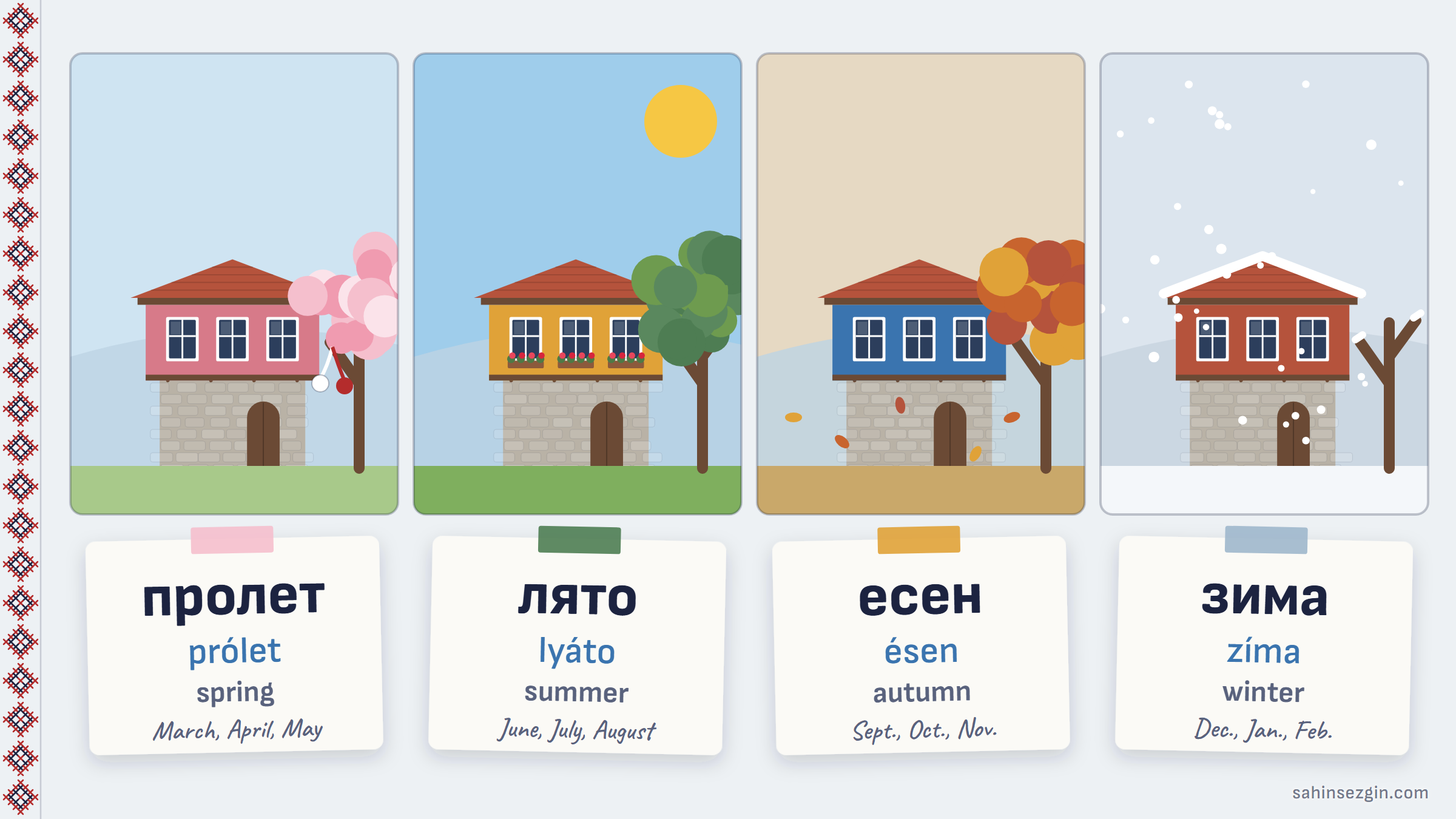
The four seasons in Bulgarian are пролет (prólet, spring), лято (lyáto, summer), есен (ésen, autumn) and зима (zíma, winter). To say “in summer”, Bulgarian uses през (prez) plus the season with “the” glued to its end.
| Bulgarian | Pronunciation | English |
|---|---|---|
| сезон | sezón | season |
| пролет | prólet | spring |
| през пролетта | pres prolettá | in spring |
| лято | lyáto | summer |
| през лятото | prez lyátoto | in summer |
| есен | ésen | autumn, fall |
| през есента | prez esentá | in autumn |
| зима | zíma | winter |
| през зимата | prez zímata | in winter |
Here is the big surprise for English speakers. Bulgarian has a “the”, but it is an ending, not a word in front. Зима (zíma) is “winter”, зимата (zímata) is “the winter”; лято (lyáto) becomes лятото (lyátoto).
In Bulgaria spring is greeted on 1 March with Баба Марта (bába márta), “Grandma March”, from an old belief that the month is a moody old woman who swings between sun and snow. People tie a мартеница (marténitsa), a token of red and white thread, on each other’s wrists and say Честита Баба Марта! (chestíta bába márta). You wear it until you see the first stork or a tree in blossom, then hang it on a branch.
PART 3 · COMPASS AND PRACTICE
6. North, south, left and right in Bulgarian: compass and signs
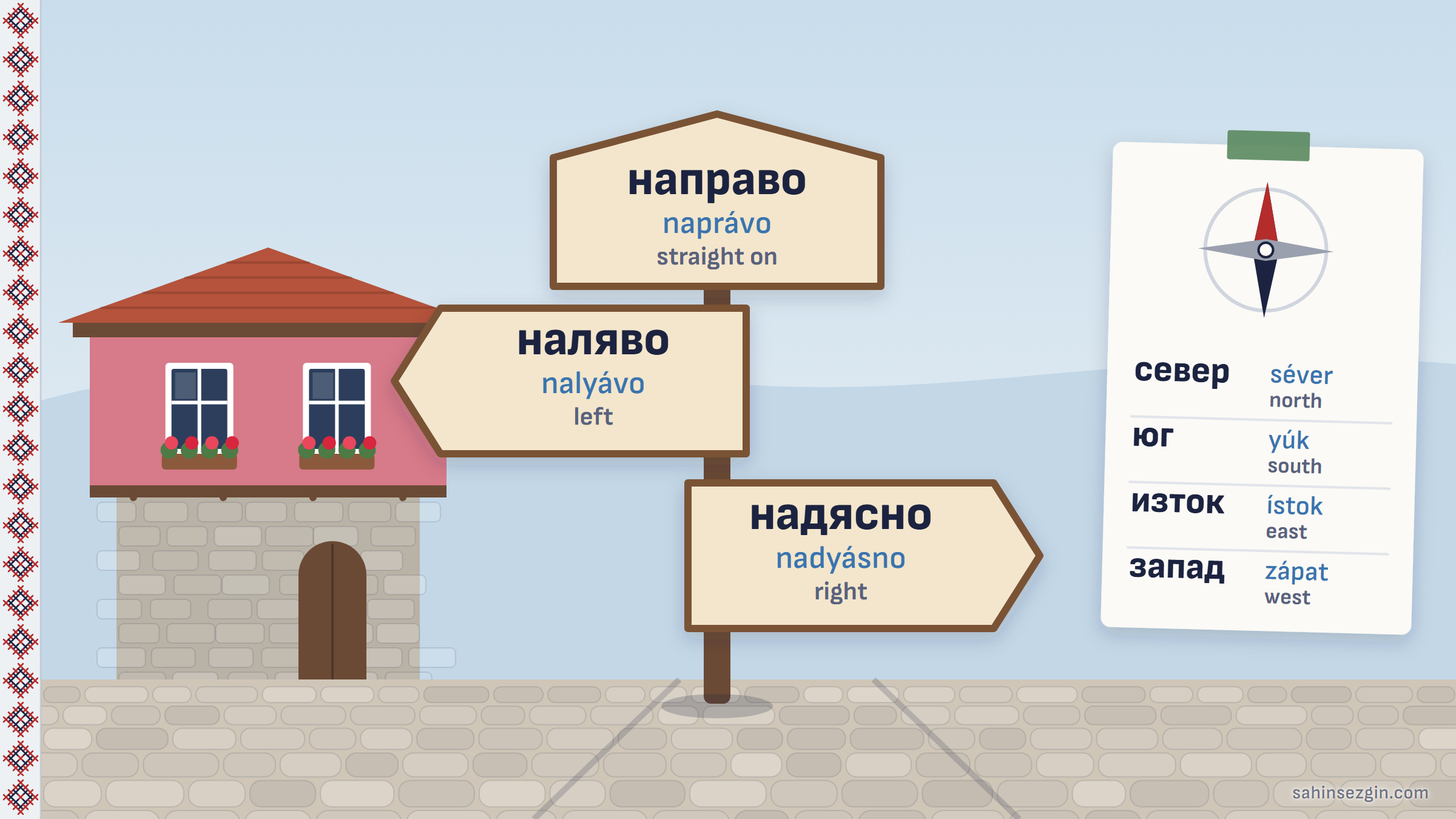
In Bulgarian, north is север (séver), south юг (yúk), east изток (ístok) and west запад (zápat). Below them come the words you will read on street signs and hear when someone points the way.
| Bulgarian | Pronunciation | English |
|---|---|---|
| север | séver | north |
| юг | yúk | south |
| изток | ístok | east |
| запад | zápat | west |
| ляво | lyávo | left |
| дясно | dyásno | right |
| наляво | nalyávo | to the left, on the left |
| надясно | nadyásno | to the right, on the right |
| направо | naprávo | straight on |
Three compass words are not read letter by letter. At the end of юг (yúk, south) and запад (zápat, west) the last consonant is devoiced: г (g) is said as k and д (d) as t. In изток (ístok, east) the з (z) becomes s before т (t). The prefix на (na) adds direction: наляво (nalyávo) means both “to the left” and “on the left”. Full street conversations come in asking for directions in Bulgarian.
7. Bulgarian calendar quiz: test yourself with 10 questions
The questions cover every part of the lesson. Pick an answer, then open the Answer line to compare it with the explanation. Eight or more right means the words have settled in; try the quiz again in a few days to keep them.
-
Which day is понеделник (ponedélnik)?
- Tuesday
- Sunday
- Monday
- Friday
Answer
Monday, the day after неделя (nedélya, Sunday).
-
How do you say “on Tuesday” in Bulgarian?
- в вторник (f ftórnik)
- във вторник (văf ftórnik)
- на вторник (na ftórnik)
Answer
Във вторник (văf ftórnik). Вторник (ftórnik) starts with в (v), so the preposition takes its long form.
-
What does вчера (fchéra) mean?
- yesterday
- tomorrow
- the day after tomorrow
Answer
Yesterday. Tomorrow is утре (útre), the day after tomorrow вдругиден (vdrúgiden).
-
How do you ask the time in Bulgarian?
- Кой ден е днес? (kóy dén e dnés)
- Коя дата е днес? (koyá dáta e dnés)
- Колко е часът? (kólko e chasắt)
Answer
Колко е часът? (kólko e chasắt). The other two ask for the day and the date.
-
Which month is юли (yúli)?
- June
- July
- August
Answer
July: the л (l) in юли (yúli) matches the l in July. June is юни (yúni).
-
How is a month name written in the middle of a Bulgarian sentence?
- with a small letter
- with a capital letter
Answer
With a small letter: на пети май (na péti máy), on the fifth of May.
-
How do you say “on the first of March”?
- през първи март (pres pắrvi márt)
- в първи март (f pắrvi márt)
- на първи март (na pắrvi márt)
Answer
На първи март (na pắrvi márt). One day takes на (na); през (prez) is for a whole month, as in през юли (prez yúli).
-
What does през лятото (prez lyátoto) mean?
- in winter
- in summer
- in spring
- in autumn
Answer
In summer. Лято (lyáto) is summer; лятото (lyátoto) is “the summer”.
-
A sign shows наляво (nalyávo). Which way do you go?
- right
- straight on
- back
- left
Answer
Left. Right is надясно (nadyásno), straight on направо (naprávo).
-
Which direction is юг (yúk)?
- north
- east
- south
- west
Answer
South. North is север (séver).
Frequently asked questions about months and days of the week in Bulgarian
What are the days of the week in Bulgarian?
The days of the week in Bulgarian, Monday to Sunday, are понеделник (ponedélnik), вторник (ftórnik), сряда (sryáda), четвъртък (chetvắrtăk), петък (pétăk), събота (sắbota) and неделя (nedélya).
How do you say month in Bulgarian?
A month is месец (mésets): този месец (tózi mésets) is “this month” and през юли (prez yúli) is “in July”.
Do you capitalize days and months in Bulgarian?
No. They take a small letter unless they open a sentence: понеделник (ponedélnik), юли (yúli).
What is the first day of the week in Bulgaria?
Monday. Bulgarian calendars start with понеделник (ponedélnik) and end with неделя (nedélya, Sunday).
Audio: Lingua Libre (Wikimedia Commons), speaker Kiril kovachev, licensed under CC BY-SA 4.0. Recordings were converted to MP3.

Write a comment