

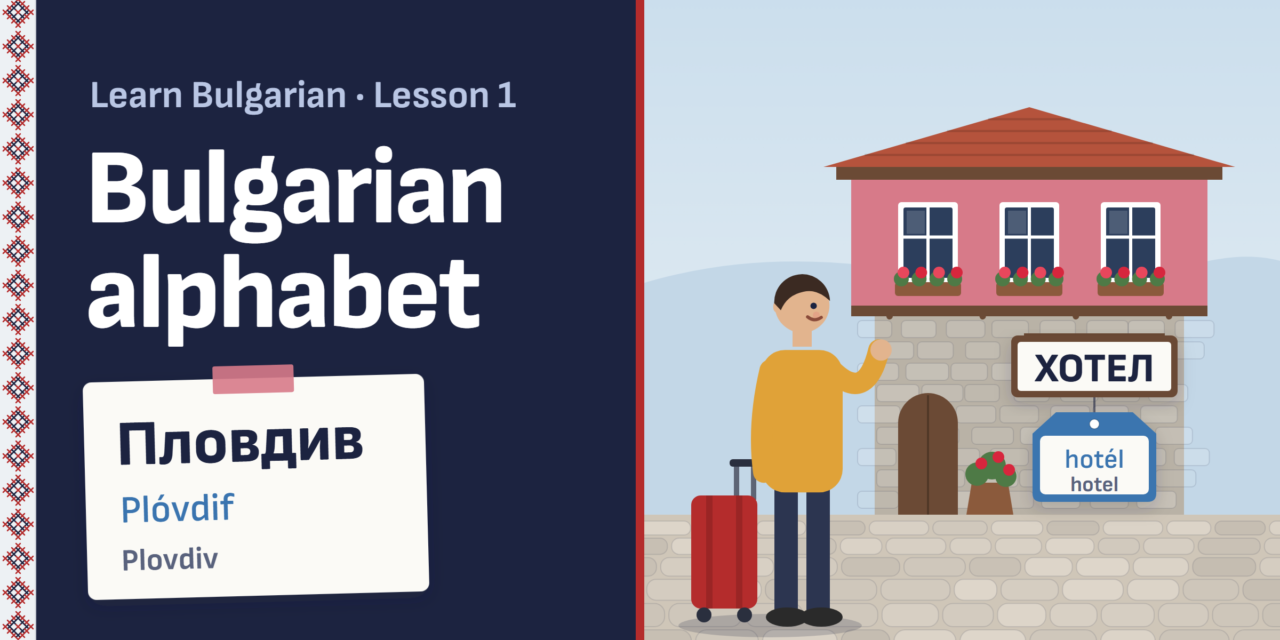
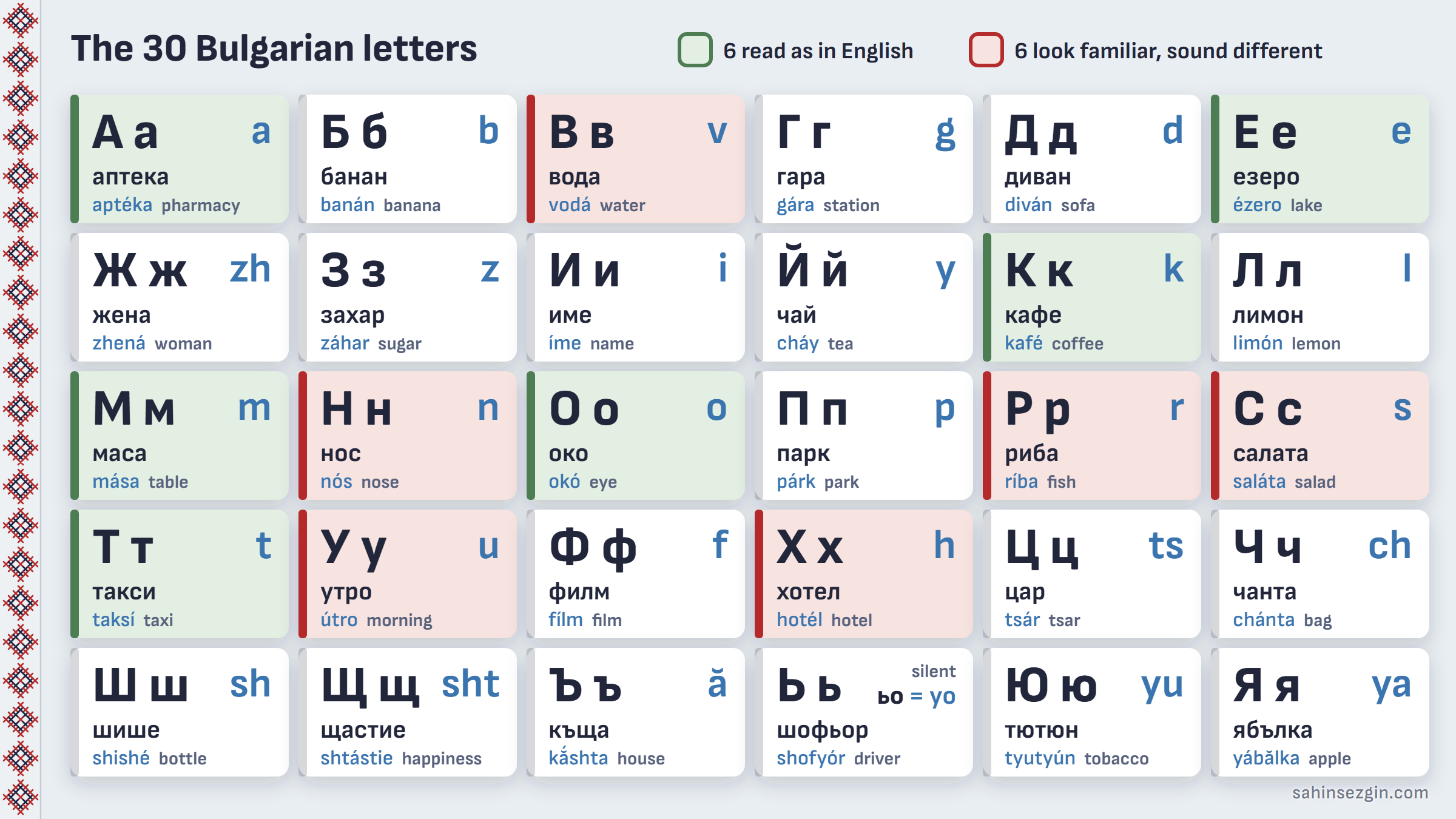
The Bulgarian alphabet is the Bulgarian form of Cyrillic, and it has 30 letters. Six of these Bulgarian letters look and sound like their English twins: А, Е, К, М, О, Т (a, e, k, m, o, t). Six more look familiar but make a different sound: В, Н, Р, С, У, Х (v, n, r, s, u, h). The other 18 have new shapes, yet most of their sounds exist in English. Each word here comes with its Bulgarian pronunciation, and the accent mark (á, é) shows the stressed syllable.
PART 1 · THE LETTERS
1. Bulgarian alphabet in English: all 30 letters and their sounds
Here is the Bulgarian alphabet in English: all 30 letters in order, each with the nearest English sound and a real word that uses it. Many examples are international, so you can guess the meaning before you finish reading, like такси (taksí, taxi). Don’t try to memorise all thirty in one sitting. Read the table aloud two or three times, then come back to it tomorrow.
| Bulgarian letter | Sound in English | Example word |
|---|---|---|
| А а | a in “father” | аптека aptéka, pharmacy |
| Б б | b | банан banán, banana |
| В в | v | вода vodá, water |
| Г г | g in “go” | гара gára, station |
| Д д | d | диван diván, sofa |
| Е е | e in “bet” | езеро ézero, lake |
| Ж ж | zh, s in “pleasure” | жена zhená, woman |
| З з | z | захар záhar, sugar |
| И и | ee in “meet” | име íme, name |
| Й й | y in “boy” | чай cháy, tea |
| К к | k | кафе kafé, coffee |
| Л л | l | лимон limón, lemon |
| М м | m | маса mása, table |
| Н н | n | нос nós, nose |
| О о | o in “or” | око okó, eye |
| П п | p | парк párk, park |
| Р р | r, lightly rolled | риба ríba, fish |
| С с | s | салата saláta, salad |
| Т т | t | такси taksí, taxi |
| У у | oo in “food” | утро útro, morning |
| Ф ф | f | филм fílm, film |
| Х х | h, close to “loch” | хотел hotél, hotel |
| Ц ц | ts in “cats” | цар tsár, tsar |
| Ч ч | ch in “chip” | чанта chánta, bag |
| Ш ш | sh in “ship” | шише shishé, bottle |
| Щ щ | sht in “ashtray” | щастие shtástie, happiness |
| Ъ ъ | ă, a in “about” | къща kắshta, house |
| Ь ь | silent, ьо = yo | шофьор shofyór, driver |
| Ю ю | yu in “you” | тютюн tyutyún, tobacco |
| Я я | ya in “yard” | ябълка yábălka, apple |
To hear each letter, play this English walkthrough beside the table and pause after every sound.
2. Bulgarian letters that look like English: friends and false friends
Twelve Bulgarian letters look like English ones, but only six sound the same, so МАМА (máma, mum) really reads “mama”. The other six are false friends. Lowercase adds a twist: р (r) looks like p, у (u) like y.
| Bulgarian | Looks like | Real sound |
|---|---|---|
| В в | B | v |
| Н н | H | n |
| Р р | P | r |
| С с | C | s |
| У у | y | u |
| Х х | X | h |
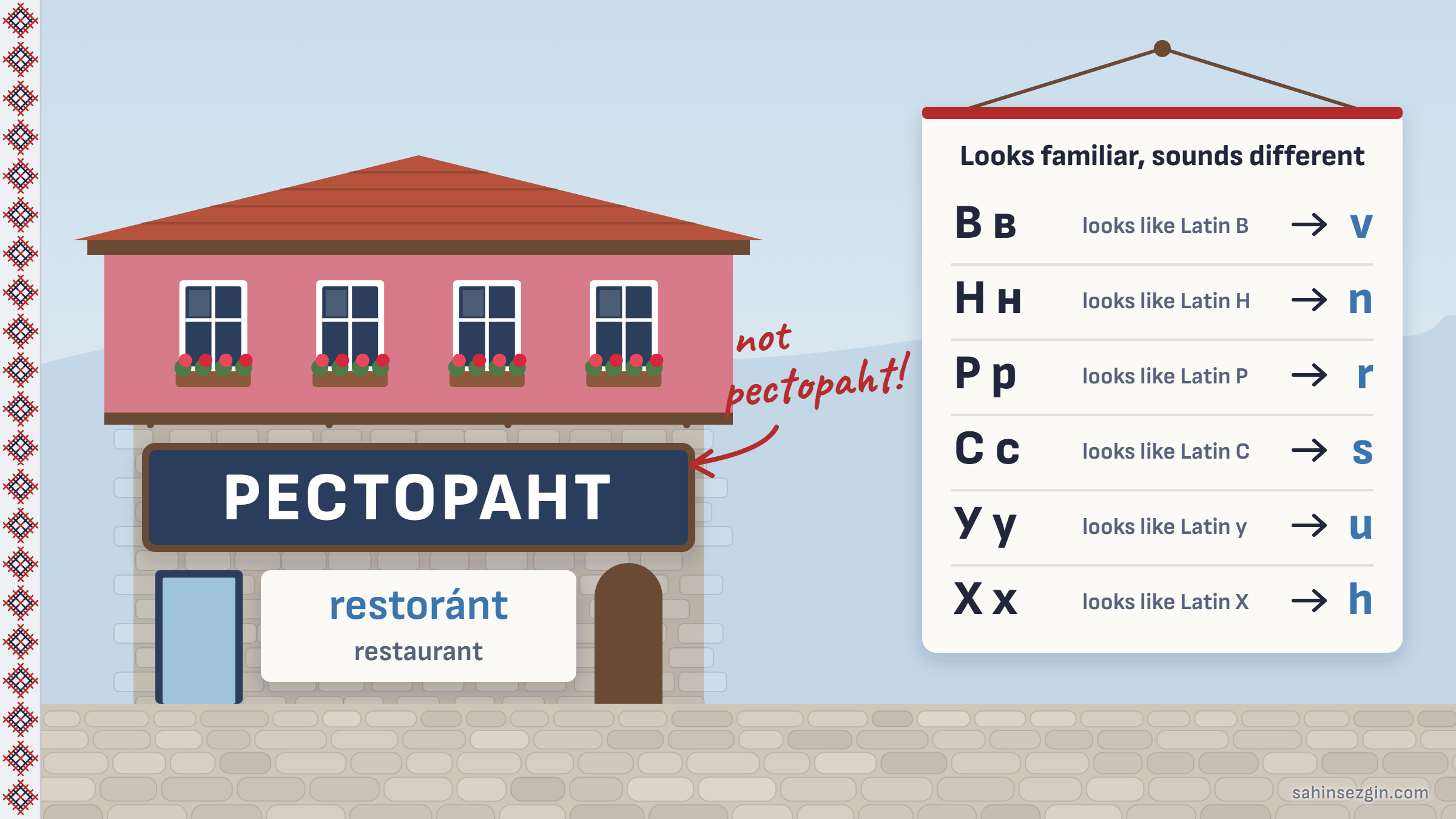
Alex, the newcomer in these lessons, first read that sign as “pectopaht”. ВАРНА (Várna) and РУСЕ (Rúse) use only friends and false friends; read both without stopping and you are past the trap. Some new shapes also fool English eyes: И (i) looks like a mirrored N, Я (ya) like a mirrored R.
The letter that brings the most questions is Ъ (ă), the relaxed vowel in “about”, heard in the middle of short words like път (pắt, road). Ь (er málăk, small er) has no sound of its own. It only appears after a consonant in the pair ьо (yo), as in шофьор (shofyór, driver). At the start of a word or after a vowel it is written йо (yo).
3. Your name in Bulgarian letters: English sounds and transliteration
To write your name in Bulgarian letters, spell it by sound, not letter by letter, as Bulgarians do with most English names. The “J” in John needs two letters, “w” becomes У (u), and “th” usually turns into Т (t).
| Bulgarian | English sound | Example |
|---|---|---|
| Дж дж | j in “John” | Джон Jón, John |
| Ч ч | ch | Чарлз Chárls, Charles |
| Ш ш | sh | Шон Shón, Sean |
| Т т | th | Смит Smít, Smith |
| У у | w | Уилям Uílyam, William |
| Кс кс | x | Алекс Áleks, Alex |
| Ъ ъ | a in “about” | Майкъл Máykăl, Michael |
| Й й | y | Йорк Yórk, York |
| Я я | ya | Яна Yána, Yana |
| К к | hard c, k | Канада Kanáda, Canada |
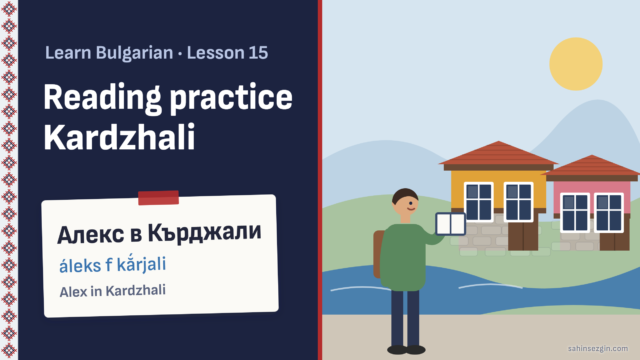
Bulgarian transliteration means writing Cyrillic in Latin letters, and the official system is the one on road signs and passports. It spells ж (zh) as zh, дж (j) as dzh, щ (sht) as sht and ъ (ă) simply as a, so Кърджали (Kắrjali) becomes Kardzhali. This course writes ă instead, so you can hear the real vowel. Word-final -ия (iya) is written -ia, which is why София (Sófiya) appears as Sofia on signs.
PART 2 · READING RULES
4. Bulgarian pronunciation rules: is it read as it is written?
Bulgarian pronunciation mostly follows the spelling, which is a relief after English “though”, “through” and “tough”. Still, three patterns make speech drift from spelling.
| Bulgarian | Pronunciation | English |
|---|---|---|
| хляб | hlyáp | bread |
| град | grát | city |
| вход | fhót | entrance |
| всичко | fsíchko | everything |
| сватба | svádba | wedding |
| града | gradắ | the city |
| чета | chetắ | I read |
| благодаря | blagodaryắ | thank you |
Final consonants lose their voice. Б, в, г, д, ж, з (b, v, g, d, zh, z) sound like p, f, k, t, sh, s at the end of a word: хляб (hlyáp, bread). Neighbours adjust: вход (fhót, entrance) starts with в (v) on paper but f in speech. Some endings sound like ă: the “the” ending of masculine nouns and one verb ending are spelled а (a) or я (ya) but said ă: града (gradắ, the city).
Fast English does something similar: “have to” comes out as “hafta”. Bulgarian does it all the time without changing the spelling. Add an ending and the b of хляб (hlyáp) comes back: хляба (hlyábă, the bread).
Stress is not written, but it changes meaning
Bulgarian stress can fall on any syllable, and spelling never shows it. You already know the idea from English “REcord” and “reCORD”. In this course the stressed vowel carries an accent mark (á). Bulgarian dictionaries use a grave accent (à) instead, so look for it when you check a word. Say each new word a little louder on the marked vowel. Lean on the wrong syllable in these pairs and you get a different word.
| Bulgarian | Pronunciation | English |
|---|---|---|
| вълна | vắlna | wool |
| вълна | vălná | wave |
| пара | pára | steam |
| пара | pará | coin |
5. Bulgarian Cyrillic alphabet vs Russian: what is different?
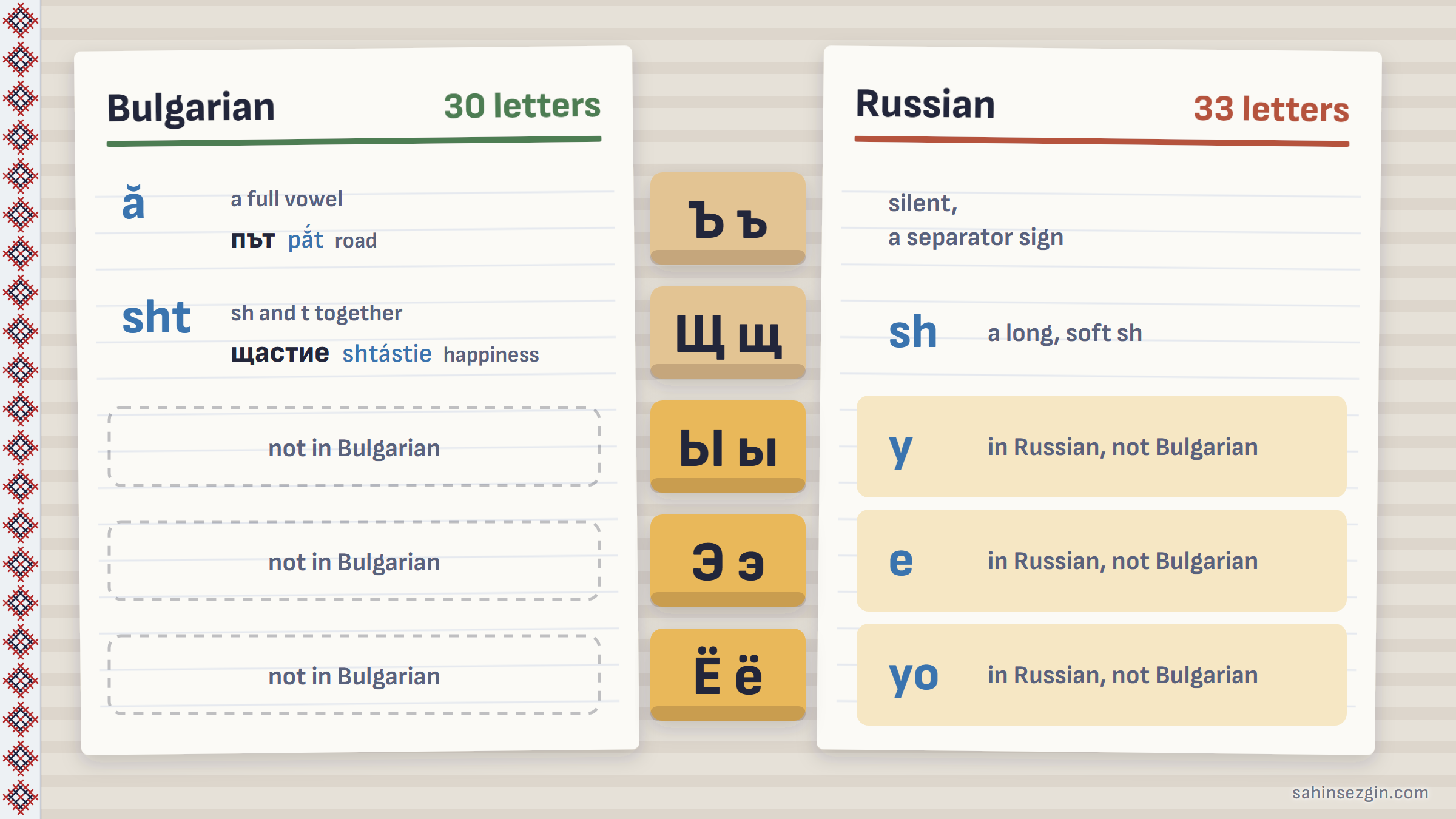
The Bulgarian Cyrillic alphabet has 30 letters and the Russian one has 33, because each language adjusted the shared script to its own sounds. Cyrillic also serves Ukrainian and Serbian, plus non-Slavic languages such as Kyrgyz. Many learners assume Bulgarian borrowed Russian spelling, but the alphabet started in Bulgaria and travelled north. A useful side effect is that the letters you learn here also let you read most Russian, Serbian and Ukrainian signs.
Cyrillic was born in Bulgaria
Cyrillic was created at the end of the 9th century in the First Bulgarian Empire by students of the brothers Cyril and Methodius. It is named after Saint Cyril, who had designed the earlier Glagolitic script. A 1945 spelling reform dropped two old letters that had lost their own sound, taking the alphabet from 32 to 30. In 2007, when Bulgaria joined the EU, Cyrillic became the EU’s third official alphabet after Latin and Greek. Bulgaria celebrates its alphabet every year on 24 May.
Sounds that differ between Bulgarian and Russian
Bulgarian and Russian letters mostly match, but these three differ most. If your app or video uses Russian pronunciation, keep them in mind. The biggest is Ъ (ă): silent in Russian, a full vowel in Bulgarian, as in път (pắt, road). Russian Ы, Э, Ё (y, e, yo) do not exist in Bulgarian at all, so a text containing them is not Bulgarian. When you are unsure about a word, check a Bulgarian dictionary rather than a Russian one.
| Bulgarian | Bulgarian sound | Russian sound |
|---|---|---|
| Ъ ъ | ă | silent separator |
| Щ щ | sht | a long, soft sh |
| Е е (word start) | e | ye |
6. Handwritten Bulgarian and italics: why т (t) looks like m
Handwritten Bulgarian uses the same letters; only the drawn shapes change. They grew out of fast handwriting: written with three downstrokes, т (t) turns into m. Italic print and many menus use these shapes too, and Bulgarian fonts often print upright д, л, т, и (d, l, t, i) in similar shapes. When a word looks unreadable, match it letter by letter against the table: an m may be t, a u may be i, an n may be p.
| Bulgarian | Handwritten, looks like | Pronunciation |
|---|---|---|
| т | Latin m | t |
| и | Latin u | i |
| п | Latin n | p |
| д | Latin g | d |
| в | Latin b | v |
| л | upside-down v | l |
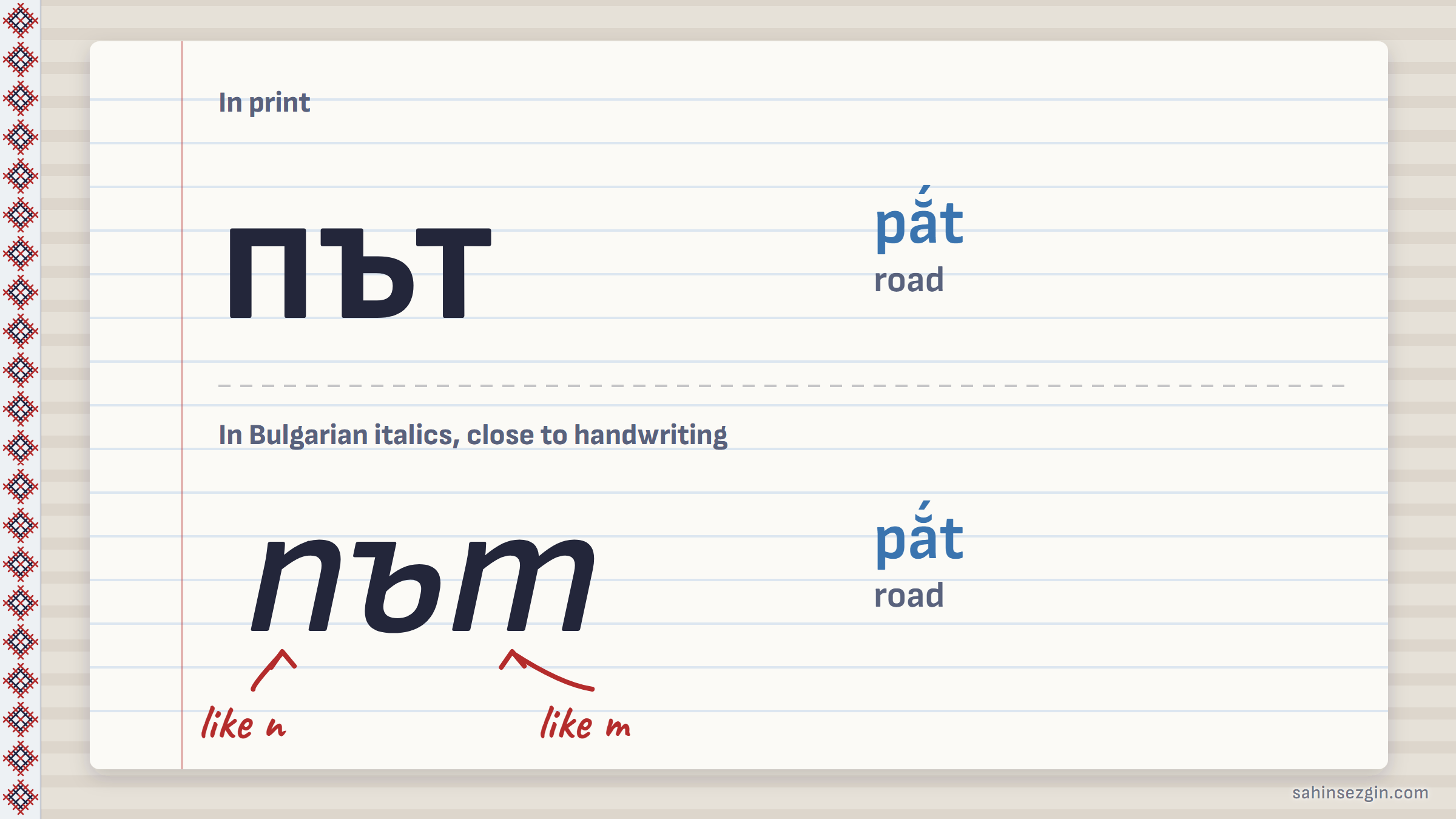
In italic път (pắt, road), the first letter looks like n and the last like m. Ш (sh) and Щ (sht) differ only by the small tail on Щ. When you write, use print letters.
PART 3 · PRACTICE
7. Practice with Bulgarian city names and signs
Spread the letters over three days, twenty minutes a day. Day one: friends and false friends. Day two: the new shapes, ending with Ц, Щ, Ъ, Ю, Я (ts, sht, ă, yu, ya). Day three: the reading rules and the words below. Cover the pronunciation column, read aloud, then check. You will see these names on timetables across the country.
| Bulgarian | Pronunciation | English |
|---|---|---|
| София | Sófiya | Sofia |
| Пловдив | Plóvdif | Plovdiv |
| Варна | Várna | Varna |
| Бургас | Burgás | Burgas |
| Кърджали | Kắrjali | Kardzhali |
| Шумен | Shúmen | Shumen |
Then try the words you will meet on doors and signs.
| Bulgarian | Pronunciation | English |
|---|---|---|
| ВХОД | fhót | entrance |
| ИЗХОД | íshot | exit |
| ТОАЛЕТНА | toalétna | toilet |
| ПОЩА | póshta | post office |
| СПИРКА | spírka | bus stop |
| БОЛНИЦА | bólnitsa | hospital |
| ОТВОРЕНО | otvóreno | open |
| ЗАТВОРЕНО | zatvóreno | closed |
Next, greetings and short phrases: hello in Bulgarian.
8. Cyrillic reading quiz: test yourself with 10 questions
These 10 questions cover signs, reading rules, the Russian differences and handwriting. Each question has exactly one correct answer. Choose yours, then open the Answer for the explanation. If most of yours are right, you are ready for Bulgarian numbers.
-
A sign above a door says ВХОД (fhót). What does it mean?
- Entrance
- Exit
- Closed
Answer
Entrance. Exit is ИЗХОД (íshot).
-
How many letters does the Bulgarian alphabet have?
- 26
- 30
- 33
Answer
30. Russian has 33, English 26.
-
A sign says БОЛНИЦА (bólnitsa). Where does it point?
- Pharmacy
- Post office
- Hospital
Answer
Hospital. A pharmacy is АПТЕКА (aptéka), a post office ПОЩА (póshta).
-
Which sound does the Cyrillic letter shaped like a Latin H make?
- h
- n
- i
Answer
n. That letter is Н (n); h is Х (h).
-
Which letter is not in the Bulgarian alphabet?
- Ъ (ă)
- Щ (sht)
- Ы (y)
- Ю (yu)
Answer
Ы (y) is in Russian, not in Bulgarian. The Bulgarian vowel ă is Ъ (ă).
-
Why does хляб (hlyáp, bread) end in a p sound when it is spelled with b?
- It is a spelling mistake
- Final consonants lose their voice
- The stress is on the last syllable
Answer
A final б (b) sounds like п (p); with an ending it returns: хляба (hlyábă).
-
What does Ъ (ă) do in Russian?
- It is read ă, as in Bulgarian
- It makes an sh sound
- It is a silent separator
Answer
Silent in Russian, a full vowel in Bulgarian.
-
When вълна (vălná) is stressed on the last syllable, what does it mean?
- Wool
- Wave
- Steam
Answer
Wave. Stressed first, vắlna means wool.
-
In handwriting, which Latin letter does a small т (t) look like?
- n
- g
- m
Answer
m. Handwritten и (i) also looks like u.
-
How does Bulgarian write the j sound in the name John?
- With two letters side by side
- With a letter shaped like a Latin J
- It cannot write this sound
Answer
With the pair дж (j): Джон (Jón).
Frequently asked questions about Bulgarian alphabet pronunciation
How do you pronounce the Bulgarian alphabet?
Bulgarian alphabet pronunciation is regular: each letter keeps one main sound, shown in the first table. In the alphabet’s own letter names, most consonants add ă: Б (b) is бъ (bắ), and Ъ (ă) is called ер голям (er golyám, big er).
How many letters are in the Bulgarian alphabet?
Thirty. Russian adds Ы, Э, Ё (y, e, yo) and reaches 33.
Is Bulgarian pronunciation hard for English speakers?
Not really. Most sounds have an English match and words are read as spelled. Practise Ъ (ă) and learn the stress with each word.
How long does it take to learn the Bulgarian alphabet?
With the three-day plan, most learners can sound out words by day three.
Audio: Lingua Libre (Wikimedia Commons), speaker Kiril kovachev, licensed under CC BY-SA 4.0; Lingua Libre (Wikimedia Commons), speaker Bogomilshopov, licensed under CC0. Recordings were converted to MP3.
Write a comment