

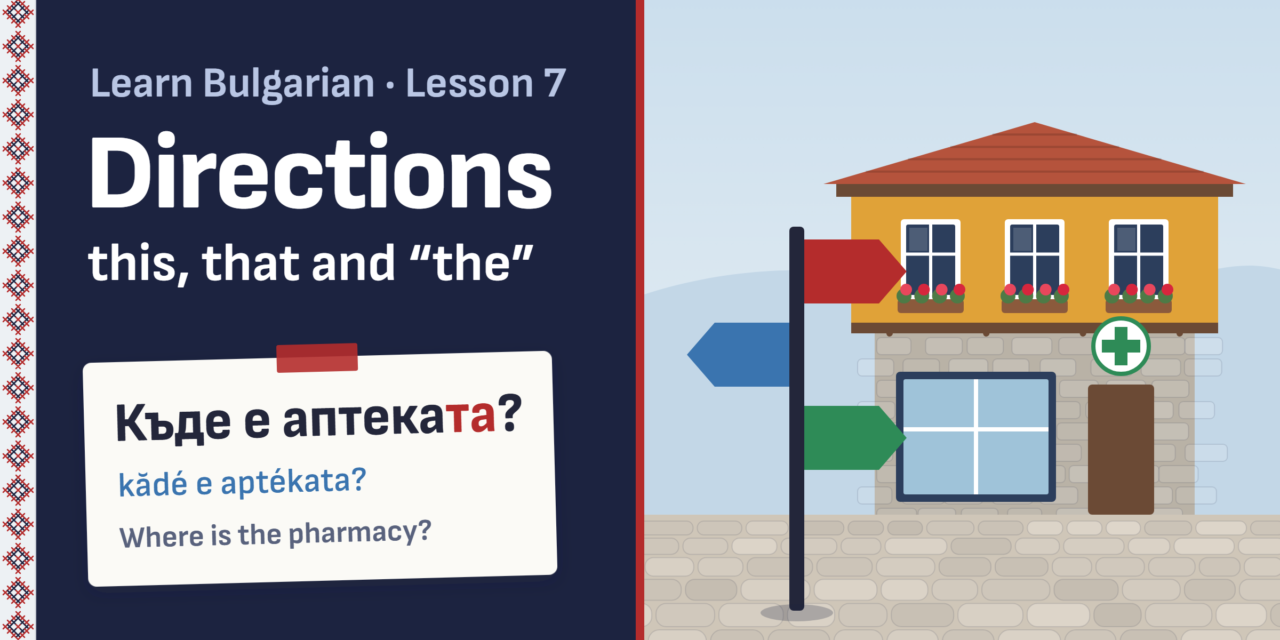
To ask “Where is the pharmacy?” in Bulgarian, say Къде е аптеката? (kădé e aptékata?): аптека (aptéka) is pharmacy, and the ending ‑та (ta) is the Bulgarian definite article, English “the”. When you are asking for directions in Bulgarian, the answer is usually наляво (nalyávo, left), надясно (nadyásno, right) or направо (naprávo, straight on). For “this pharmacy” the ending disappears: тази аптека (tázi aptéka). Read the pronunciation in brackets as it is spelled; the accent marks the stressed vowel. If Cyrillic still slows you down, review the Bulgarian alphabet first.
PART 1 · THE ENDING THAT MEANS THE
1. Places in town in Bulgarian: pharmacy, post office, bus stop and 8 more
Here are 11 places you are likely to look for in a Bulgarian town, each with its gender, because gender decides which form of “the” a noun takes. You learned to spot gender from the last letter in Bulgarian noun gender and plural: a final consonant usually means masculine, a final ‑а (a) feminine.
| Bulgarian | Pronunciation | English |
|---|---|---|
| аптека | aptéka | pharmacy (feminine) |
| поща | póshta | post office (feminine) |
| гара | gára | train station (feminine) |
| спирка | spírka | bus or tram stop (feminine) |
| улица | úlitsa | street (feminine) |
| църква | tsắrkva | church (feminine) |
| джамия | jamíya | mosque (feminine) |
| магазин | magazín | shop (masculine) |
| хотел | hotél | hotel (masculine) |
| площад | ploshtát | square (masculine) |
| пазар | pazár | market (masculine) |
Careful with магазин (magazín): it looks like “magazine” but means a shop. In площад (ploshtát, square) the final д (d) sounds like t, because Bulgarian consonants lose their voice at the end of a word.
2. Bulgarian definite article: “the” goes on the end of the word
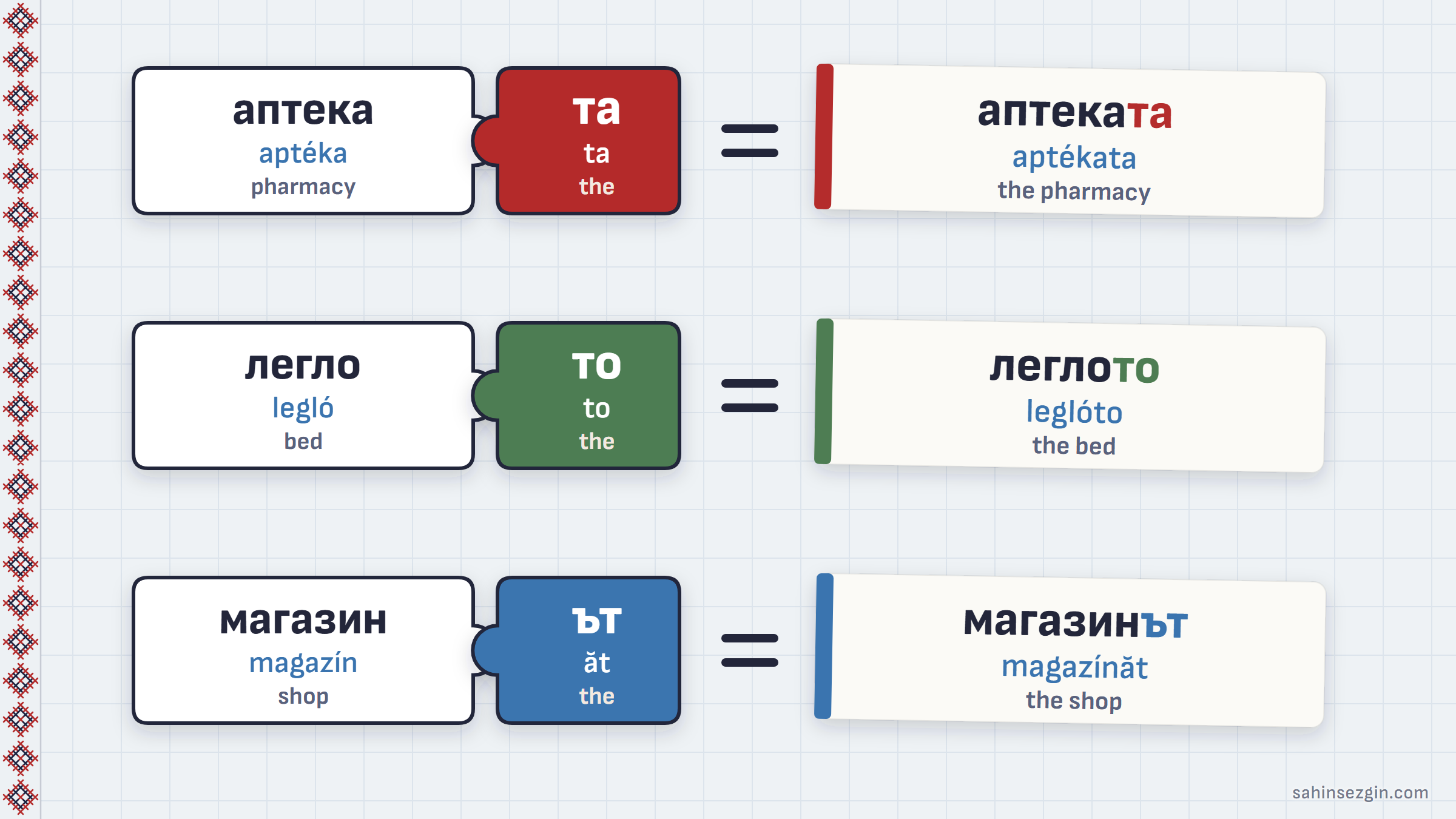
The Bulgarian definite article is glued to the end of the noun: аптеката (aptékata), хотелът (hotélăt). In English, the definite article “the” stands in front instead. Russian, its big Slavic cousin, has no article at all. The ending depends on gender: feminine ‑та (ta), neuter ‑то (to), masculine ‑ът (ăt). Bulgarian usually needs no word for “a”: аптека (aptéka) alone means “a pharmacy”. The ending is usually unstressed, so the stress mostly stays put.
English bridge: pharmacy plus “the” gives аптеката (aptékata), written as one word with no space or hyphen. Wherever English says “the”, Bulgarian usually adds the ending.
Feminine and neuter nouns: аптеката (aptékata), леглото (leglóto)
Here the ending simply attaches to the word. Say аптеката (aptékata) as “aptéka” plus a light “ta”. The neuter nouns below come from the previous lesson; they end in a vowel and add ‑то (to). Most street places are feminine, so ‑та (ta) is the ending you will hear most when asking the way. Use it for a specific place you both know: the local pharmacy, the stop on the corner.
| Bulgarian (plain → with “the”) | Pronunciation | English |
|---|---|---|
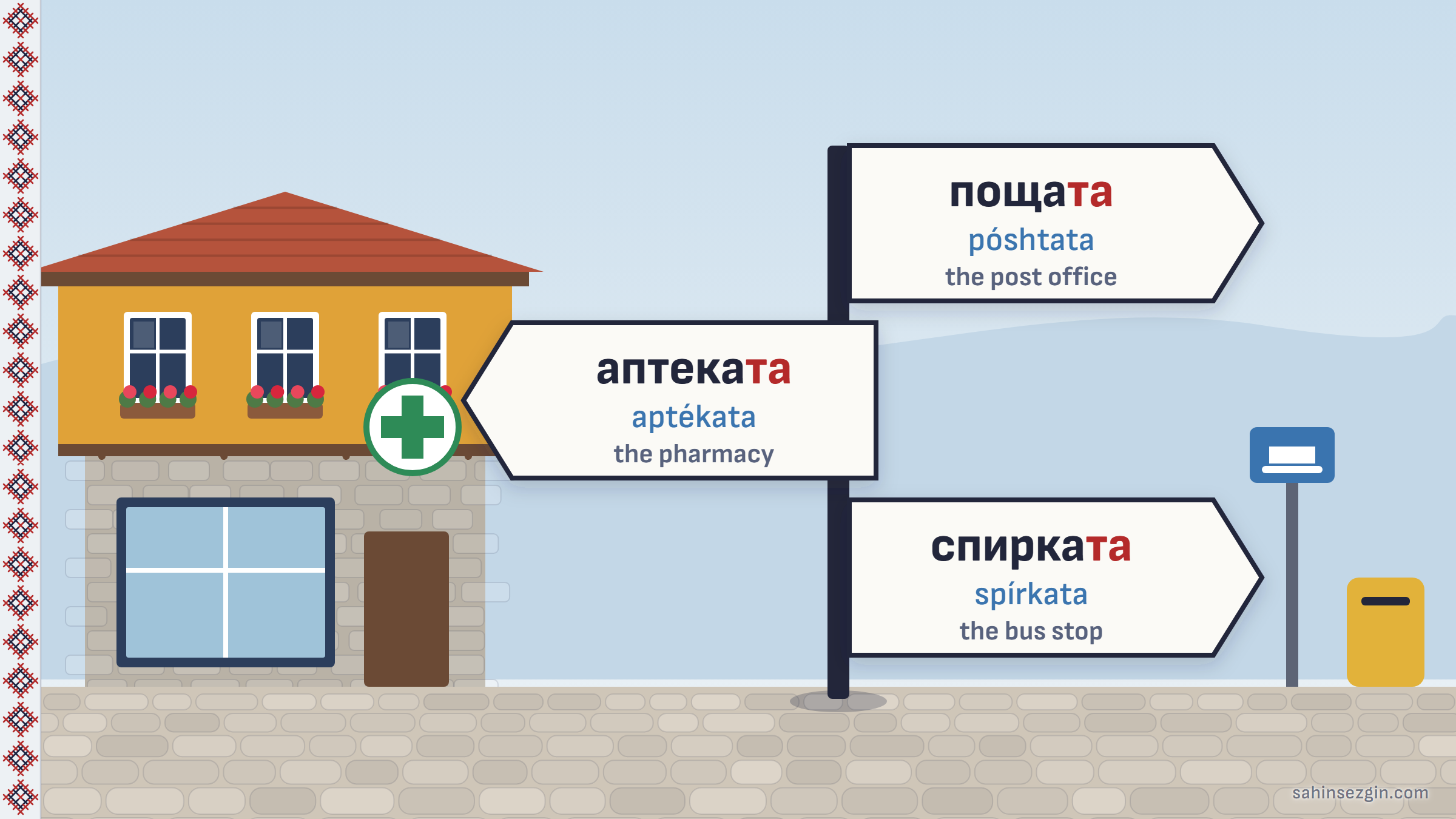
| аптека → аптеката | aptéka → aptékata | the pharmacy |
| поща → пощата | póshta → póshtata | the post office |
| спирка → спирката | spírka → spírkata | the stop |
| легло → леглото | legló → leglóto | the bed |
| кафе → кафето | kafé → kaféto | the coffee |
Masculine nouns: магазинът (magazínăt) and магазина (magazínă)
Masculine nouns have two forms. As the subject they take the long ending ‑ът (ăt): Магазинът е тук. (magazínăt e túk.) “The shop is here.” Elsewhere, for example after до (do, next to), they take the short ‑а (a), pronounced like the “a” in “sofa”: до магазина (do magazínă). Two exceptions: masculine nouns for men ending in ‑а (a) take ‑та (ta), so баща (bashtá, father) becomes бащата (bashtáta). Nouns in ‑тел (tel) or ‑й (y) take ‑ят (yat): учителят (uchítelyat, the teacher), музеят (muzéyat, the museum).
| Bulgarian (plain → subject → other) | Pronunciation | English |
|---|---|---|
| магазин → магазинът → магазина | magazín → magazínăt → magazínă | shop |
| хотел → хотелът → хотела | hotél → hotélăt → hotélă | hotel |
| пазар → пазарът → пазара | pazár → pazárăt → pazáră | market |
Plural nouns: масите (másite), леглата (legláta)
In the plural the ending ignores gender and looks at the last letter. A plural in ‑и (i) or ‑е (e) adds ‑те (te); a plural in ‑а (a) adds ‑та (ta). Build the plural first, then add “the”. Пердетата (perdétata, the curtains) looks like a stutter, but the first ‑та (ta) is the plural and the second is “the”. The stress does not move, and you only check the final letter.
| Bulgarian (plural → with “the”) | Pronunciation | English |
|---|---|---|
| маси → масите | mási → másite | the tables |
| магазини → магазините | magazíni → magazínite | the shops |
| легла → леглата | leglá → legláta | the beds |
| пердета → пердетата | perdéta → perdétata | the curtains |
PART 2 · THIS AND THAT
3. This and that in Bulgarian: този (tózi) for near, онзи (ónzi) for far
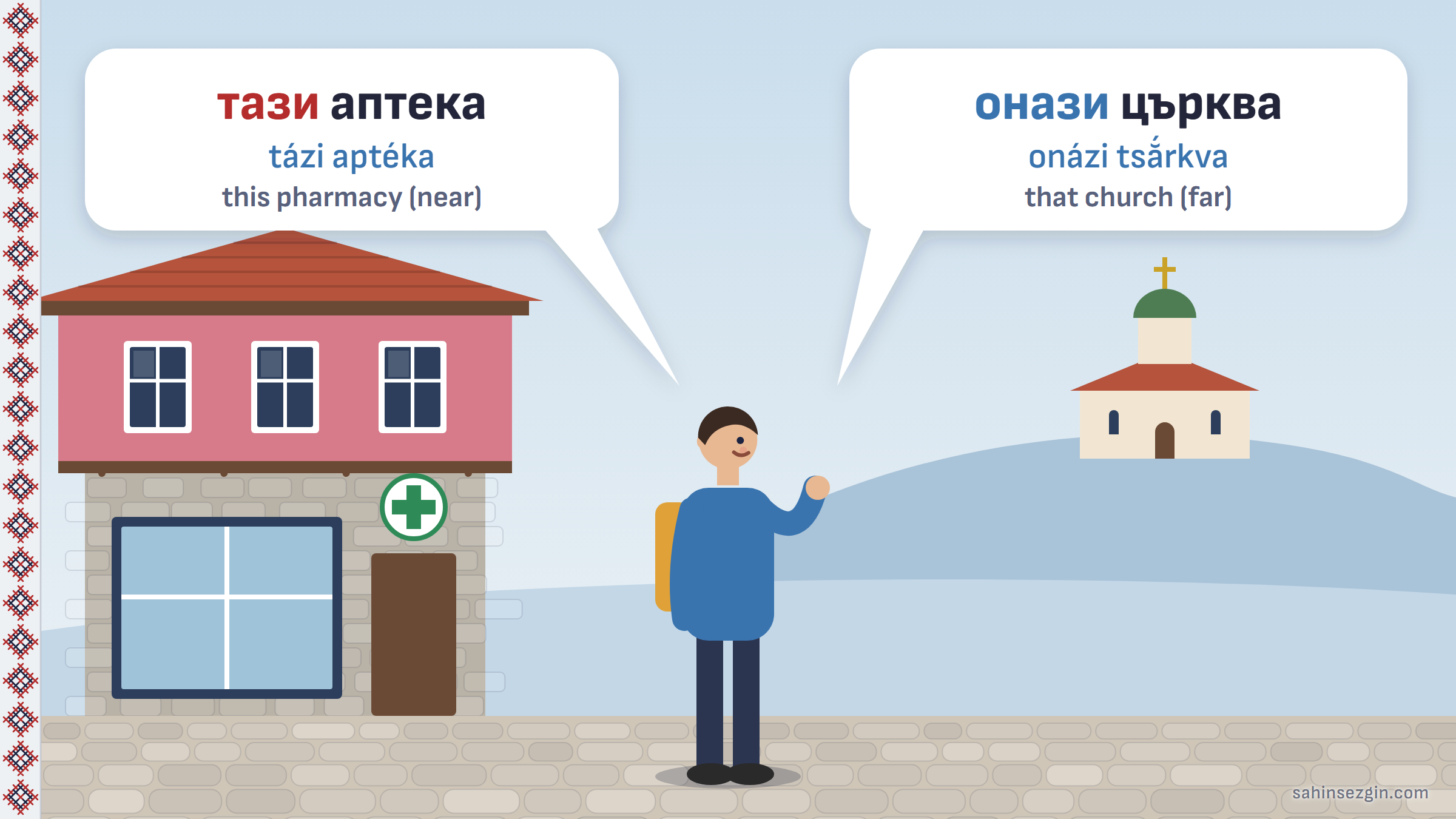
This and that in Bulgarian split just like in English: the този (tózi) set points to things near you, the онзи (ónzi) set to things far away. The difference is that Bulgarian “this” changes with gender and number, like the article. The plural forms are your “these” and “those”.
| Bulgarian | Pronunciation | English |
|---|---|---|
| този магазин | tózi magazín | this shop (masculine) |
| тази аптека | tázi aptéka | this pharmacy (feminine) |
| това кафе | tová kafé | this coffee (neuter) |
| тези улици | tézi úlitsi | these streets (plural) |
| онзи хотел | ónzi hotél | that hotel (masculine) |
| онази църква | onázi tsắrkva | that church (feminine) |
| онова такси | onová taksí | that taxi (neuter) |
| онези магазини | onézi magazíni | those shops (plural) |
Every “that” form starts with он (on). The middle vowel tells the forms apart: masculine този (tózi) has o, feminine тази (tázi) a, plural тези (tézi) e, while neuter това (tová) ends in а (a). Mind the stress: онзи (ónzi) on the first syllable, онази (onázi) and онова (onová) later.
4. “This is the post office” in Bulgarian: това (tová) and the dropped ending
After a word for “this” or “that” the noun loses its article: тази аптека (tázi aptéka) is right, тази аптеката (tázi aptékata) is wrong. But English “this” never changes, so it is tempting to say това аптека (tová aptéka). Before a noun, the form must match its gender.
| Bulgarian | Pronunciation | English |
|---|---|---|
| Тази аптека е отворена. | tázi aptéka e otvórena. | This pharmacy is open. |
| Аптеката е отворена. | aptékata e otvórena. | The pharmacy is open. |
| Какво е това? | kakvó e tová? | What is this? |
| Това е пощата. | tová e póshtata. | This is the post office. |
| Онова е гарата. | onová e gárata. | That is the train station. |
When you point and say “this is…” or “that is…”, Bulgarian uses това (tová) or онова (onová) alone, whatever the gender: Това е пощата. (tová e póshtata.) You used the same pattern in nice to meet you in Bulgarian: Това е Мила. (tová e míla.) “This is Mila.” Here the noun keeps its ending, just as in English.
PART 3 · DIRECTIONS
5. Asking for directions in Bulgarian: left, right, straight on, near and far
Asking for directions in Bulgarian starts with Извинете (izvinéte), “excuse me”, and the answer comes in a few short words: go straight, turn left, next to the post office. Direction words never change. A known place after a preposition takes the article, because both of you know which post office it is: до пощата (do póshtata).
| Bulgarian | Pronunciation | English |
|---|---|---|
| Извинете | izvinéte | Excuse me |
| къде | kădé | where |
| Как да стигна до гарата? | kák da stígna do gárata? | How do I get to the train station? |
| Можете ли да ми покажете на картата? | mózhete li da mi pokázhete na kártata? | Can you show me on the map? |
| наляво | nalyávo | to the left |
| надясно | nadyásno | to the right |
| направо | naprávo | straight on |
| близо | blízo | near, close |
| далече | daléche | far |
| до пощата | do póshtata | next to the post office |
| срещу църквата | sreshtú tsắrkvata | opposite the church |
Don’t know the way at all? Ask Как да стигна до…? (kák da stígna do…?), “How do I get to…?”; here до (do) means “to”. Наляво (nalyávo) and надясно (nadyásno) look alike; the л (l) in наляво (nalyávo) is the l of “left”. Далече ли е? (daléche li e?) means “Is it far?”; ли (li) turns a statement into a yes or no question.
6. Where is the pharmacy in Bulgarian: a dialogue in Plovdiv
In Bulgarian, “Where is the pharmacy?” is Къде е аптеката? (kădé e aptékata?), and it is the first thing Alex asks in this fictional dialogue. New in Plovdiv and with a headache, he meets his neighbour бай Петър (bay Pétăr) outside. Бай (bay) works like a friendly “uncle” for an older man.
| Bulgarian | Pronunciation | English |
|---|---|---|
| Alex: Добър ден! Извинете, къде е аптеката? | dóbăr dén! izvinéte, kădé e aptékata? | Hello! Excuse me, where is the pharmacy? |
| Bay Petar: Аптеката ли? Тя е до пощата. | aptékata li? tyá e do póshtata. | The pharmacy? It is next to the post office. |
| Alex: А къде е пощата? | a kădé e póshtata? | And where is the post office? |
| Bay Petar: Виждаш ли онази църква? | vízhdash li onázi tsắrkva? | Do you see that church? |
| Alex: Да, виждам я. | dá, vízhdam ya. | Yes, I see it. |
| Bay Petar: Пощата е срещу църквата. | póshtata e sreshtú tsắrkvata. | The post office is opposite the church. |
| Alex: Далече ли е? | daléche li e? | Is it far? |
| Bay Petar: Не, близо е. Направо, после наляво. | né, blízo e. naprávo, pósle nalyávo. | No, it is close. Straight on, then left. |
| Alex: По тази улица ли? | po tázi úlitsa li? | Along this street? |
| Bay Petar: Да, по тази улица. | dá, po tázi úlitsa. | Yes, along this street. |
| Alex: Благодаря! | blagodaryắ! | Thank you! |
| Bay Petar: Няма защо! | nyáma zashtó! | You’re welcome! |
The known places carry the article, and all three are feminine: аптеката (aptékata), пощата (póshtata), църквата (tsắrkvata). Бай Петър (bay Pétăr) calls the pharmacy тя (tyá), “she”, where English says “it”. In По тази улица ли? (po tázi úlitsa li?) the noun has no ending, because тази (tázi) stands in front of it.
7. Bulgarian definite article and this or that quiz: test yourself with 10 questions
Ten questions to review: the first six cover the article on the end of the word, the last four cover this, that and the dialogue. Pick an answer and a short explanation opens. If you miss one, reread its table.
-
You mean the local pharmacy you both know. Which form of аптека (aptéka, pharmacy) do you use?
- аптекато (aptékato)
- аптеката (aptékata)
- аптеките (aptékite)
Answer
Аптеката (aptékata): feminine nouns take ‑та (ta).
-
Which word means “the bed”?
- леглота (leglóta)
- леглоте (leglóte)
- леглото (leglóto)
Answer
Леглото (leglóto): легло (legló) is neuter and takes ‑то (to).
-
Which is correct for “Where is the pharmacy?”
- Къде е аптеката? (kădé e aptékata?)
- Къде е тази аптеката? (kădé e tázi aptékata?)
- Къде е аптекато? (kădé e aptékato?)
Answer
Къде е аптеката? (kădé e aptékata?) The second option has both тази (tázi) and the article.
-
“The shop is here”: the shop is the subject. Which sentence is correct?
- Магазинта е тук. (magazínta e túk.)
- Магазинът е тук. (magazínăt e túk.)
- Магазинто е тук. (magazínto e túk.)
Answer
Магазинът е тук. (magazínăt e túk.) A masculine subject takes ‑ът (ăt).
-
Маси (mási) means tables. Which word means “the tables”?
- масита (másita)
- масито (másito)
- масите (másite)
Answer
Масите (másite): a plural in ‑и (i) takes ‑те (te).
-
Баща (bashtá, father) is masculine. Which word means “the father”?
- бащата (bashtáta)
- бащото (bashtóto)
- бащато (bashtáto)
Answer
Бащата (bashtáta): masculine nouns for men ending in ‑а (a) take ‑та (ta).
-
You point to a church in the distance. How do you say “that church”?
- онзи църква (ónzi tsắrkva)
- онази църква (onázi tsắrkva)
- онова църква (onová tsắrkva)
Answer
Онази църква (onázi tsắrkva): църква (tsắrkva) is feminine.
-
Which is correct for “This hotel is here”?
- Тази хотел е тук. (tázi hotél e túk.)
- Този хотелът е тук. (tózi hotélăt e túk.)
- Този хотел е тук. (tózi hotél e túk.)
Answer
Този хотел е тук. (tózi hotél e túk.) Хотел (hotél) is masculine and takes no article after “this”.
-
You point at a building. How do you ask “What is this?”
- Какво е това? (kakvó e tová?)
- Какво е тази? (kakvó e tázi?)
- Какво е тези? (kakvó e tézi?)
Answer
Какво е това? (kakvó e tová?) Standing alone, “this” is това (tová).
-
Бай Петър (bay Pétăr) says Пощата е срещу църквата. (póshtata e sreshtú tsắrkvata.) What does it mean?
- The post office is next to the church.
- The church is behind the post office.
- The post office is opposite the church.
Answer
Срещу (sreshtú) means “opposite”; “next to” is до (do).
Frequently asked questions about asking for directions in Bulgarian
How do you say “where is” in Bulgarian?
Say Къде е…? (kădé e…?) plus the place with its article: Къде е гарата? (kădé e gárata?) “Where is the train station?” Begin with Извинете (izvinéte) to be polite.
Does Bulgarian have a definite article like “the”?
Yes, as an ending on the noun: ‑та (ta), ‑то (to), ‑ът (ăt), ‑ят (yat) or ‑а (a). Аптеката (aptékata) is “the pharmacy”, музеят (muzéyat) “the museum”.
How do you say left and right in Bulgarian?
Left is наляво (nalyávo), right is надясно (nadyásno), straight on is направо (naprávo).
Audio: Lingua Libre (Wikimedia Commons), speaker Kiril kovachev, licensed under CC BY-SA 4.0. Recordings were converted to MP3.
Write a comment