

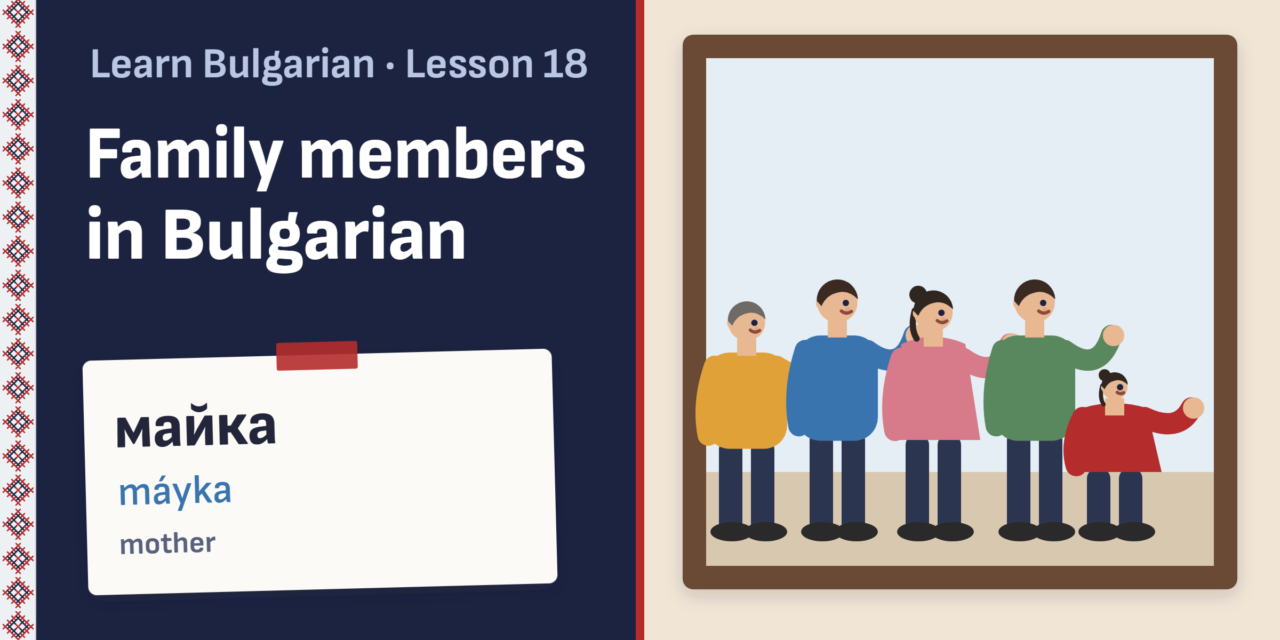
Family in Bulgarian is семейство (seméystvo, family), and the closest relatives are майка (máyka, mother), баща (bashtá, father), брат (brát, brother) and сестра (sestrá, sister). You will also learn how to say “my mother” or “his sister” with a short possessive that comes after the noun. Every Bulgarian word is followed by its pronunciation in brackets, and the stressed syllable carries an accent mark. If you cannot read Cyrillic yet, start with the Bulgarian alphabet lesson.
PART 1 · FAMILY AND RELATIVES
1. Family in Bulgarian: семейство (seméystvo) and your closest relatives
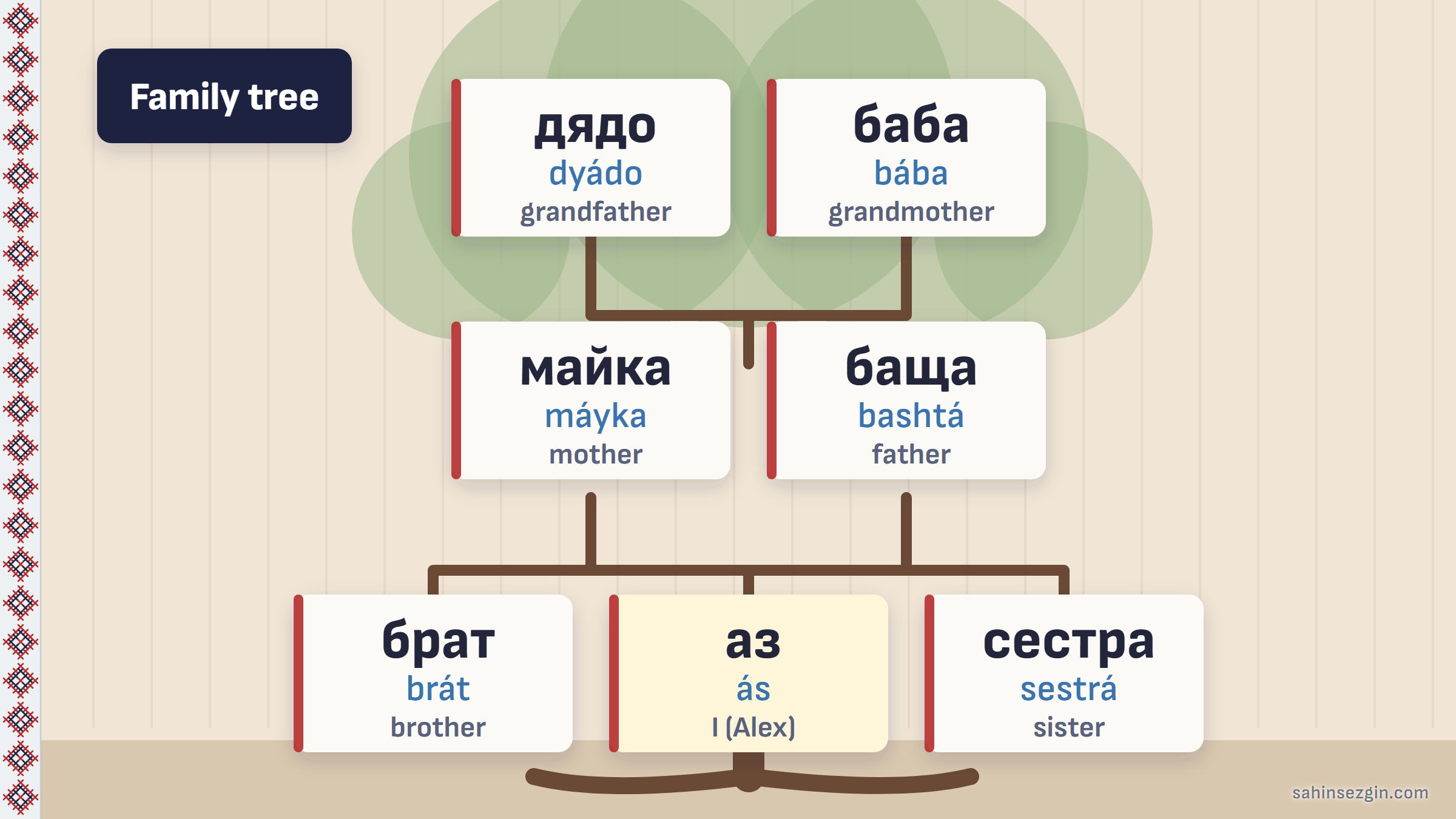
Family in Bulgarian is семейство (seméystvo, family), and a relative is роднина (rodnína); the plural is роднини (rodníni, relatives). Nine words cover the people closest to you, and the table below puts them in the order you will need them. Parents are родители (rodíteli) as a pair. Bulgarian has a neutral word and a warmer word for mom and dad, and you pick by situation. Read the table first, then the details below.
| Bulgarian | Pronunciation | English |
|---|---|---|
| майка | máyka | mother |
| мама | máma | mom (when calling out) |
| баща | bashtá | father |
| татко | tátko | dad (everyday) |
| родители | rodíteli | parents |
| брат | brát | brother |
| сестра | sestrá | sister |
| син | sín | son |
| дъщеря | dăshteryá | daughter |
Mother in Bulgarian and father in Bulgarian: майка (máyka) and баща (bashtá)
Mother in Bulgarian is майка (máyka) and father in Bulgarian is баща (bashtá). These are the neutral words for forms and stories. When you speak to them directly, or talk about them lovingly, you switch to мама (máma) and татко (tátko), much like “mom” and “dad”. One grammar surprise: баща (bashtá) ends in ‑а (a), which usually signals a feminine noun, but it is masculine because it names a man. The noun gender and plural lesson explains how endings and gender work.
Grandmother and grandfather in Bulgarian: баба (bába) and дядо (dyádo)
Grandmother in Bulgarian is баба (bába) and grandfather is дядо (dyádo). English does not tell the two sides apart, and neither does Bulgarian: both grandmothers are баба (bába) and both grandfathers are дядо (dyádo), so you rely on the sentence to show which side of the family you mean. Here are two sentences to learn by heart: Това е баба ми. (tová e bába mi.) “This is my grandmother.” Това е дядо ми. (tová e dyádo mi.) “This is my grandfather.”
Careful: баба (bába) means grandmother, not father. Your father is баща (bashtá) or татко (tátko).
2. Brother and sister in Bulgarian: брат (brát), сестра (sestrá), бате (báte) and кака (káka)
Brother in Bulgarian is брат (brát) and sister in Bulgarian is сестра (sestrá). The ending ‑а (a) on сестра (sestrá) marks it as feminine, and both words are very common in daily conversation. To show who is older, Bulgarian adds an adjective: по-голям брат (pó-golyám brát) is an older brother and по-малка сестра (pó-málka sestrá) is a younger sister. The word по (pó) works like “more”, the same way you met it in the colors and clothes lesson.
| Bulgarian | Pronunciation | English |
|---|---|---|
| брат | brát | brother |
| сестра | sestrá | sister |
| по-голям брат | pó-golyám brát | older brother |
| по-малка сестра | pó-málka sestrá | younger sister |
| бате | báte | big brother (as a title) |
| кака | káka | big sister (as a title) |
Older brother in Bulgarian: бате (báte) and по-голям брат (pó-golyám brát)
An older brother in Bulgarian is по-голям брат (pó-golyám brát), and the friendly title for him is бате (báte). You say бате (báte) when you speak to him, and you can add his name, as in бате Георги (báte geórgi), the way people say “big brother George”. When you introduce him to someone, брат ми (brát mi) is the shortest option. To stress that he is older, say по-големият ми брат (pó-golémiyat mi brát), literally “the older my brother”. The short word ми (mi) sits after the first word of the phrase. An older sister gets the matching title кака (káka).
3. Uncle and aunt in Bulgarian: вуйчо (vúycho), чичо (chícho) and леля (lélya)
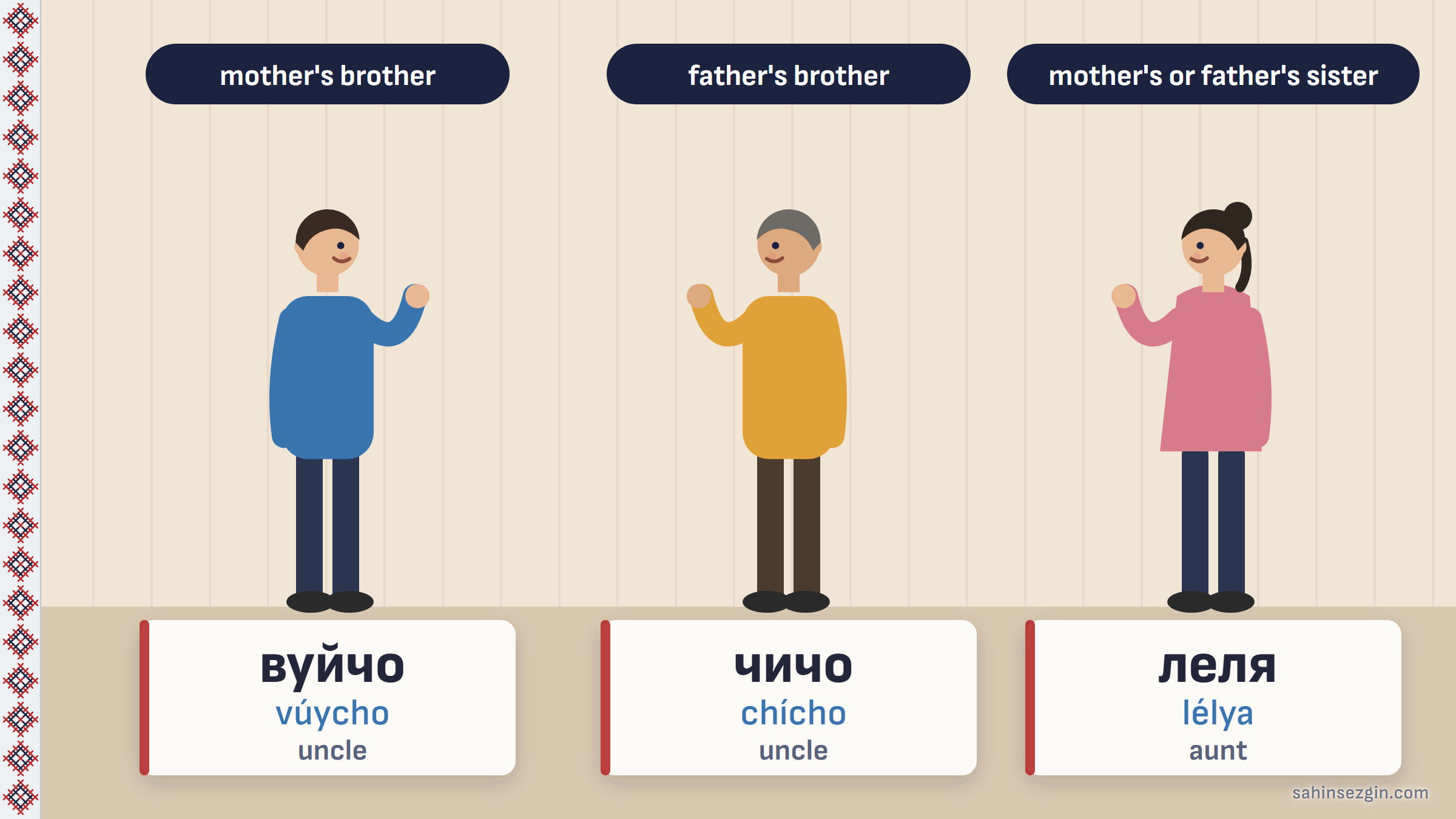
Uncle in Bulgarian depends on the side of the family: вуйчо (vúycho) is your mother’s brother and чичо (chícho) is your father’s brother. Aunt is simpler, because one word, леля (lélya), covers both. The table adds the two words for cousins, which do not change with the side of the family. Learn the first two as a pair, since the sides stay apart. You will see all of them in full sentences below.
| Bulgarian | Pronunciation | English |
|---|---|---|
| вуйчо | vúycho | uncle (mother’s brother) |
| чичо | chícho | uncle (father’s brother) |
| леля | lélya | aunt |
| братовчед | bratovchét | cousin (male) |
| братовчедка | bratovchétka | cousin (female) |
Uncle in Bulgarian: вуйчо (vúycho) and чичо (chícho)
Uncle in Bulgarian is вуйчо (vúycho) for your mother’s brother and чичо (chícho) for your father’s brother. Do not use them as synonyms, because Bulgarians keep the two sides apart. “This is my uncle” is Това е вуйчо ми. (tová e vúycho mi.) or Това е чичо ми. (tová e chícho mi.), depending on the side. You already know това (tová) from the this, that and directions lesson, where it means “this”.
Aunt in Bulgarian: леля (lélya) and тетка (tétka)
Aunt in Bulgarian is леля (lélya), whether she is your mother’s sister or your father’s sister. In some regions you will also hear тетка (tétka), but леля (lélya) is the standard word. If you need to be exact, add a clause: Тя е леля ми, сестрата на майка ми. (tyá e lélya mi, sestráta na máyka mi.) “She is my aunt, my mother’s sister.” The plural is лели (léli): две лели (dvé léli) means “two aunts”.
PART 2 · MY MOTHER, HER MOTHER
4. My mother in Bulgarian: майка ми (máyka mi) and the short possessives
“My mother” in Bulgarian is майка ми (máyka mi) and “my father” is баща ми (bashtá mi). The possessive comes after the noun, as if you said “mother-my”, and it is a short unstressed word. There are seven of them: ми (mi, my), ти (ti, your), му (mu, his), ѝ (i, her), ни (ni, our), ви (vi, your plural or polite) and им (im, their). With a plain singular relative, no extra ending goes in between: you say майка ми (máyka mi), not майката ми (máykata mi). The exceptions are a relative with an adjective in front and formal words such as съпругът ми (săprúgăt mi), which take “the” at the end.
| Bulgarian | Pronunciation | English |
|---|---|---|
| майка ми | máyka mi | my mother |
| майка ти | máyka ti | your mother |
| майка му | máyka mu | his mother |
| майка ѝ | máyka i | her mother |
| майка ни | máyka ni | our mother |
| майка ви | máyka vi | your mother (plural or polite) |
| майка им | máyka im | their mother |
Plural relatives take “the” at the end, so the possessive follows that form: братя (brátya, brothers) becomes братята ми (brátyata mi, my brothers), and сестрите ми (sestríte mi) means “my sisters”.
His mother and her mother in Bulgarian: майка му (máyka mu) and майка ѝ (máyka i)
His mother in Bulgarian is майка му (máyka mu) and her mother is майка ѝ (máyka i). This works exactly as in English: the word depends on who owns the relative, not on the relative. The small accent mark on ѝ (i) separates it from the word и (i, and), which sounds the same. Another example: сестра му (sestrá mu) is “his sister”. The short word stays right behind the noun.
5. Husband and wife in Bulgarian: съпруг (săprúk), съпруга (săprúga) and жена ми (zhená mi)
Husband in Bulgarian is съпруг (săprúk) and wife in Bulgarian is съпруга (săprúga). In everyday speech, people use the possessive instead: мъж ми (mắsh mi) means “my husband” and жена ми (zhená mi) means “my wife”. Here is the catch: on their own, мъж (mắsh) means “man” and жена (zhená) means “woman”, and only the short word ми (mi) turns them into a spouse. In formal or written Bulgarian you will see съпругът ми (săprúgăt mi) and съпругата ми (săprúgata mi), which end in “the”.
| Bulgarian | Pronunciation | English |
|---|---|---|
| съпруг | săprúk | husband |
| съпруга | săprúga | wife |
| мъж ми | mắsh mi | my husband |
| жена ми | zhená mi | my wife |
| съпругът ми | săprúgăt mi | my husband (formal) |
| съпругата ми | săprúgata mi | my wife (formal) |
PART 3 · DIALOGUE AND QUIZ
6. A family dialogue in Bulgarian: Alex and Mila look at a photo album
This family dialogue in Bulgarian pulls the lesson together. Alex is visiting Plovdiv, and his friend Mila shows him the family album. He asks about her siblings and the people in the photographs, then she asks about his grandfather. Watch how ми (mi) and ти (ti) sit right behind the relative.
| Bulgarian | Pronunciation | English |
|---|---|---|
| Mila: Това е семейството ми. | tová e seméystvoto mi. | This is my family. |
| Alex: Имаш ли брат? | ímash li brát? | Do you have a brother? |
| Mila: Да, имам по-голям брат. Казва се Борис. | da, ímam pó-golyám brát. kázva se borís. | Yes, I have an older brother. His name is Boris. |
| Alex: А сестра? | a sestrá? | And a sister? |
| Mila: Нямам сестра, но имам две лели. | nyámam sestrá, no ímam dvé léli. | I have no sister, but I have two aunts. |
| Alex: Кой е този мъж на снимката? | kóy e tózi mắsh na snímkata? | Who is this man in the photo? |
| Mila: Това е вуйчо ми Георги. Той е брат на майка ми. | tová e vúycho mi geórgi. tóy e brát na máyka mi. | This is my uncle George. He is my mother’s brother. |
| Mila: Откъде е дядо ти? | otkădé e dyádo ti? | Where is your grandfather from? |
| Alex: Дядо ми е от Шотландия, а аз съм от Лондон. | dyádo mi e ot shotlándiya, a ás săm ot lóndon. | My grandfather is from Scotland, and I am from London. |
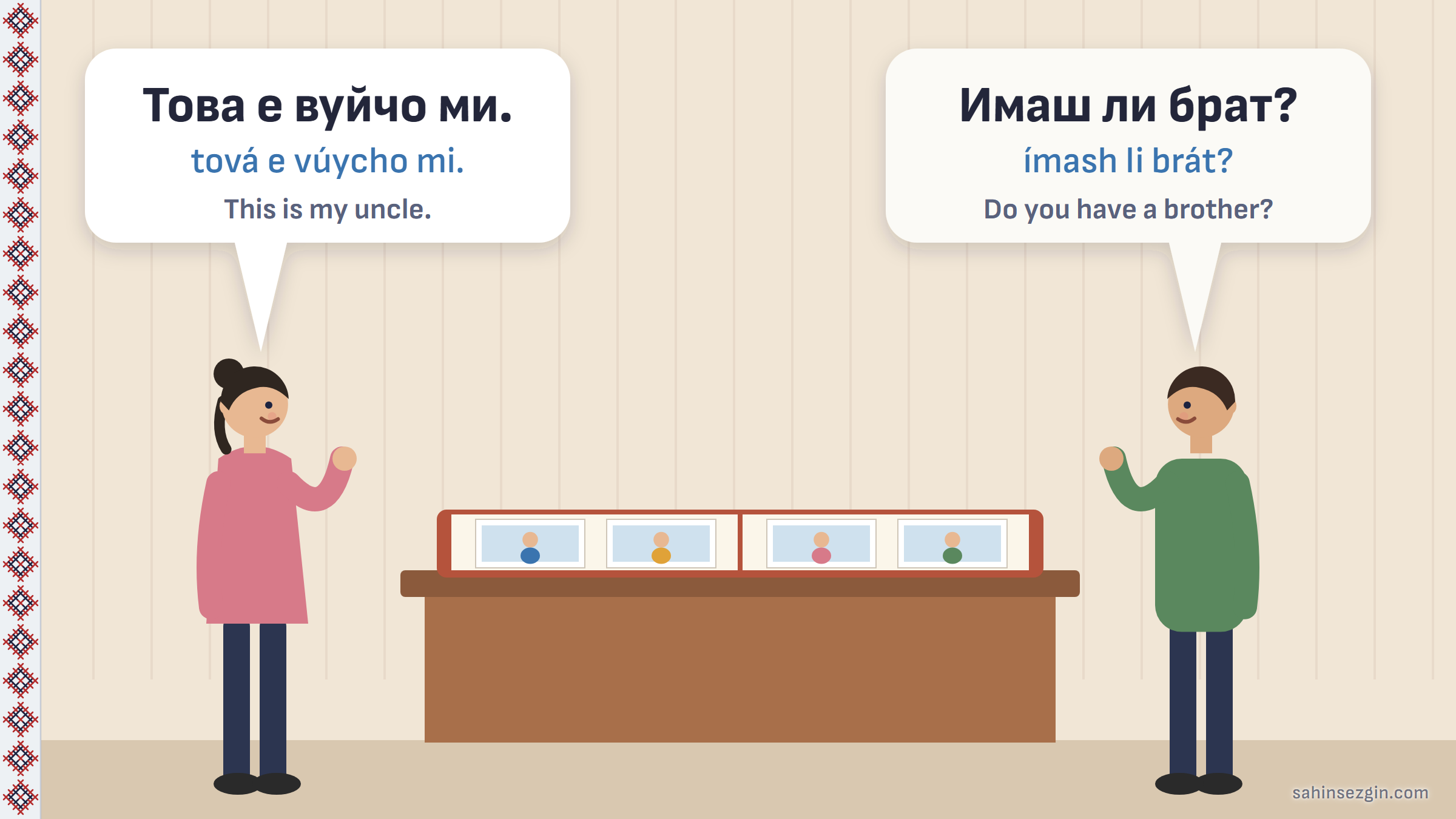
Two small words did most of the work here. имам (ímam) means “I have” and нямам (nyámam) means “I do not have”. The question marker ли (li) turns a statement into a question, so Имаш ли брат? (ímash li brát?) is “Do you have a brother?”
7. Bulgarian family members quiz: test yourself with 10 questions
Ten questions check the family words, the two uncles, the short possessives and the dialogue. Pick an answer and the correct one is marked straight away, with a short explanation underneath. If you miss one, go back to the matching section and read the table out loud.
-
Which word means “mother”?
- баща (bashtá)
- майка (máyka)
- сестра (sestrá)
Answer
Майка (máyka) is mother.
-
How do you address an older brother in Bulgarian?
- вуйчо (vúycho)
- леля (lélya)
- бате (báte)
Answer
Бате (báte) is the title for an older brother, and кака (káka) is the matching title for an older sister.
-
Which word means your mother’s brother?
- чичо (chícho)
- вуйчо (vúycho)
- дядо (dyádo)
Answer
Вуйчо (vúycho) is the mother’s brother. Чичо (chícho) is the father’s.
-
How do you say “my mother”?
- ми майка (mi máyka)
- майка аз (máyka ás)
- майка ми (máyka mi)
Answer
The short possessive follows the noun: майка ми (máyka mi), like “mother-my”.
-
What does баба (bába) mean?
- Father
- Grandmother
- Aunt
Answer
Баба (bába) is grandmother, not father. Father is баща (bashtá) or татко (tátko).
-
Which single word means aunt, on either side of the family?
- леля (lélya)
- вуйчо (vúycho)
- брат (brát)
Answer
Леля (lélya) covers both sides of the family.
-
You talk about Mila and want to say “her sister”. Which is correct?
- сестра му (sestrá mu)
- сестра ни (sestrá ni)
- сестра ѝ (sestrá i)
Answer
For a female owner use ѝ (i). The word му (mu) is for “his” and ни (ni) means “our”.
-
What does Имаш ли сестра? (ímash li sestrá?) ask?
- Where is your sister?
- Do you have a sister?
- What is your sister’s name?
Answer
Имаш (ímash) is “you have” and ли (li) marks a question: “Do you have a sister?”
-
Which phrase means “my husband” in everyday speech?
- жена ми (zhená mi)
- мъж ми (mắsh mi)
- майка ми (máyka mi)
Answer
Мъж ми (mắsh mi) is “my husband”; жена ми (zhená mi) is “my wife”.
-
Mila says “Нямам сестра, но имам две лели.” (nyámam sestrá, no ímam dvé léli.) What does she mean?
- I have a sister but no aunts.
- I have no sister, but I have two aunts.
- I have two sisters.
Answer
Нямам (nyámam) is “I do not have”, имам (ímam) is “I have” and две лели (dvé léli) is “two aunts”.
Frequently asked questions about family members in Bulgarian
How do you say father in Bulgarian?
Father in Bulgarian is баща (bashtá). When you call to him, you say татко (tátko), “dad”.
How do you say brother in Bulgarian?
Brother in Bulgarian is брат (brát) and sister is сестра (sestrá).
How do you say grandmother in Bulgarian?
Grandmother in Bulgarian is баба (bába) and grandfather is дядо (dyádo).
How do you say “my mother” in Bulgarian?
“My mother” is майка ми (máyka mi), and “my father” is баща ми (bashtá mi). The short word ми (mi) follows the noun, or its adjective if there is one.
Audio: Lingua Libre (Wikimedia Commons), speaker Kiril kovachev, licensed under CC BY-SA 4.0. Recordings were converted to MP3.
Write a comment