


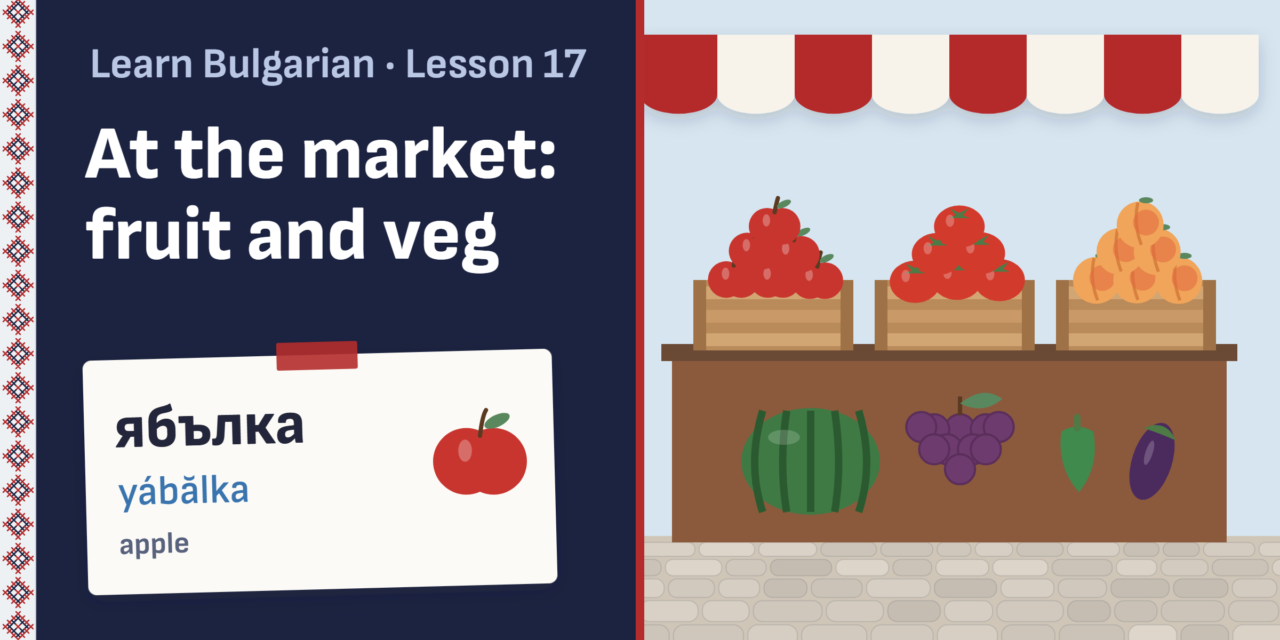
A Bulgarian market is a пазар (pazár): an open-air market where you buy fruit and vegetables by the kilo straight from the stall. Most towns have one, and in Sofia the best known is Женски пазар (zhénski pazár), the “Women’s Market”. In this Bulgarian market lesson you will learn ten fruits, ten vegetables, how to ask for a kilo and how to bargain politely. You will also meet a counting rule English does not have: “two tomatoes” adds a special ending. Pronunciation follows each Bulgarian word in brackets, stress marked. If Cyrillic is still new to you, start with the Bulgarian alphabet lesson.
PART 1 · FRUITS AND VEGETABLES
1. Fruits in Bulgarian: плодове (plodové) and the 10 you see at every stall
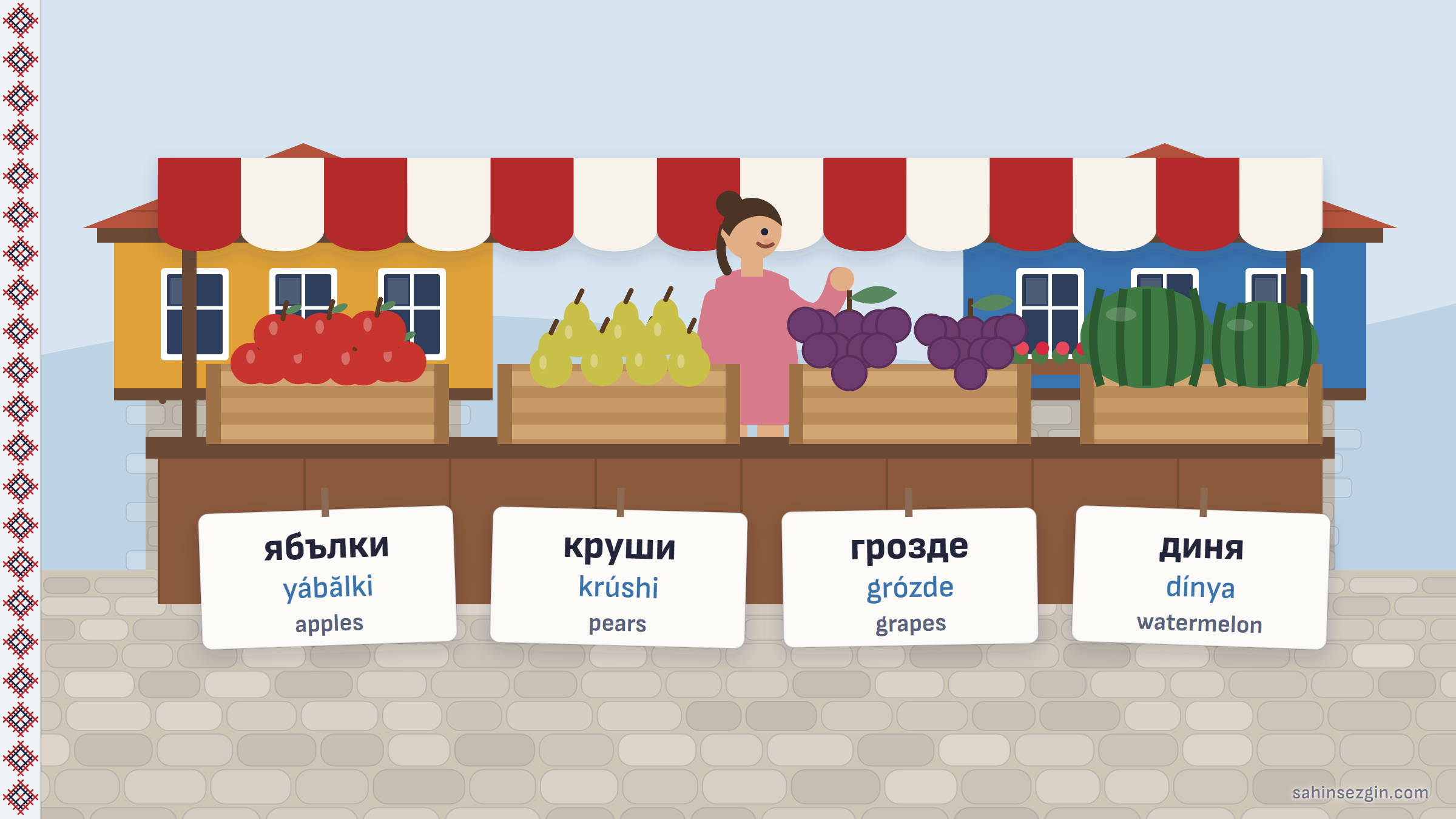
Fruits in Bulgarian are плодове (plodové); one fruit is плод (plót). The final д (d) sounds like “t” at the end of a word, so you hear “plot”. The table lists the ten fruits you meet most at a Bulgarian market. Watch the letters that look English but are not: in диня (dínya) the letter Н (n) is an “n”, and in праскова (práskova) the letter Р (r) is an “r” and С (s) an “s”. Диня is watermelon, not melon; melon is пъпеш (pắpesh).
| Bulgarian | Pronunciation | English |
|---|---|---|
| ябълка | yábălka | apple |
| круша | krúsha | pear |
| портокал | portokál | orange |
| банан | banán | banana |
| грозде | grózde | grapes |
| ягода | yágoda | strawberry |
| череша | cherésha | cherry |
| праскова | práskova | peach |
| диня | dínya | watermelon |
| кайсия | kaysíya | apricot |
Apple in Bulgarian: ябълка (yábălka) and fruit plurals
Apple in Bulgarian is ябълка (yábălka), and apples are ябълки (yábălki). At the market you almost always ask for fruit in the plural, so the plural is the form to learn. The rule comes from the noun gender and plural lesson: a feminine fruit ending in ‑а (a) swaps it for ‑и (i), so круша (krúsha) becomes круши (krúshi) and череша (cherésha) becomes череши (cheréshi). Masculine fruits ending in a consonant add ‑и (i): портокал (portokál) becomes портокали (portokáli). Грозде (grózde) is a mass noun and stays singular: кило грозде (kiló grózde), “a kilo of grapes”.
| Bulgarian | Pronunciation | English |
|---|---|---|
| ябълка → ябълки | yábălka → yábălki | apple, apples |
| круша → круши | krúsha → krúshi | pear, pears |
| портокал → портокали | portokál → portokáli | orange, oranges |
| череша → череши | cherésha → cheréshi | cherry, cherries |
2. Vegetables in Bulgarian: зеленчуци (zelenchútsi) and words borrowed from Turkish
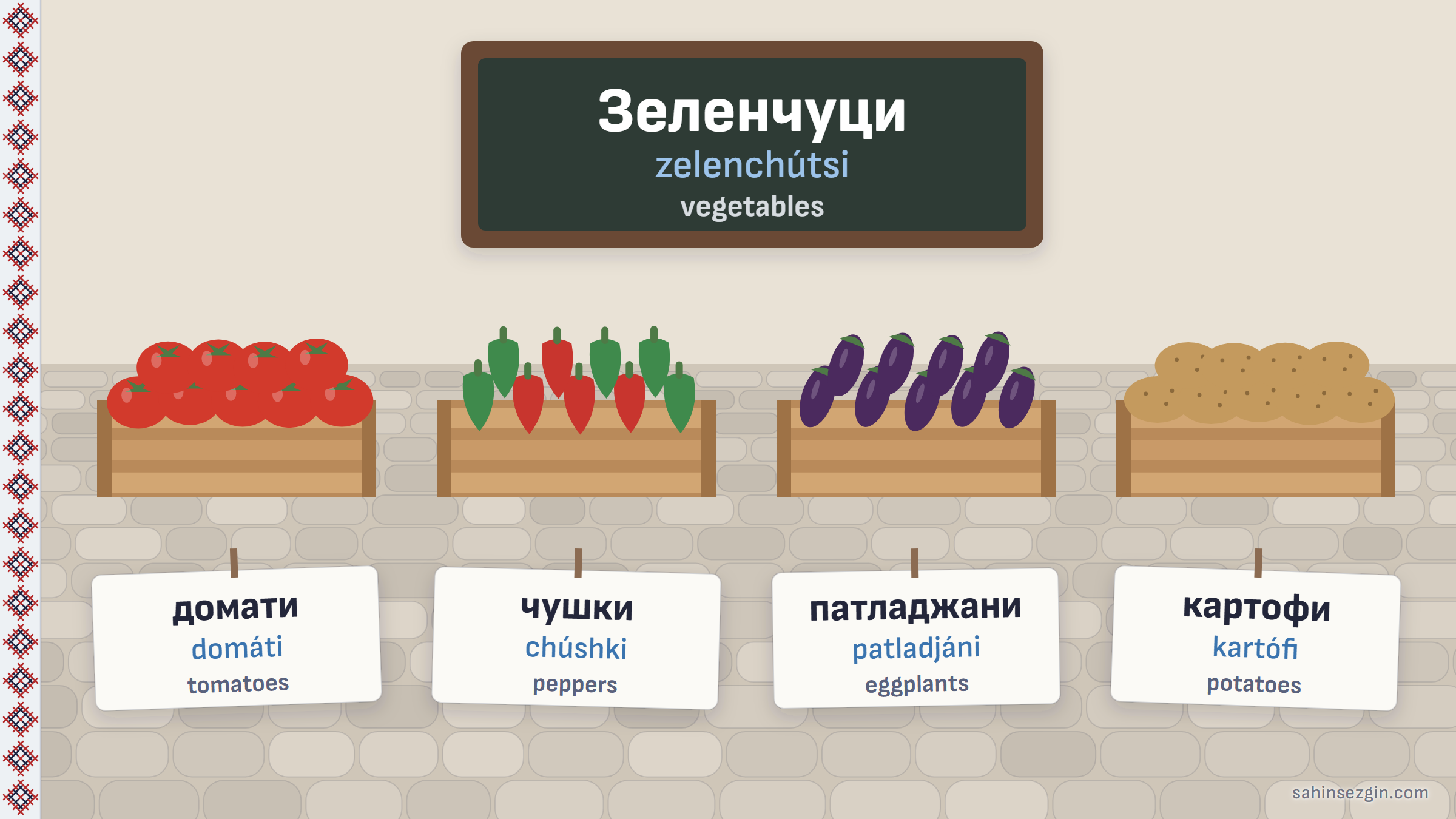
Vegetables in Bulgarian are зеленчуци (zelenchútsi); one vegetable is зеленчук (zelenchúk). The root is зелен (zelén), “green”, which you met in the colors in Bulgarian lesson. Several market words came into Bulgarian from Turkish during the Ottoman centuries: патладжан (patladján, eggplant), бамя (bámya, okra) and спанак (spanák, spinach) all sound close to their Turkish originals, and even the word пазар (pazár) is one of them. Чушка (chúshka) is a bell pepper. The table shows the ten vegetables you will see at almost every stall.
| Bulgarian | Pronunciation | English |
|---|---|---|
| домат | domát | tomato |
| краставица | krástavitsa | cucumber |
| картоф | kartóf | potato |
| лук | lúk | onion |
| чушка | chúshka | pepper |
| морков | mórkof | carrot |
| зеле | zéle | cabbage |
| патладжан | patladján | eggplant |
| бамя | bámya | okra |
| спанак | spanák | spinach |
Tomato in Bulgarian: домат (domát) and vegetable plurals
Tomato in Bulgarian is домат (domát), and tomatoes are домати (domáti). Notice the stress: English says “toMAYto”, Bulgarian says “doMAT”, on the last syllable. Other masculine vegetables work the same way: картоф (kartóf) becomes картофи (kartófi), морков (mórkof) becomes моркови (mórkovi). Feminine ones swap ‑а (a) for ‑и (i): краставица (krástavitsa) becomes краставици (krástavitsi), чушка (chúshka) becomes чушки (chúshki). Лук (lúk) and зеле (zéle) are usually treated as a mass, like грозде (grózde): кило лук (kiló lúk) is “a kilo of onions”. To point at the tomatoes you want, say тези домати (tézi domáti), “these tomatoes”.
PART 2 · AT THE MARKET
3. The Bulgarian market: пазар (pazár) and your first phrases at the stall
The Bulgarian market word is пазар (pazár), and “to do the shopping” is пазарувам (pazarúvam), built on the same root. Do not confuse it with the stock market: a Bulgarian asking “Отиваш ли на пазар?” (otívash li na pazár?) means the fruit and vegetable market. Prices are in euro, Bulgaria’s currency since January 2026. Asking a price was covered in the Bulgaria currency lesson with Колко струва? (kólko strúva?). At the market the question becomes Колко струва килото? (kólko strúva kilóto?), “How much is a kilo?” To check freshness, ask Пресни ли са? (présni li sa?), “Are they fresh?”, and for sweetness Сладки ли са? (slátki li sa?).
| Bulgarian | Pronunciation | English |
|---|---|---|
| Колко струва килото? | kólko strúva kilóto? | How much is a kilo? |
| Пресни ли са? | présni li sa? | Are they fresh? |
| Сладки ли са? | slátki li sa? | Are they sweet? |
| Дайте ми половин кило череши. | dáyte mi polovín kiló cheréshi. | Give me half a kilo of cherries. |
Kilo and grams in Bulgarian: кило (kiló) and половин кило (polovín kiló)
A kilo in Bulgarian is кило (kiló); the full word килограм (kilográm) appears on labels, but everyone says кило in conversation. There is no “of” in Bulgarian: “a kilo of apples” is едно кило ябълки (ednó kiló yábălki), word for word “one kilo apples”. Кило is a neuter noun, so “one” is едно (ednó) and the plural is кила (kilá): две кила домати (dvé kilá domáti), “two kilos of tomatoes”. Half a kilo is половин кило (polovín kiló), and a gram is грам (grám). After a number the gram gets an odd ending, двеста грама (dvésta gráma), “two hundred grams”; the reason is in section 4.
4. Counting in Bulgarian: два домата (dvá domáta) and двама (dváma)
“Two tomatoes” in Bulgarian is два домата (dvá domáta), not два домати (dvá domáti). This is the count form: a masculine noun ending in a consonant that does not name a person takes ‑а (a) instead of the plural ‑и (i) after a number. Nouns ending in a soft consonant take ‑я (ya), as in два коня (dvá kónya), “two horses”. The rule touches only masculine nouns; feminine and neuter nouns keep the normal plural: две ябълки (dvé yábălki), “two apples”. The number “two” itself changes too: два (dvá) with masculine nouns, две (dvé) with feminine and neuter ones. The same count form follows колко (kólko, how many) and няколко (nyákolko, a few): Колко лимона? (kólko limóna?), “How many lemons?”
| Bulgarian | Pronunciation | English |
|---|---|---|
| един домат | edín domát | one tomato (masculine) |
| два домата | dvá domáta | two tomatoes (count form) |
| три лимона | trí limóna | three lemons (count form) |
| пет портокала | pét portokála | five oranges (count form) |
| много домати | mnógo domáti | a lot of tomatoes (no number, normal plural) |
| две ябълки | dvé yábălki | two apples (feminine, normal plural) |
Counting people: двама (dváma) and трима (tríma)
When you count men or a mixed group, Bulgarian uses special numbers: двама (dváma) “two people”, трима (tríma) “three people”. After them the noun takes the normal plural, not the count form: двама продавачи (dváma prodaváchi), “two sellers”, трима студенти (tríma studénti), “three students”. These numbers also stand alone. At a café next to the market you can tell the waiter Ние сме двама. (níe sme dváma.), “There are two of us.” It works much like English “the two of us”: the number names a group of people. For a group of women only, the ordinary number is used instead: две жени (dvé zhéni), “two women”.
5. Bargaining in Bulgarian: Може ли по-евтино? (mózhe li pó-éftino?)
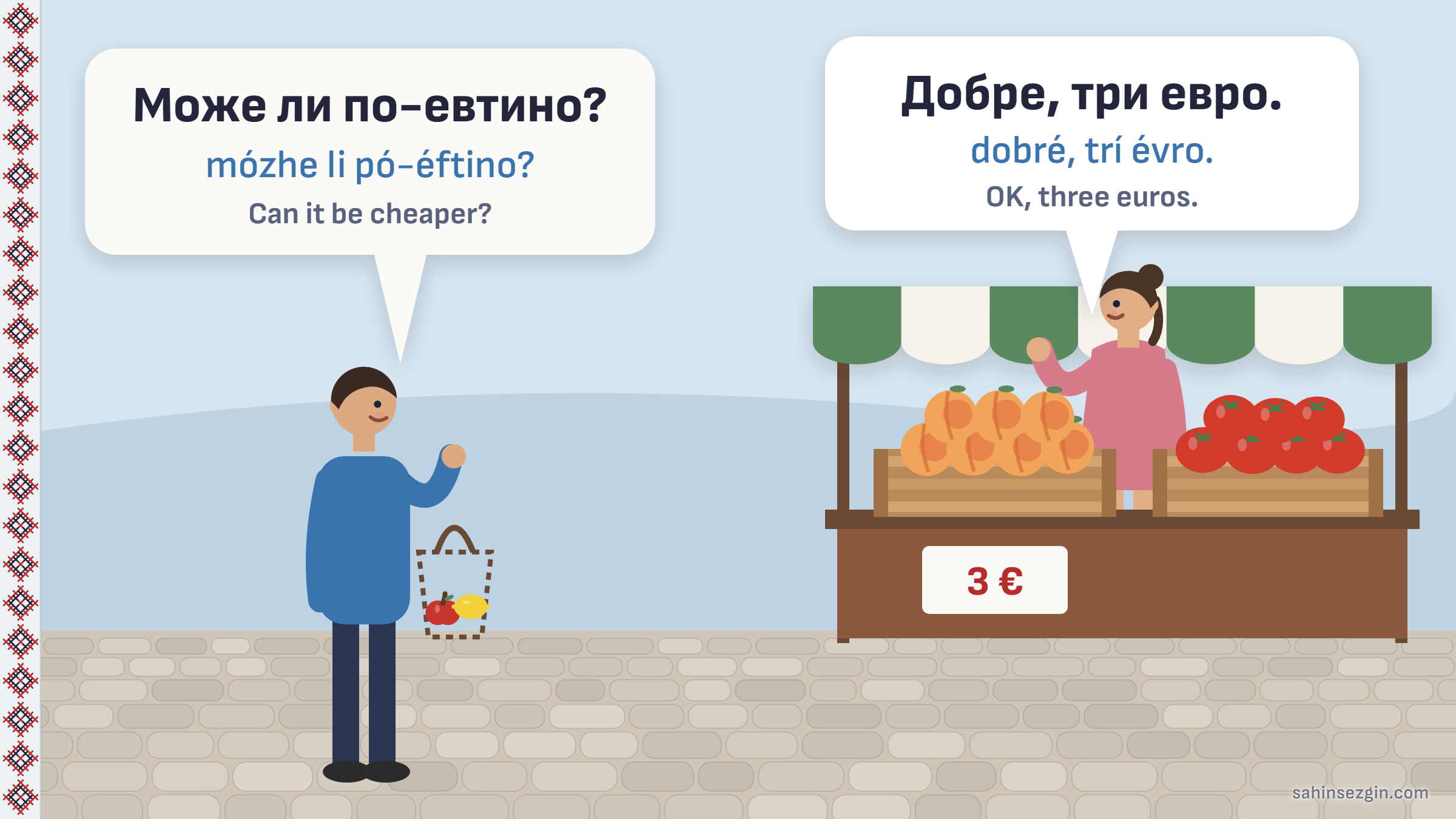
The shortest way to bargain in Bulgarian is Може ли по-евтино? (mózhe li pó-éftino?), “Can it be cheaper?” Bargaining itself is пазарлък (pazarlắk), and “to bargain” is пазаря се (pazárya se). The prefix по (pó) works like English “‑er” or “more”: евтино (éftino) is “cheap”, по-евтино (pó-éftino) is “cheaper”; you met it in по-малък (pó-málăk), “smaller”, in Lesson 16. For “Will you give me a discount?” say Ще ми направите ли отстъпка? (shte mi naprávite li otstắpka?). Отстъпка (otstắpka) is the discount a seller gives you personally; a shop sale is намаление (namalénie). Quantity is your best argument: Ако взема две кила? (akó vzéma dvé kilá?), “What if I take two kilos?”
Expensive and cheap in Bulgarian: скъп (skắp) and евтин (éftin)
Expensive in Bulgarian is скъп (skắp), and cheap is евтин (éftin). Like colors, both agree with the noun: скъпа диня (skắpa dínya), “an expensive watermelon”, евтини домати (éftini domáti), “cheap tomatoes”. Short answers use the neuter form: Скъпо е (skắpo e), “It’s expensive”, Евтино е (éftino e), “It’s cheap”. Add one word and you are bargaining: Много е скъпо (mnógo e skắpo), “It’s very expensive”. Sellers usually answer by praising their produce: Пресни са, от село! (présni sa, ot sélo!), “They’re fresh, from the village!”
Watch the end of the word: Bulgarian puts “the” at the end of nouns. Праскови (práskovi) is “peaches”, прасковите (práskovite) is “the peaches”, and килото (kilóto) is “the kilo”. That is why the market question says Колко струва килото? (kólko strúva kilóto?), literally “How much is the kilo?”
6. A bargaining dialogue in Bulgarian: Alex and Yana at the market
This bargaining dialogue puts the whole lesson together: asking the price, the count form, по-евтино (pó-éftino) and отстъпка (otstắpka). Alex is spending a semester in Plovdiv and goes to the market on Saturday morning. Yana sells fruit and vegetables behind the stall. Alex wants peaches and tomatoes, finds the price a bit high and asks whether two kilos would bring a discount. At the end Yana adds a lemon as a small gift. Read each line aloud, then cover the English column.
| Bulgarian | Pronunciation | English |
|---|---|---|
| Yana: Добро утро! Какво желаете? | dobró útro! kakvó zheláete? | Good morning! What would you like? |
| Alex: Колко струват прасковите? | kólko strúvat práskovite? | How much are the peaches? |
| Yana: Четири евро килото. Много са сладки. | chétiri évro kilóto. mnógo sa slátki. | Four euros a kilo. They’re very sweet. |
| Alex: Малко е скъпо. Може ли по-евтино? | málko e skắpo. mózhe li pó-éftino? | It’s a bit expensive. Can it be cheaper? |
| Yana: Колко кила искате? | kólko kilá ískate? | How many kilos do you want? |
| Alex: Две кила. Ще ми направите ли отстъпка? | dvé kilá. shte mi naprávite li otstắpka? | Two kilos. Will you give me a discount? |
| Yana: Добре, три евро килото. | dobré, trí évro kilóto. | OK, three euros a kilo. |
| Alex: Благодаря! И три домата, моля. | blagodaryắ! i trí domáta, mólya. | Thank you! And three tomatoes, please. |
| Yana: Заповядайте. И един лимон от мен. | zapovyádayte. i edín limón ot mén. | Here you are. And a lemon from me. |
PART 3 · QUIZ
7. Alex’s shopping bag quiz: test yourself with 10 questions
Ten questions on fruits, vegetables, asking for a kilo, the count form and bargaining phrases. Pick an answer; the right one is marked and a short explanation opens below it. If you miss a question, go back to that section, read the tables and the dialogue aloud once more, and try again.
-
Which word means “strawberry”?
- череша (cherésha)
- ягода (yágoda)
- праскова (práskova)
Answer
Ягода (yágoda) is a strawberry. Череша (cherésha) is a cherry, праскова (práskova) a peach.
-
What is диня (dínya)?
- Melon
- Apricot
- Watermelon
Answer
Диня (dínya) is a watermelon. Melon is пъпеш (pắpesh), apricot is кайсия (kaysíya).
-
Which vegetable is “eggplant”?
- патладжан (patladján)
- краставица (krástavitsa)
- чушка (chúshka)
Answer
Патладжан (patladján) is an eggplant. Краставица (krástavitsa) is a cucumber, чушка (chúshka) a pepper.
-
How do you say “two tomatoes”?
- два домати (dvá domáti)
- два домата (dvá domáta)
- две домат (dvé domát)
Answer
Домат (domát) is masculine, so after a number it takes the count form ‑а (a), and “two” is два (dvá).
-
Which is correct for “two apples”?
- два ябълка (dvá yábălka)
- два ябълки (dvá yábălki)
- две ябълки (dvé yábălki)
Answer
Ябълка (yábălka) is feminine: “two” is две (dvé) and the noun keeps the normal plural.
-
Alex wants to say “Give me half a kilo of cherries.” Which sentence does it?
- Дайте ми половин кило череши. (dáyte mi polovín kiló cheréshi.)
- Колко струва килото? (kólko strúva kilóto?)
- Пресни ли са? (présni li sa?)
Answer
Дайте ми (dáyte mi) is “give me” and половин кило (polovín kiló) “half a kilo”. The other two ask about price and freshness.
-
What does Може ли по-евтино? (mózhe li pó-éftino?) mean?
- Is it very expensive?
- Can it be cheaper?
- How much is a kilo?
Answer
По (pó) adds the meaning “more” or “‑er”: по-евтино (pó-éftino) is “cheaper”.
-
Which word is the discount you ask a seller for when you bargain?
- намаление (namalénie)
- пазар (pazár)
- отстъпка (otstắpka)
Answer
A personal discount is отстъпка (otstắpka). Намаление (namalénie) is a shop sale, пазар (pazár) the market.
-
Fill the gap: Ние сме … (níe sme …) “There are two of us.” (Alex and a friend)
- два (dvá)
- двама (dváma)
- две (dvé)
Answer
To count men or a mixed group, Bulgarian uses двама (dváma).
-
Yana says “Пресни са, от село!” (présni sa, ot sélo!). What is she telling you?
- It’s expensive but good.
- They’re fresh, from the village.
- There’s a sale today.
Answer
Пресни (présni) is “fresh” and от село (ot sélo) “from the village”: she is praising her produce.
Frequently asked questions about the Bulgarian market, fruits and vegetables
What is a Bulgarian market called?
A market is пазар (pazár) in Bulgarian. In Sofia the best-known open-air market is Женски пазар (zhénski pazár), the Women’s Market.
What are the most common fruits in Bulgarian?
The fruits you see most are ябълка (yábălka) apple, круша (krúsha) pear, портокал (portokál) orange, банан (banán) banana, грозде (grózde) grapes, ягода (yágoda) strawberry, череша (cherésha) cherry, праскова (práskova) peach, диня (dínya) watermelon and кайсия (kaysíya) apricot.
How do you say vegetables in Bulgarian?
Vegetables are зеленчуци (zelenchútsi). Tomato is домат (domát), potato картоф (kartóf), onion лук (lúk), pepper чушка (chúshka) and cucumber краставица (krástavitsa).
Can you bargain at a Bulgarian market?
At market stalls a polite Може ли по-евтино? (mózhe li pó-éftino?) is normal, especially when you buy more than a kilo. In supermarkets prices are fixed.
Audio: Lingua Libre (Wikimedia Commons), speaker Kiril kovachev, licensed under CC BY-SA 4.0. Recordings were converted to MP3.
Write a comment