


This Bulgarian reading practice is a short A1 story about Alex’s first trip to Kardzhali, a town in southern Bulgaria that Bulgarians write as Кърджали (kắrjali). You read it sentence by sentence, with the pronunciation and an English translation next to each line. It uses only patterns from earlier lessons. Every Bulgarian word has its pronunciation in brackets, with the stressed vowel marked. Still slow with Cyrillic? Keep the Bulgarian alphabet lesson open in another tab.
PART 1 · BEFORE YOU READ
1. Kardzhali in Bulgarian: Кърджали (kắrjali), the town in the story
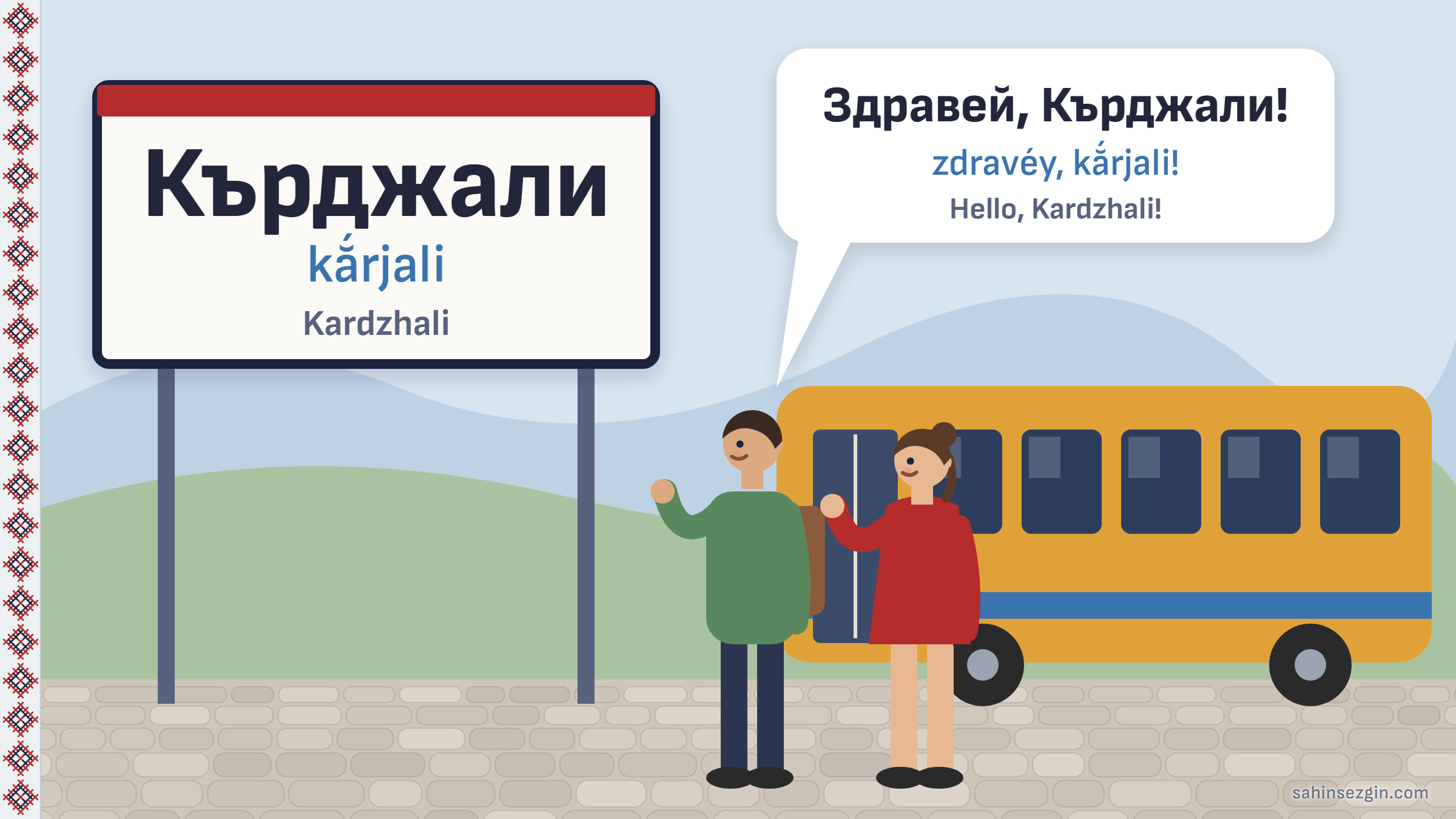
Kardzhali in Bulgarian is Кърджали (kắrjali), with the stress on the first syllable. It sits in the Rhodope Mountains in the south of the country, on the Arda river, and it is the centre of the province of the same name, close to the Greek border. Many people in the region speak Turkish as well as Bulgarian, which is why a character in our story speaks both. On English maps you will see the name written Kardzhali or Kărdzhali; both are the same town. The table lists every place name that appears in the story.
| Bulgarian | Pronunciation | English |
|---|---|---|
| Кърджали | kắrjali | Kardzhali |
| Пловдив | plóvdif | Plovdiv |
| Арда | árda | the Arda (river) |
| Родопите | rodópite | the Rhodopes (mountains) |
| България | bălgáriya | Bulgaria |
Letters that fool English readers: in Пловдив (plóvdif) the в (v) is a “v”, not a “b”, and at the end of a word it sounds like “f”. In Кърджали (kắrjali) the р (r) is an “r” and the ъ (ă) is the short “uh” sound in “but”. Read the letters as Bulgarian, not as English.
2. Bulgarian texts for beginners: the new words in this story
Bulgarian texts for beginners are easier when you know the new words before you start, so here they are. Everything else in the story comes from earlier lessons. A good routine has three steps: read the word tables aloud once, read the story without looking at the English, then check the English only for the lines you could not work out. You do not need to understand every word on the first pass. The words come in two groups.
Travel and town words
Most travel words here are verbs and adjectives. Пътувам (pătúvam) means “I travel”, and its root път (pắt) means “road” or “time”, as in “for the first time”. Роден (róden) means “born”. Adjectives change with the gender of the noun: голям град (golyám grát) is “a big town”, because град (grát) is masculine. You saw this agreement in the Bulgarian noun gender and plural lesson. The final д (d) in град (grát) sounds like “t”, and the final в (v) in красив (krasíf) sounds like “f”.
| Bulgarian | Pronunciation | English |
|---|---|---|
| роден | róden | born |
| за първи път | za pắrvi pắt | for the first time |
| пътувам | pătúvam | I travel |
| град | grát | town, city |
| река | reká | river |
| голям | golyám | big |
| красив | krasíf | beautiful |
| село | sélo | village |
| връщам се | vrắshtam se | I go back, I return |
| догодина | dogodína | next year |
Market, family and table words
The second group covers the market and the table. Morning and evening come with an ending attached: сутринта (sutrintá) is “in the morning”, вечерта (vechertá) “in the evening”. The adjective тежък (tézhăk, heavy) becomes тежка (tézhka) with a feminine noun, and the watermelon, диня (dínya), is feminine, so the story uses the second form. Delicious works the same way: вкусен (fkúsen) becomes вкусна (fkúsna) for the banitsa. The в (v) at the start sounds like “f” before к (k). Prices and shopping words were in the Bulgaria currency lesson.
| Bulgarian | Pronunciation | English |
|---|---|---|
| дядо | dyádo | grandfather |
| комшия | komshíya | neighbour |
| пазар | pazár | market |
| домати | domáti | tomatoes |
| сирене | sírene | white cheese |
| диня | dínya | watermelon |
| чанта | chánta | bag |
| тежък → тежка | tézhăk → tézhka | heavy (masculine → feminine) |
| вкусен → вкусна | fkúsen → fkúsna | delicious (masculine → feminine) |
| айрян | ayryán | ayran, a salty yogurt drink |
| сутринта | sutrintá | in the morning |
| следобед | sledóbet | in the afternoon |
| вечерта | vechertá | in the evening |
PART 2 · THE STORY
3. Bulgarian reading practice: Алекс в Кърджали (áleks f kắrjali)
This Bulgarian reading practice story has two parts, told by Alex himself. The story is fiction: Alex from London and his friend Mila from Plovdiv take the bus to Kardzhali, where his grandfather was born. In the first part Alex introduces himself and describes the town. Watch the little word в (v, in): before a voiceless sound such as к (k) or п (p) it is said “f”, so в Кърджали (f kắrjali) starts with an “f”.
| Bulgarian | Pronunciation | English |
|---|---|---|
| Здравейте! Казвам се Алекс и съм от Лондон. | zdravéyte! kázvam se áleks i săm ot lóndon. | Hello! My name is Alex and I’m from London. |
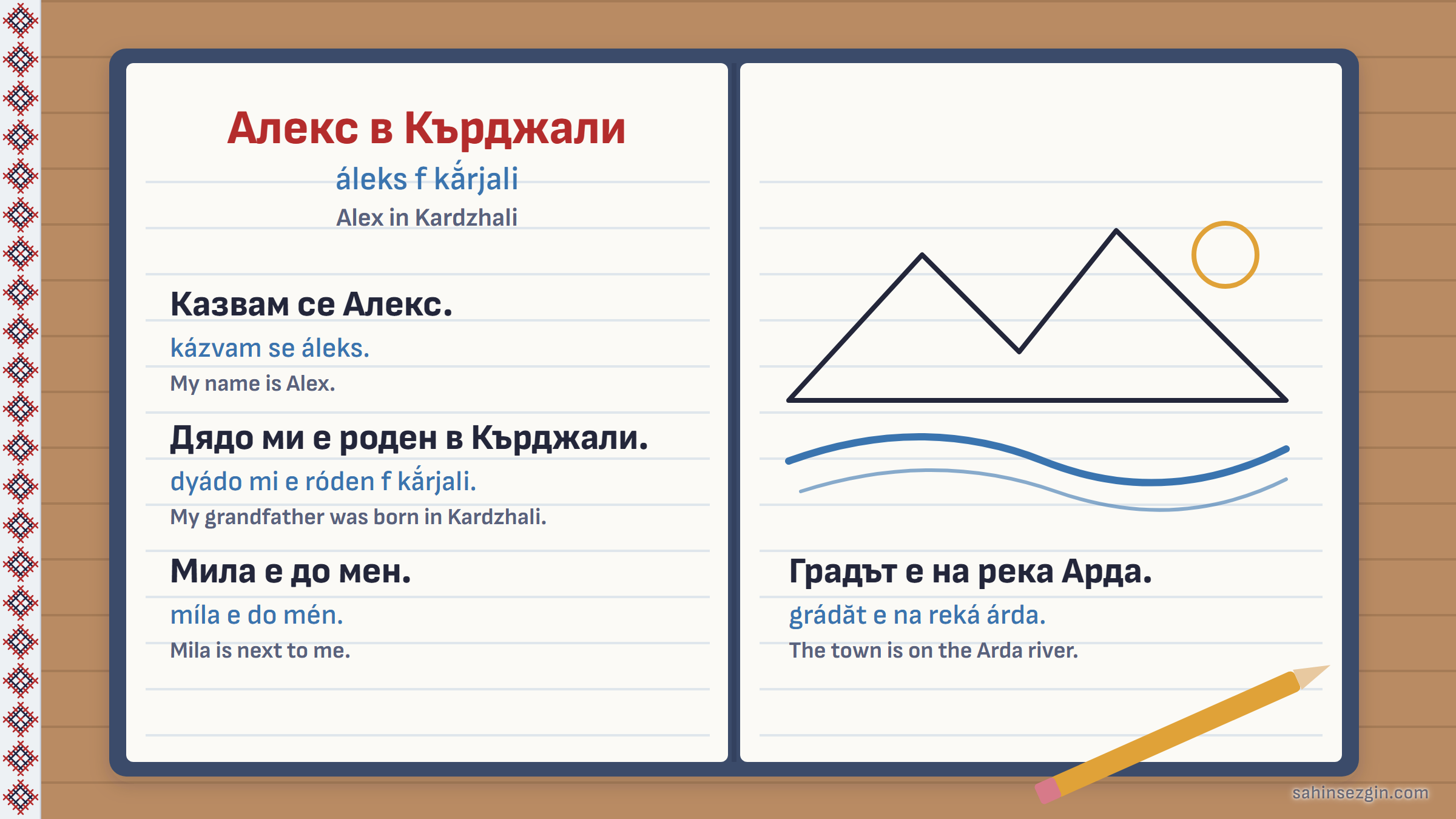
| Дядо ми е роден в Кърджали. | dyádo mi e róden f kắrjali. | My grandfather was born in Kardzhali. |
| Днес съм в Кърджали за първи път. | dnés săm f kắrjali za pắrvi pắt. | Today I’m in Kardzhali for the first time. |
| Пътувам с автобус от Пловдив. | pătúvam s aftobús ot plóvdif. | I’m travelling by bus from Plovdiv. |
| В автобуса има много хора. | v aftobúsa íma mnógo hóra. | There are a lot of people on the bus. |
| Мила е до мен. | míla e do mén. | Mila is next to me. |
| Тя е от Пловдив и говори добре английски. | tyá e ot plóvdif i govóri dobré anglíyski. | She is from Plovdiv and speaks English well. |
| Кърджали не е голям град, но е много красив. | kắrjali ne e golyám grát, no e mnógo krasíf. | Kardzhali isn’t a big town, but it’s very beautiful. |
| Градът е на река Арда. | grádăt e na reká árda. | The town is on the Arda river. |
Bulgarian short story, part two: the market and the village
In the second part of this Bulgarian short story Alex goes to the market and then to his grandfather’s old village. There are two small conversations: one with a seller, one with bay Petar. The speaker’s name is at the start of the row in Latin letters. Bay Petar was his grandfather’s neighbour; бай (bay) is a respectful word Bulgarians put before an older man’s name, a little like “Uncle”. Also look out for the endings that mean “the”: доматите (domátite) is “the tomatoes”, селото (séloto) “the village”.
| Bulgarian | Pronunciation | English |
|---|---|---|
| Сутринта отиваме на пазара. | sutrintá otívame na pazára. | In the morning we go to the market. |
| Там има домати, сирене и диня. | tám íma domáti, sírene i dínya. | There are tomatoes, white cheese and watermelon. |
| Слагам доматите в чантата. | slágam domátite f chántata. | I put the tomatoes in the bag. |
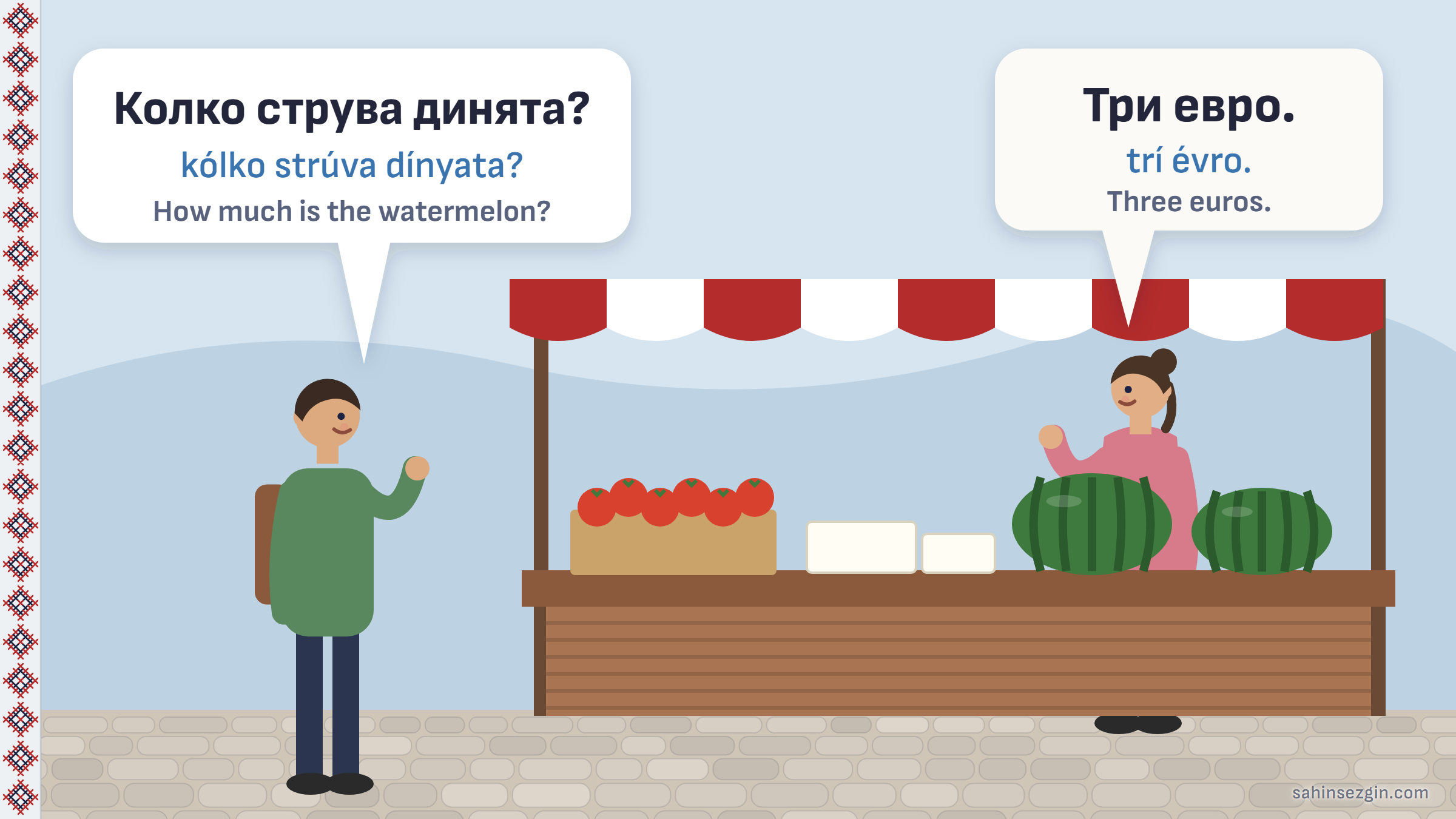
| Alex: Колко струва динята? | kólko strúva dínyata? | How much is the watermelon? |
| Seller: Три евро. | trí évro. | Three euros. |
| Искам да купя една диня. | ískam da kúpya edná dínya. | I want to buy a watermelon. |
| Но тя е много тежка и не мога да я нося сам. | no tyá e mnógo tézhka i ne móga da ya nósya sám. | But it’s very heavy and I can’t carry it on my own. |
| Следобед отиваме в селото на дядо. | sledóbet otívame f séloto na dyádo. | In the afternoon we go to Grandfather’s village. |
| Там живее бай Петър, старият комшия на дядо ми. | tám zhivée bay pétăr, stáriyat komshíya na dyádo mi. | Bay Petar, my grandfather’s old neighbour, lives there. |
| Той говори турски и български. | tóy govóri túrski i bắlgarski. | He speaks Turkish and Bulgarian. |
| На масата има баница и айрян. | na másata íma bánitsa i ayryán. | There is banitsa and ayran on the table. |
| Bay Petar: Добре дошли! Искате ли още баница? | dobré doshlí! ískate li óshte bánitsa? | Welcome! Would you like some more banitsa? |
| Alex: Да, моля! Много е вкусна. | da, mólya! mnógo e fkúsna. | Yes, please! It’s delicious. |
| Вечерта се връщаме в Пловдив. | vechertá se vrắshtame f plóvdif. | In the evening we go back to Plovdiv. |
| Ще дойда пак догодина. | shte dóyda pak dogodína. | I’ll come again next year. |
4. Bulgarian words English speakers already know
Some words in the story look strange in Cyrillic but sound familiar once you read them. Автобус (aftobús) is “autobus”, a bus. Евро (évro) is the euro, Bulgaria’s currency since January 2026. Домати (domáti) is close to “tomatoes”. There is also one false friend: сирене (sírene) has nothing to do with a siren. It is the salty white cheese Bulgarians crumble over salads, and the filling of bay Petar’s banitsa.
| Bulgarian | Pronunciation | English |
|---|---|---|
| автобус | aftobús | bus |
| евро | évro | euro |
| домати | domáti | tomatoes |
| сирене | sírene | white cheese (not “siren”) |
PART 3 · REVIEW AND QUIZ
5. Grammar in the story: the patterns behind the sentences
Almost every sentence in the story is built from patterns you already know. Съм (săm) is “I am”: съм от Лондон (săm ot lóndon), “I’m from London”. For he, she or it the form is е (e): Мила е до мен (míla e do mén). Има (íma) means “there is” or “there are”. The question word ли (li) turns a sentence into a yes or no question, the job English gives to “do” or a rising voice: Искате ли (ískate li), “would you like”. And градът (grádăt) shows the definite article on the end of the noun: “the town”.
The last sentence of the story uses ще (shte) for the future, like “will”: Ще дойда (shte dóyda), “I will come”. Искам да (ískam da) means “I want to” and мога да (móga da) “I can”. Bulgarian has no infinitive, so the second verb follows да (da) and is also conjugated for the person: “I want that I buy”. Both patterns are covered in detail in the I don’t understand in Bulgarian lesson.
| Bulgarian | Pronunciation | English |
|---|---|---|
| Искам да купя една диня. | ískam da kúpya edná dínya. | I want to buy a watermelon. |
| Не мога да я нося сам. | ne móga da ya nósya sám. | I can’t carry it on my own. |
| Ще дойда пак догодина. | shte dóyda pak dogodína. | I’ll come again next year. |
6. Alex’s trip quiz: test yourself with 10 questions
Ten questions check how well you understood the story. Some ask about what happens, others about the patterns in the sentences, in mixed order. Pick an answer; the right one is marked and a short explanation opens below. If you get one wrong, go back to that row of the story and read it aloud once more.
-
Where was Alex’s grandfather born?
- In London
- In Kardzhali
- In Plovdiv
Answer
Дядо ми е роден в Кърджали (dyádo mi e róden f kắrjali): “My grandfather was born in Kardzhali”.
-
What does Пътувам с автобус (pătúvam s aftobús) mean?
- I’m travelling by bus.
- I’m buying a bus ticket.
- I’m waiting for the bus.
Answer
Пътувам (pătúvam) is “I travel”, с автобус (s aftobús) “by bus”.
-
According to the story, which river is the town on?
- The Maritsa
- The Danube
- The Arda
Answer
Градът е на река Арда (grádăt e na reká árda): the town is on the Arda river.
-
What does Alex want to buy at the market but cannot carry?
- Tomatoes
- A watermelon
- White cheese
Answer
Искам да купя една диня (ískam da kúpya edná dínya): he wants a watermelon, but it is too heavy.
-
Which line answers the question Колко струва динята? (kólko strúva dínyata?)
- Добре дошли! (dobré doshlí!)
- В селото. (f séloto.)
- Три евро. (trí évro.)
Answer
The question asks for a price, so the answer is a price: “Three euros”.
-
In Не мога да я нося сам (ne móga da ya nósya sám), what does мога да (móga da) express?
- Being able to do something
- Wanting something
- The future
Answer
Мога да (móga da) is “I can”; with не (ne) it becomes “I can’t”.
-
Which languages does bay Petar speak?
- Only Bulgarian
- Turkish and Bulgarian
- English and Bulgarian
Answer
Той говори турски и български (tóy govóri túrski i bắlgarski): he speaks Turkish and Bulgarian.
-
In Искате ли още баница? (ískate li óshte bánitsa?), what does ли (li) do?
- It makes the sentence negative.
- It makes the noun plural.
- It turns the sentence into a question.
Answer
Ли (li) marks a yes or no question: “Would you like…?”
-
Which time does Ще дойда пак догодина (shte dóyda pak dogodína) talk about?
- The future
- The past
- Right now
Answer
Ще (shte) marks the future: “I’ll come again next year.”
-
What do Alex and Mila do in the evening?
- They stay in the village.
- They go back to Plovdiv.
- They go to the market.
Answer
Вечерта се връщаме в Пловдив (vechertá se vrắshtame f plóvdif): in the evening they go back to Plovdiv.
Frequently asked questions about Bulgarian reading practice
How do I practise reading Bulgarian as a beginner?
Learn the new words first, read the text aloud without the translation and guess the meaning, then check the English.
How do you say Kardzhali in Bulgarian?
Kardzhali is written Кърджали (kắrjali), with the stress on the first syllable.
Do I need to know the Cyrillic alphabet to read Bulgarian texts?
Not for this lesson: every word has its pronunciation in Latin letters.
Audio: Lingua Libre (Wikimedia Commons), speaker Kiril kovachev, licensed under CC BY-SA 4.0; Lingua Libre (Wikimedia Commons), speaker Bogomilshopov, licensed under CC0. Recordings were converted to MP3.
Write a comment