

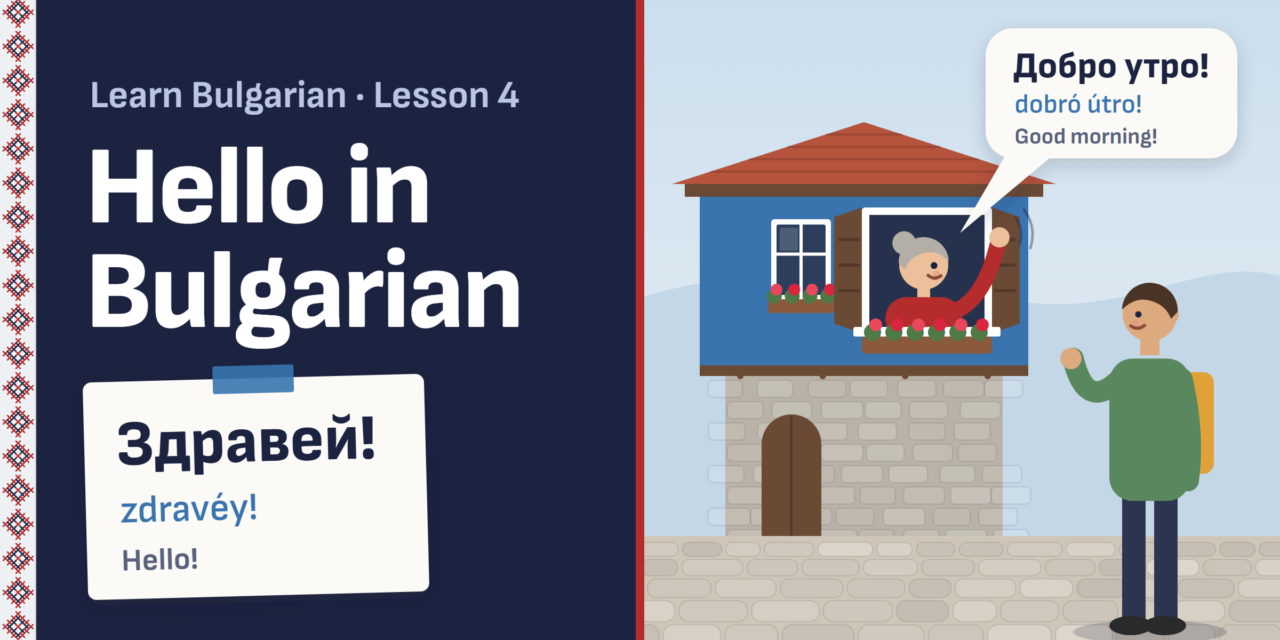
Hello in Bulgarian is здравей (zdravéy). For good morning in Bulgarian, say добро утро (dobró útro). This lesson adds the rest of the basic Bulgarian phrases: how are you, goodbye, please, thank you and sorry, plus the gesture that confuses most visitors, the head shake for yes. Every Bulgarian word has its pronunciation in brackets, with an accent on the stressed syllable.
Can’t read Cyrillic yet? Start with the Bulgarian alphabet lesson. Some letters look English but are not: в (v), р (r), н (n), у (u).
PART 1 · HELLO, HOW ARE YOU, GOODBYE
1. Hello in Bulgarian: здравей (zdravéy), здравейте (zdravéyte) and здрасти (zdrásti)
Hello in Bulgarian comes in three common forms, and the choice depends on who is in front of you. Use здравей (zdravéy) with one person you know well, a friend or a child. Say здравейте (zdravéyte) to a stranger, an older person or a whole group; the ending те (te) makes it polite or plural. Among friends you will mostly hear the short здрасти (zdrásti), which feels like “hi”. When unsure, pick здравейте.
| Bulgarian | Pronunciation | English |
|---|---|---|
| Здравей! | zdravéy! | Hello! (to one friend) |
| Здравейте! | zdravéyte! | Hello! (polite, or to a group) |
| Здрасти! | zdrásti! | Hi! (casual) |
| Ало? | álo? | Hello? (on the phone) |
| Добре дошъл / Добре дошла | dobré doshắl / dobré doshlá | Welcome (to a man / to a woman) |
| Добре дошли! | dobré doshlí! | Welcome! (polite, or to a group) |
2. Good morning in Bulgarian and greetings for each part of the day
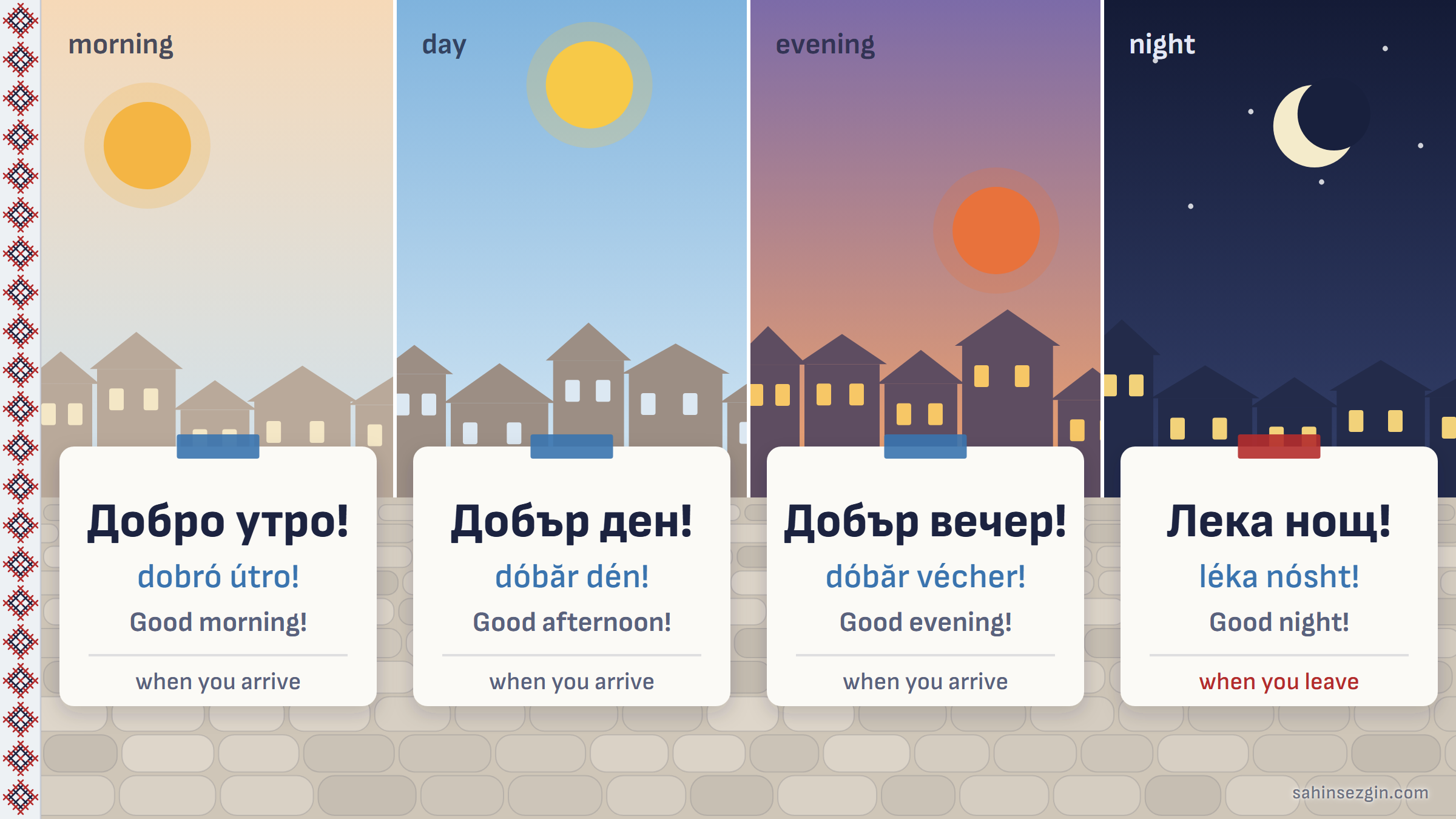
Good morning in Bulgarian is добро утро (dobró útro), fine until about ten or eleven. After that, switch to добър ден (dóbăr dén), literally “good day”, the standard daytime greeting. In the evening it becomes добър вечер (dóbăr vécher). Вечер (vécher, evening) is feminine, yet the greeting keeps a fixed masculine form; in other phrases “good” changes its ending to match the noun (добро утро), as Bulgarian noun gender and plural explains.
| Bulgarian | Pronunciation | English |
|---|---|---|
| Добро утро! | dobró útro! | Good morning! |
| Добър ден! | dóbăr dén! | Good afternoon! / Hello! (when you meet) |
| Добър вечер! | dóbăr vécher! | Good evening! (when you meet) |
| Приятен ден! | priyáten dén! | Have a nice day! (when you leave) |
| Приятна вечер! | priyátna vécher! | Have a nice evening! (when you leave) |
| Лека нощ! | léka nósht! | Good night! |
Arriving or leaving: добър ден (dóbăr dén) or приятен ден (priyáten dén)?
English uses “good afternoon” in both directions, but Bulgarian splits it. Добър ден (dóbăr dén) and добър вечер (dóbăr vécher) are only for arriving: you say them as you walk into a bakery. When you leave, you wish a pleasant rest of the day with приятен ден (priyáten dén) or, later on, приятна вечер (priyátna vécher). Лека нощ (léka nósht) is “good night”, a goodbye said late or before bed, never a greeting at the door.
3. How are you in Bulgarian: как си (kák si) and как сте (kák ste)
How are you in Bulgarian is как си? (kák si?) with a friend and как сте? (kák ste?) with someone you address politely. Spoken fast, the first one sounds like a single word, which is why chats spell it “kaksi”. The usual answer is добре съм (dobré săm), “I’m fine”, and then you return the question with а ти? (a tí?) or а вие? (a víe?). Many Bulgarians answer quite literally, so you may hear горе-долу (góre-dólu), “so-so”.
| Bulgarian | Pronunciation | English |
|---|---|---|
| Как си? | kák si? | How are you? (informal) |
| Как сте? | kák ste? | How are you? (polite, or to a group) |
| Какво става? | kakvó stáva? | What’s up? (casual) |
| Как върви? | kák vărví? | How is it going? |
| Добре съм. | dobré săm | I’m fine. |
| Горе-долу. | góre-dólu | So-so. |
| А ти? / А вие? | a tí? / a víe? | And you? (informal / polite) |
Ти (tí) or Вие (víe): the informal and the polite you
Modern English has one “you”, Bulgarian has two. Ти (tí) is for family, friends and children. Вие (víe) is for strangers, older people and shop staff. The verb changes too, which is why как си (kák si) turns into как сте (kák ste). Start with Вие and let the Bulgarian side offer the switch, often with да минем на ти (da mínem na tí), “let’s say ti”. You will practise this in nice to meet you in Bulgarian.
4. Goodbye in Bulgarian: довиждане (dovízhdane), чао (cháo) and до утре (do útre)
Goodbye in Bulgarian is довиждане (dovízhdane), safe everywhere. Its zh sounds like the “s” in “pleasure”. With friends, Bulgarians simply say чао (cháo), borrowed from Italian. “See you soon” is до скоро (do skóro), and “see you tomorrow” is до утре (do útre); до (do) means “until”. When someone leaves with a wish, reply и на теб (í na tép, “you too”) or the polite и на вас (í na vás).
| Bulgarian | Pronunciation | English |
|---|---|---|
| Довиждане! | dovízhdane! | Goodbye! |
| Чао! | cháo! | Bye! (casual) |
| Дочуване! | dochúvane! | Bye! (on the phone) |
| До скоро! | do skóro! | See you soon! |
| До утре! | do útre! | See you tomorrow! |
| И на теб! / И на вас! | í na tép! / í na vás! | You too! (informal / polite) |
PART 2 · POLITE WORDS AND THE HEAD SHAKE
5. Please, thank you and sorry in Bulgarian
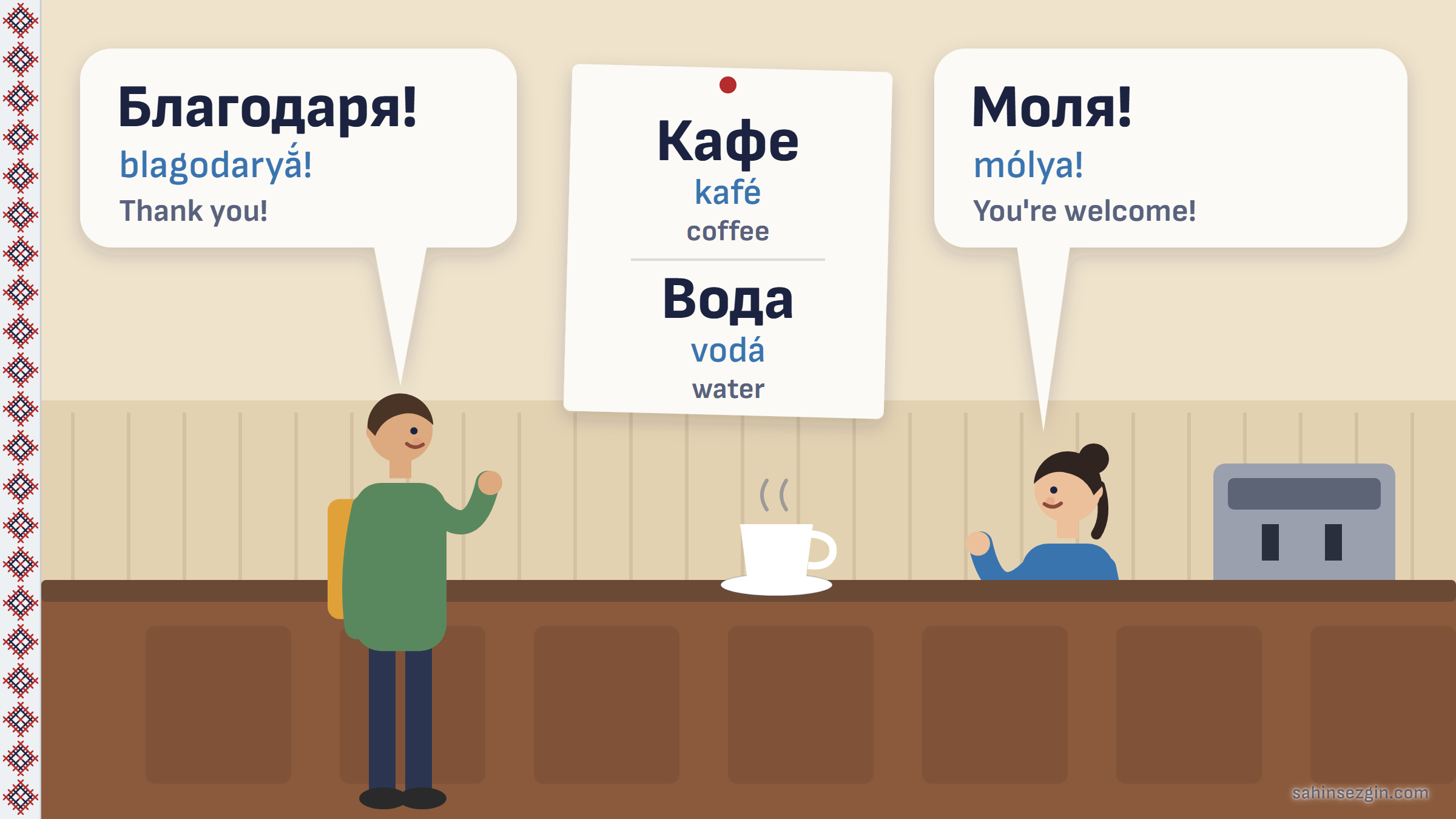
Thank you in Bulgarian is благодаря (blagodaryắ), and for sorry in Bulgarian there are two words, извинете (izvinéte) and съжалявам (săzhalyávam). In благодаря the stressed final я (ya) sounds like a short “uh”, so the standard form is blagodaryắ; in everyday speech you also hear blagodaryá. Friends say мерси (mersí), from French. Извинете is “excuse me” for small things, like squeezing past someone on the bus. Съжалявам is a real apology: “I’m sorry”.
| Bulgarian | Pronunciation | English |
|---|---|---|
| Благодаря. | blagodaryắ | Thank you. |
| Много благодаря. | mnógo blagodaryắ | Thank you very much. |
| Мерси. | mersí | Thanks. (casual) |
| Моля. | mólya | Please. / You’re welcome. |
| Ако обичате. | áko obíchate | Please. (more formal) |
| Няма защо. | nyáma zashtó | Don’t mention it. |
| Извинете. / Извинявай. | izvinéte / izvinyávay | Excuse me, sorry. (polite / informal) |
| Съжалявам. | săzhalyávam | I’m sorry. |
Please and you’re welcome: one word, моля (mólya)
Please in Bulgarian is моля (mólya), the busiest polite word in the language. Put it at the end of a request and it means please: едно кафе, моля (ednó kafé, mólya), “a coffee, please”. Say it after someone thanks you and it means “you’re welcome”. With a rising tone, моля? (mólya?) means “sorry, what did you say?”. Ако обичате (áko obíchate) is a more formal please, literally “if you like”, common in announcements and on signs.
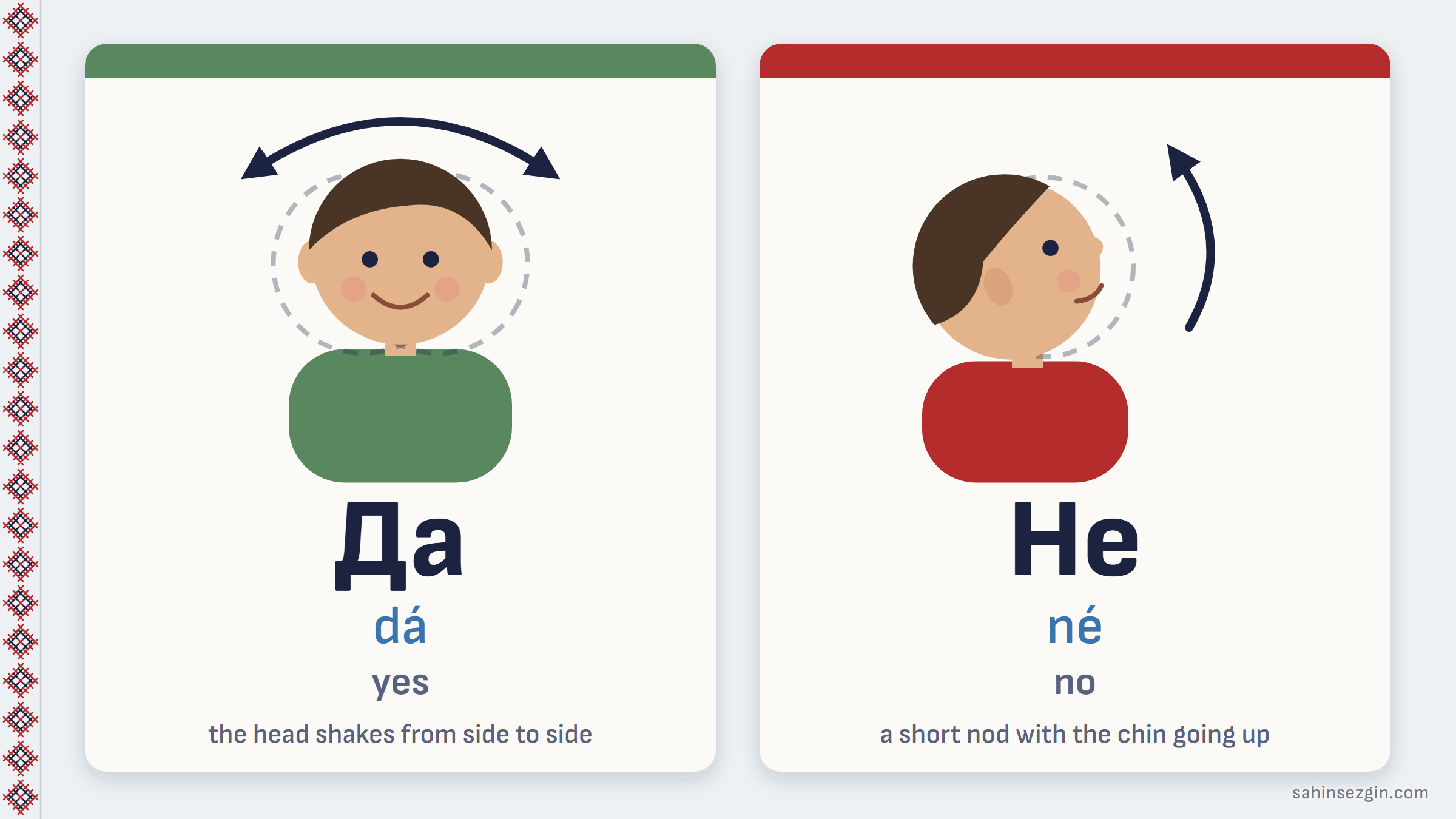
6. Yes and no in Bulgarian: да (dá), не (né) and the head shake
Yes in Bulgarian is да (dá) and no is не (né). Russian speakers should note that the Bulgarian no is не, not нет (nyét). Put не in front of a verb and it makes it negative: не разбирам (ne razbíram) means “I don’t understand”. If an answer confuses you, ask да или не? (dá íli né?), “yes or no?”. That question can save you from the wrong dish, and nobody finds it rude.
| Bulgarian | Pronunciation | English |
|---|---|---|
| Да. | dá | Yes. |
| Не. | né | No. |
| Да или не? | dá íli né? | Yes or no? |
| Не разбирам. | ne razbíram | I don’t understand. |
Why do Bulgarians shake their head for yes?
Bulgarians traditionally shake their head from side to side to mean yes, and that is the real trap. For no, they give a short upward nod, tipping the chin up and back. So the gesture an English speaker reads as “no” means yes. People who work with tourists often switch to Western gestures, so trust the word, not the head. Bulgarians often say да (dá) or не (né) aloud too. Nobody knows for certain how the custom began.
PART 3 · COMMON PHRASES AND PRACTICE
7. Basic Bulgarian words and common phrases for your first day
These are the basic Bulgarian words and phrases a visitor needs in the first week: asking for the bill, finding the toilet, admitting you don’t understand. Learn these common Bulgarian phrases as whole chunks and leave the grammar for later. The little word ли (li) turns a sentence into a question, like “do” in English, but it comes right after the word you ask about. The video below adds twenty more everyday words to practise with.
| Bulgarian | Pronunciation | English |
|---|---|---|
| Говорите ли английски? | govórite li anglíyski? | Do you speak English? |
| Извинете, къде е тоалетната? | izvinéte, kădé e toalétnata? | Excuse me, where is the toilet? |
| Може ли сметката? | mózhe li smétkata? | Can I have the bill? |
| Колко струва? | kólko strúva? | How much is it? |
| Едно кафе, моля. | ednó kafé, mólya | A coffee, please. |
Two short dialogues: Alex meets Mila and bay Petar
Alex has just moved to Plovdiv. In the first dialogue he meets Mila, a student his age, so both use ти (tí). In the second he greets his older neighbour, bay Petar, with the polite сте (ste), while bay Petar answers with ти. An older person may speak informally to a younger one, but not the other way round. Бай (báy) is a friendly, respectful title for an older man, a bit like “uncle”. The characters are fictional.
| Bulgarian | Pronunciation | English |
|---|---|---|
| Mila: Здравей! Аз съм Мила. А ти как се казваш? | zdravéy! ás săm Míla. a tí kák se kázvash? | Hi! I’m Mila. And what’s your name? |
| Alex: Казвам се Алекс. Приятно ми е. | kázvam se Áleks. priyátno mi e. | My name is Alex. Nice to meet you. |
| Mila: И на мен. Как си? | í na mén. kák si? | Nice to meet you too. How are you? |
| Alex: Добре съм, благодаря. А ти? | dobré săm, blagodaryắ. a tí? | I’m fine, thanks. And you? |
| Bulgarian | Pronunciation | English |
|---|---|---|
| Alex: Добро утро! Как сте? | dobró útro! kák ste? | Good morning! How are you? |
| Petar: Добре, благодаря. А ти? | dobré, blagodaryắ. a tí? | Fine, thanks. And you? |
| Alex: Много добре. Приятен ден! | mnógo dobré. priyáten dén! | Very well. Have a nice day! |
| Petar: И на теб! Довиждане! | í na tép! dovízhdane! | You too! Goodbye! |
8. Bulgarian greetings quiz: test yourself with 10 questions
All ten questions use words from this lesson. Pick an answer, then open “Answer” for a short explanation. If you miss one, find the phrase in its table and say it aloud three times. Come back in two days and try again.
-
You want to ask an older stranger “How are you?”. What do you say?
- Как си? (kák si?)
- Как сте? (kák ste?)
- Как се казваш? (kák se kázvash?)
Answer
Как сте? (kák ste?) is the polite form; как си? (kák si?) is for friends.
-
What does лека нощ (léka nósht) mean?
- Good evening
- Good morning
- Good night
Answer
Good night, said when you leave late. Good evening is добър вечер (dóbăr vécher).
-
You walk into a room with five people. Which hello fits?
- Здравейте (zdravéyte)
- Здравей (zdravéy)
- Довиждане (dovízhdane)
Answer
Здравейте (zdravéyte) is for a group.
-
A Bulgarian grandmother answers you with a short upward nod of the chin. What does she traditionally mean?
- Yes
- No
Answer
No. A side to side shake means yes. If in doubt, ask да или не? (dá íli né?).
-
Someone says благодаря (blagodaryắ) to you. Which reply means “you’re welcome”?
- Съжалявам (săzhalyávam)
- Моля (mólya)
- Здрасти (zdrásti)
Answer
Моля (mólya). Съжалявам (săzhalyávam) means “I’m sorry”.
-
It is 7 p.m. and you enter a small shop. Which greeting do you use?
- Добър вечер (dóbăr vécher)
- Лека нощ (léka nósht)
- Добро утро (dobró útro)
Answer
Добър вечер (dóbăr vécher). Лека нощ (léka nósht) is only for leaving.
-
You bump into someone on the tram. What is the quick polite word?
- Мерси (mersí)
- Чао (cháo)
- Извинете (izvinéte)
Answer
Извинете (izvinéte), “excuse me”.
-
What does добре дошли (dobré doshlí) mean?
- See you soon
- Welcome
- Have a nice day
Answer
Welcome, to a group or politely. To one man it is добре дошъл (dobré doshắl).
-
A friend texts you “kaksi”. What is the friend asking?
- How are you?
- Where are you from?
- What’s your name?
Answer
“Kaksi” is как си? (kák si?) in Latin letters. Answer with добре съм (dobré săm).
-
You are leaving a café in the afternoon. How do you wish the staff a nice day?
- Добър ден (dóbăr dén)
- Приятен ден (priyáten dén)
Answer
Приятен ден (priyáten dén). Добър ден (dóbăr dén) is only for arriving.
Frequently asked questions about hello in Bulgarian and basic phrases
How do you say hello in Bulgarian?
Say здравей (zdravéy), or здравейте (zdravéyte) to a group or politely.
How do you say good morning in Bulgarian?
Good morning is добро утро (dobró útro). Later in the day say добър ден (dóbăr dén), and in the evening добър вечер (dóbăr vécher).
How do you say thank you in Bulgarian?
Thank you is благодаря (blagodaryắ), often heard as blagodaryá. Friends also say мерси (mersí).
Do Bulgarians really shake their head for yes?
Traditionally yes: a side to side shake means да (dá, yes) and a short upward nod means не (né, no).
Audio: Lingua Libre (Wikimedia Commons), speaker Kiril kovachev, licensed under CC BY-SA 4.0. Recordings were converted to MP3.
Write a comment