

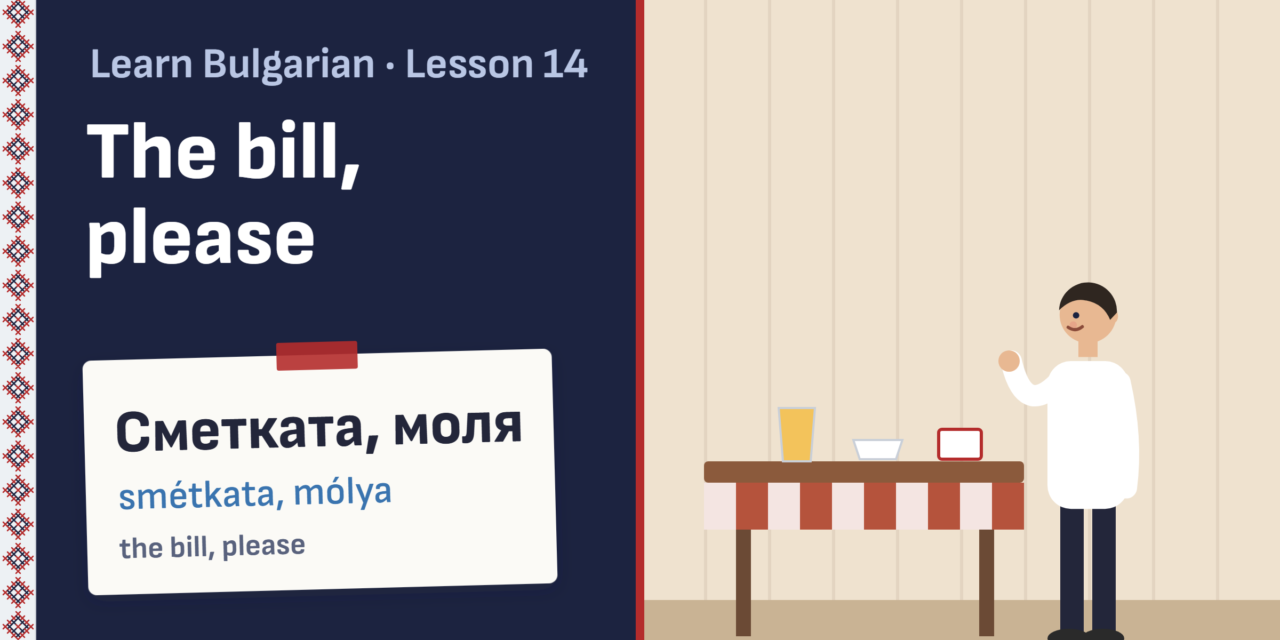
“The bill, please” in Bulgarian is Сметката, моля (smétkata, mólya); the more polite version is Може ли сметката? (mózhe li smétkata?). In this lesson you walk into a Bulgarian restaurant, ask for a table, read the menu, order food and drinks, pay and leave a tip. You will also meet нали (nalí), the little word for “right?”. Every Bulgarian word has its pronunciation in brackets, with the stressed vowel marked. If Cyrillic still slows you down, keep the Bulgarian alphabet lesson open in another tab.
PART 1 · TABLE AND MENU
1. Bulgarian restaurant phrases at the door: a table for two and the waiter
A restaurant in Bulgarian is ресторант (restoránt), and a waiter is сервитьор (servityór); a waitress is сервитьорка (servityórka). The traditional Bulgarian tavern with grilled meat, wooden tables and folk music is a механа (mehána). To get a waiter’s attention, a short Извинете! (izvinéte!) does the job, like “Excuse me!” in English. On a busy evening, ask Имате ли свободна маса? (ímate li svobódna mása?), “Do you have a free table?”.
| Bulgarian | Pronunciation | English |
|---|---|---|
| ресторант | restoránt | restaurant |
| сервитьор | servityór | waiter |
| Извинете! | izvinéte! | Excuse me! |
| Имате ли свободна маса? | ímate li svobódna mása? | Do you have a free table? |
| Имам резервация. | ímam rezervátsiya. | I have a reservation. |
| Маса за двама, моля. | mása za dváma, mólya. | A table for two, please. |
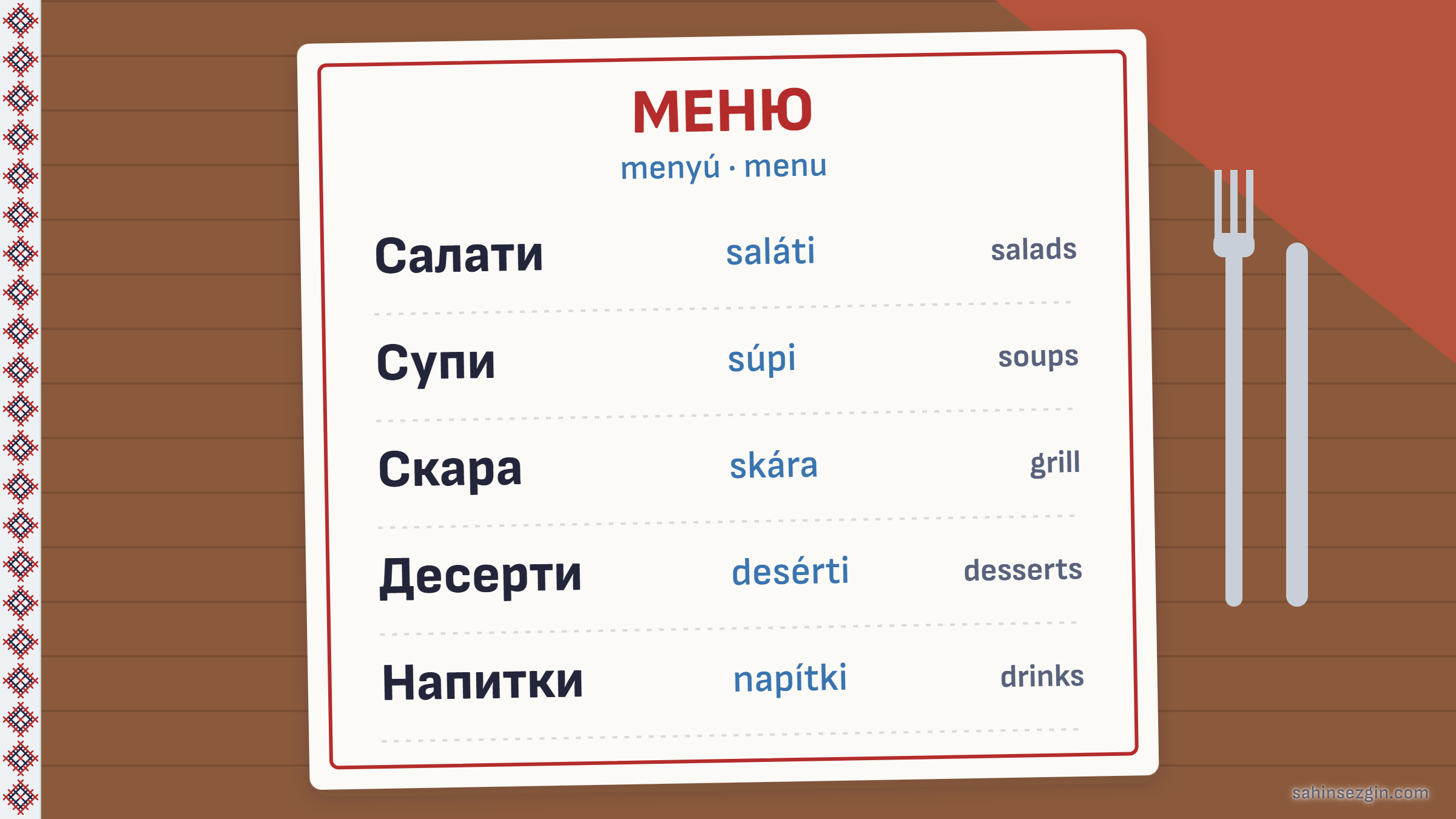
2. Reading a Bulgarian menu: Може ли менюто? (mózhe li menyúto?)
“Menu” in Bulgarian is меню (menyú), almost the English word. When you ask for it, the word gets the ending ‑то (to): Може ли менюто? (mózhe li menyúto?), “Could I have the menu?”. That ending is the Bulgarian “the”, and it sits at the end of the noun instead of in front of it. You met Може ли (mózhe li) with verbs in the I don’t understand in Bulgarian lesson; here a noun follows it directly. Many places also have an English menu.
| Bulgarian | Pronunciation | English |
|---|---|---|
| салати | saláti | salads |
| супи | súpi | soups |
| основни ястия | osnóvni yástiya | main courses |
| скара | skára | grilled dishes |
| десерти | desérti | desserts |
| напитки | napítki | drinks |
PART 2 · ORDERING
3. Ordering food in Bulgarian: Ще взема (shte vzéma) and За мен (za mén)
Ordering food in Bulgarian is easiest with Ще взема (shte vzéma), “I’ll have”. The word ще (shte) is the Bulgarian “will”: it never changes and always stands in front of the verb. The waiter asks Какво ще поръчате? (kakvó shte porắchate?), “What would you like to order?”, and you answer Ще взема една шопска салата (shte vzéma edná shópska saláta). Shorter still is За мен (za mén), “for me”: За мен супа (za mén súpa). Your friend wants the same? И за мен същото (i za mén sắshtoto).
| Bulgarian | Pronunciation | English |
|---|---|---|
| Какво ще поръчате? | kakvó shte porắchate? | What would you like to order? |
| Ще взема една шопска салата. | shte vzéma edná shópska saláta. | I’ll have a shopska salad. |
| За мен супа. | za mén súpa. | Soup for me. |
| И за мен същото. | i za mén sắshtoto. | The same for me. |
What do you recommend? Какво препоръчвате? (kakvó preporắchvate?)
When the dish names on the menu tell you nothing, ask the waiter Какво препоръчвате? (kakvó preporắchvate?), “What do you recommend?”. Колко голяма е порцията? (kólko golyáma e pórtsiyata?) asks “How big is the portion?”; one plate can feed two. Кое е най-вкусното? (kóe e nay-fkúsnoto?) asks “Which one is the tastiest?”. The word най (nay) works like the English “most” or “-est” and is joined to the adjective with a hyphen.
4. Coffee, tea and water in Bulgarian: едно кафе (ednó kafé), един чай (edín cháy)
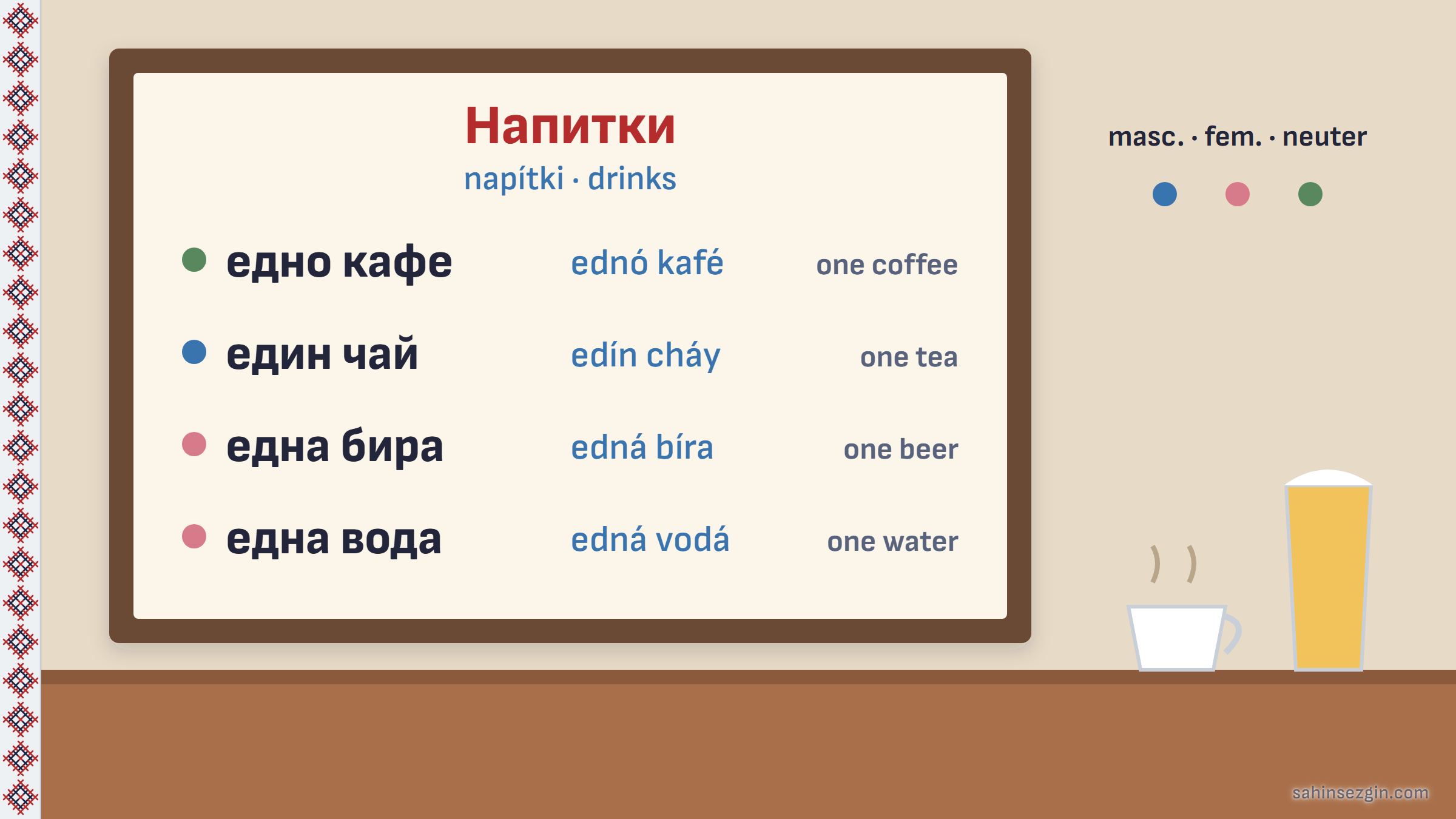
Coffee in Bulgarian is кафе (kafé) and tea is чай (cháy). The tricky part is the word “one”, which follows the gender of the noun. Кафе (kafé) is neuter, so you say едно кафе (ednó kafé). Чай (cháy) is masculine: един чай (edín cháy). Вода (vodá, water) is feminine: една вода (edná vodá). When you order water, expect the question “sparkling or still?”: газирана (gazírana) is sparkling, негазирана (negazírana) is still.
| Bulgarian | Pronunciation | English |
|---|---|---|
| едно кафе | ednó kafé | one coffee |
| кафе с мляко | kafé s mlyáko | coffee with milk |
| един чай | edín cháy | one tea |
| газирана вода | gazírana vodá | sparkling water |
| негазирана вода | negazírana vodá | still water |
Watch out: чай (cháy) on its own usually brings herbal tea or a tea bag, not strong black tea. Ask for черен чай (chéren cháy) if you want black tea. And кафе (kafé) normally arrives as an espresso, not a large filter coffee.
Beer and wine in Bulgarian: бира (bíra), наливна (nalívna) and вино (víno)
Beer in Bulgarian is бира (bíra) and wine is вино (víno). Бира (bíra) is feminine, so one beer is една бира (edná bíra). Draught beer is наливна бира (nalívna bíra), and bottled beer is бира в бутилка (bíra v butílka). With wine the waiter usually asks about colour first, so answer with червено вино (chervéno víno) for red or бяло вино (byálo víno) for white. Cheers in Bulgarian is Наздраве! (nazdráve!); the Bulgarian food lesson covers toasts and table wishes.
| Bulgarian | Pronunciation | English |
|---|---|---|
| една бира | edná bíra | one beer |
| наливна бира | nalívna bíra | draught beer |
| бира в бутилка | bíra v butílka | bottled beer |
| чаша червено вино | chásha chervéno víno | a glass of red wine |
| чаша бяло вино | chásha byálo víno | a glass of white wine |
PART 3 · THE BILL AND THE TIP
5. The bill please in Bulgarian: Може ли сметката? (mózhe li smétkata?)
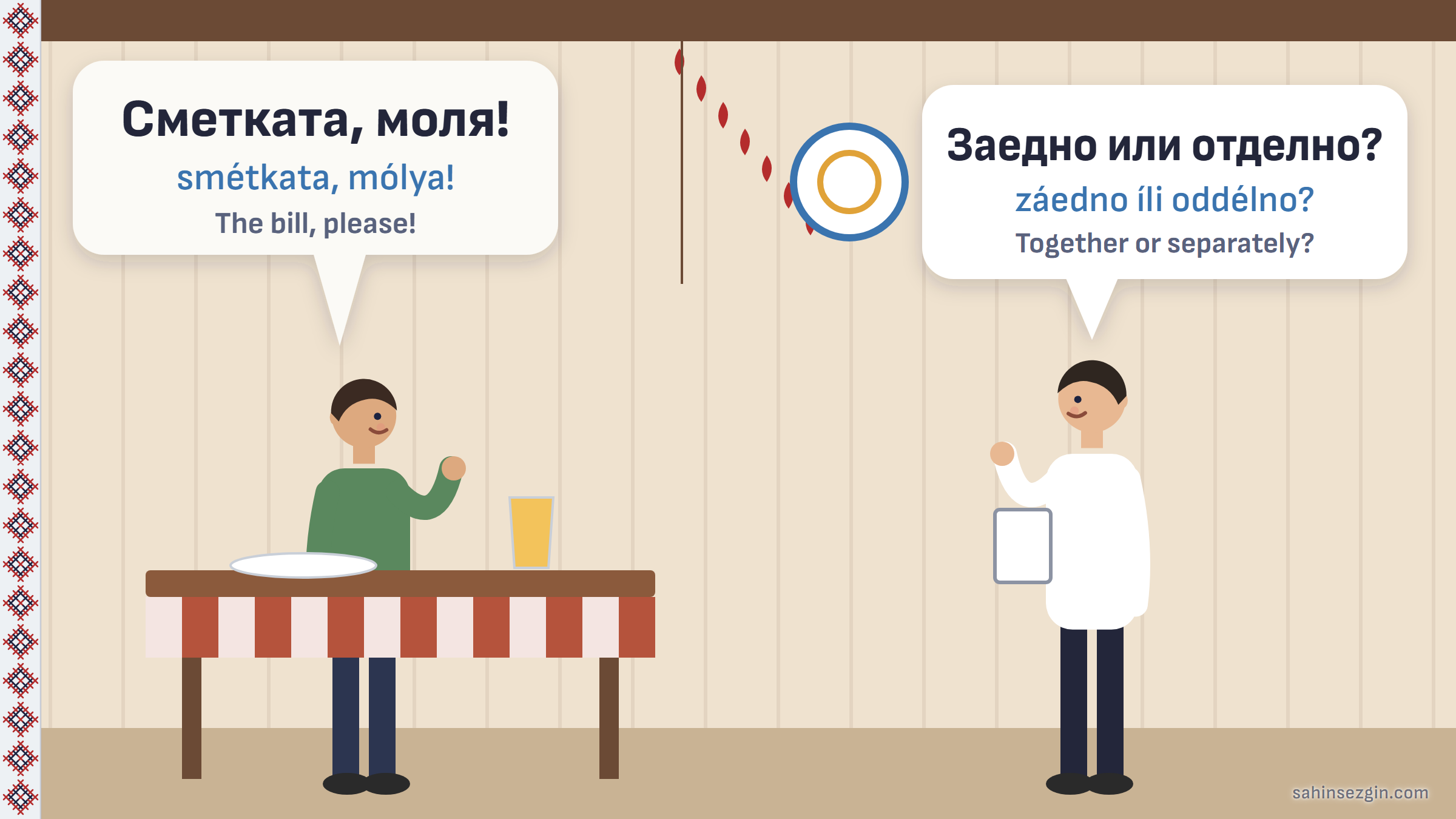
“The bill, please” in Bulgarian is Може ли сметката? (mózhe li smétkata?), word for word “Can the bill?”. Waiters rarely bring the bill before you ask, so you will need this sentence every time. Next the waiter may ask Заедно или отделно? (záedno íli oddélno?), “Together or separately?”, and then С карта или в брой? (s kárta íli v bróy?), “By card or in cash?”. The Bulgaria currency lesson has the words for money and change.
| Bulgarian | Pronunciation | English |
|---|---|---|
| Може ли сметката? | mózhe li smétkata? | Could I have the bill? |
| Заедно или отделно? | záedno íli oddélno? | Together or separately? |
| С карта или в брой? | s kárta íli v bróy? | By card or in cash? |
“Right?” in Bulgarian: нали (nalí) for a quick check
Before you pay, you may want to confirm something: “You take cards, right?”. In Bulgarian that “right?” is нали (nalí), and it never changes its form. Put it at the end: Може с карта, нали? (mózhe s kárta, nalí?). It can also open the sentence: Нали обичаш кафе? (nalí obíchash kafé?), “You like coffee, don’t you?”. English needs a different tag for every verb (isn’t it, don’t you, can’t we); Bulgarian uses нали (nalí) for all of them. The question word ли (li) asks a real yes/no question, while нали (nalí) means “I think so, please confirm”.
6. Tipping in Bulgaria: бакшиш (bakshísh) and “keep the change”
Tipping in Bulgaria is not compulsory, but a tip is welcome when you liked the service. Travel guides usually describe about 10 percent as a common restaurant tip, while in cafés and bars people simply round up the bill. The word for tip is бакшиш (bakshísh). Before you add anything, check the bill: if a service charge, обслужване (opslúzhvane), is already on it, you don’t need to tip again. To leave the rest of your cash, say Задръжте рестото (zadrắshte réstoto), “Keep the change”.
| Bulgarian | Pronunciation | English |
|---|---|---|
| бакшиш | bakshísh | tip |
| обслужване | opslúzhvane | service (charge) |
| Включено ли е обслужването? | fklyúcheno li e opslúzhvaneto? | Is service included? |
| Задръжте рестото. | zadrắshte réstoto. | Keep the change. |
| Това е за вас. | tová e za vás. | This is for you. |
Pronunciation trap: in Задръжте (zadrắshte) the letter ж (zh) is said as sh, because the voiceless т (t) follows it. Write it as you hear it and your Bulgarian will sound natural.
7. At the mehana: a Bulgarian restaurant dialogue with Alex and Mila
Alex, who has just moved to Bulgaria, and his friend Mila from Plovdiv walk into a mehana in the old town on a Saturday evening. The dialogue is made up, and it uses every pattern from this lesson in the order a real waiter would bring them: the table, the menu, drinks, a recommendation, a check with нали (nalí) and finally the bill. Read the Bulgarian column slowly and aloud first. Then cover the English column.
| Bulgarian | Pronunciation | English |
|---|---|---|
| Waiter: Добър вечер! Маса за двама ли? | dobắr vécher! mása za dváma li? | Good evening! A table for two? |
| Mila: Да, моля. Може ли менюто? | da, mólya. mózhe li menyúto? | Yes, please. Could we have the menu? |
| Waiter: Заповядайте. Какво ще пиете? | zapovyádayte. kakvó shte píete? | Here you are. What will you drink? |
| Alex: За мен една голяма наливна бира. | za mén edná golyáma nalívna bíra. | A large draught beer for me. |
| Mila: А за мен чаша бяло вино. | a za mén chásha byálo víno. | And a glass of white wine for me. |
| Alex: Какво препоръчвате? | kakvó preporắchvate? | What do you recommend? |
| Waiter: Пилешката супа днес е много вкусна. | píleshkata súpa dnes e mnógo fkúsna. | The chicken soup is very good today. |
| Alex: Тя е без свинско, нали? | tyá e bes svínsko, nalí? | It has no pork, right? |
| Waiter: Да, разбира се. | da, razbíra se. | Yes, of course. |
| Alex: Добре, ще взема една супа и шопска салата. | dobré, shte vzéma edná súpa i shópska saláta. | Fine, I’ll have a soup and a shopska salad. |
| Alex: Извинете! Може ли сметката? | izvinéte! mózhe li smétkata? | Excuse me! Could we have the bill? |
| Waiter: Заедно или отделно? | záedno íli oddélno? | Together or separately? |
| Alex: Заедно, в брой. Задръжте рестото. | záedno, v bróy. zadrắshte réstoto. | Together, in cash. Keep the change. |
8. Restaurant phrases quiz: test yourself with 10 questions
Ten questions review the whole lesson: asking for a table, menu headings, ordering, drinks, нали (nalí), the bill and the tip, in mixed order. Pick an answer to see the explanation. If you miss a question, go back to its table and read the sentence aloud once.
-
You have finished eating and want to ask politely for the bill. What do you say?
- Може ли менюто? (mózhe li menyúto?)
- Може ли сметката? (mózhe li smétkata?)
- Какво препоръчвате? (kakvó preporắchvate?)
Answer
Сметката (smétkata) means “the bill”.
-
On the menu, what will you find under напитки (napítki)?
- Soups
- Desserts
- Drinks
Answer
Напитки (napítki) means “drinks”.
-
Which one correctly says “One coffee, please”?
- Едно кафе, моля. (ednó kafé, mólya.)
- Един кафе, моля. (edín kafé, mólya.)
- Една кафе, моля. (edná kafé, mólya.)
Answer
Кафе (kafé) is neuter, so “one” is едно (ednó).
-
The waiter asks Какво ще поръчате? (kakvó shte porắchate?). What does he want to know?
- How many people are with you
- What you would like to order
- Whether you are paying by card
Answer
Ще (shte) marks the future, and поръчате (porắchate) is “you order”.
-
Your friend has ordered and you want exactly the same. What do you say?
- Още малко време. (óshte málko vréme.)
- Задръжте рестото. (zadrắshte réstoto.)
- И за мен същото. (i za mén sắshtoto.)
Answer
Същото (sắshtoto) means “the same”.
-
You want to make sure a dish has no pork. Which sentence asks “…, right?”
- Това е без свинско, нали? (tová e bes svínsko, nalí?)
- Има ли пилешко? (íma li píleshko?)
- Свинско, моля. (svínsko, mólya.)
Answer
Нали (nalí) at the end works like “right?” or “isn’t it?”.
-
Which statement about нали (nalí) is true?
- It can only start a sentence.
- It changes with the person, like a verb.
- It never changes and can go at the start or the end.
Answer
Нали (nalí) keeps one form and fits at either end of the sentence.
-
The waiter asks Заедно или отделно? (záedno íli oddélno?). What is the question about?
- Cash or card
- One bill for everyone or separate bills
- A table inside or outside
Answer
Заедно (záedno) is “together” and отделно (oddélno) is “separately”.
-
You notice обслужване (opslúzhvane) already on your bill. What does that tell you?
- The drinks were free.
- A service charge is included, so no extra tip is needed.
- You must pay in cash.
Answer
Обслужване (opslúzhvane) means “service”; on a bill it is the service charge.
-
Which word do you need to order draught beer?
- газирана (gazírana)
- бутилка (butílka)
- наливна (nalívna)
Answer
Наливна бира (nalívna bíra) is draught beer.
Frequently asked questions about eating out in Bulgaria
How do you say “the bill, please” in Bulgarian?
“The bill, please” in Bulgarian is Сметката, моля (smétkata, mólya). The more polite form is Може ли сметката? (mózhe li smétkata?).
Do you tip in Bulgaria?
Yes, if you liked the service, but it is not compulsory. Travel guides usually mention around 10 percent in restaurants; in cafés people round up. Check the bill for обслужване (opslúzhvane), a service charge, first.
How do you say “delicious” and “bon appetit” in Bulgarian?
“It’s delicious” is Много е вкусно (mnógo e fkúsno), and “bon appetit” is Добър апетит (dobắr apetít), said before the first bite.
Audio: Lingua Libre (Wikimedia Commons), speaker Kiril kovachev, licensed under CC BY-SA 4.0. Recordings were converted to MP3.
Write a comment