

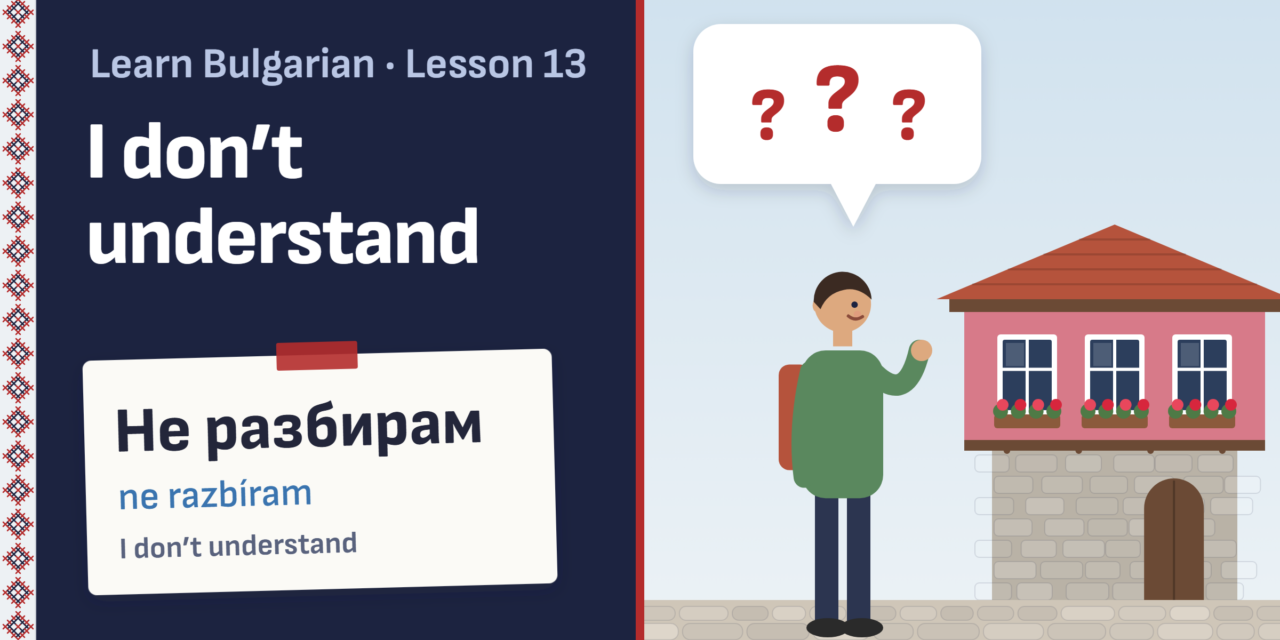
“I don’t understand” in Bulgarian is Не разбирам (ne razbíram); “I want” is Искам (ískam) and “I can” is Мога (móga). This lesson gives you the phrases that rescue a fast conversation, then one surprising rule: Bulgarian has no infinitive, so “to go” never appears on its own. Every Bulgarian word has its pronunciation in brackets, stressed vowel marked. Still slow with Cyrillic? Keep the Bulgarian alphabet lesson open in another tab.
PART 1 · WHEN YOU DON’T UNDERSTAND
1. I don’t understand in Bulgarian: Не разбирам (ne razbíram) and Не знам (ne znám)
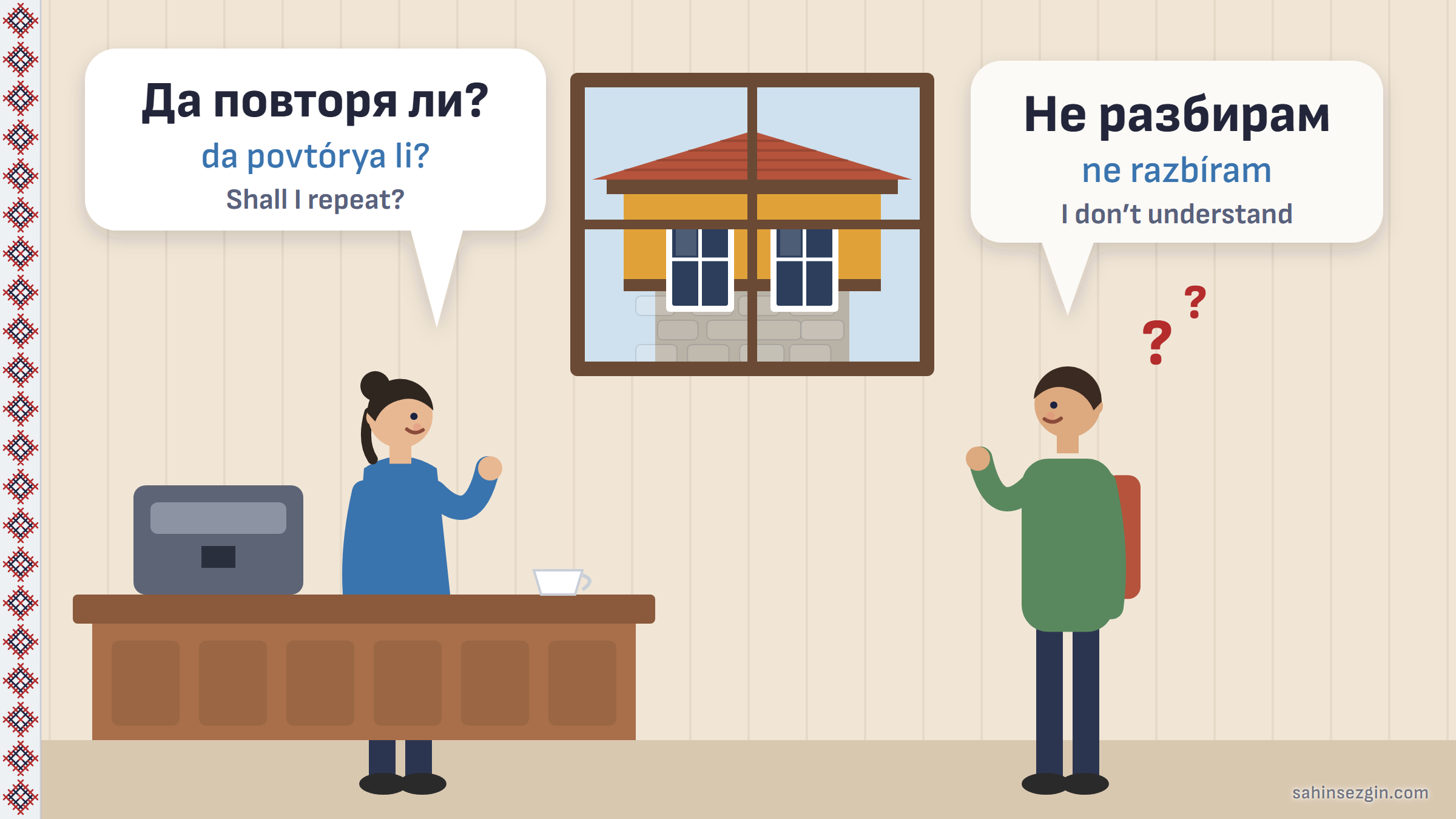
“I don’t understand” in Bulgarian is Не разбирам (ne razbíram). The word не (ne) means “not” and goes straight in front of the verb, with no helper like the English “do”: разбирам (razbíram) is “I understand”. “I don’t know” uses a different verb: Не знам (ne znám). Heard the question but have no answer? Say Не знам (ne znám). Missed the words themselves? Then say Не разбирам (ne razbíram) instead.
| Bulgarian | Pronunciation | English |
|---|---|---|
| Не разбирам. | ne razbíram. | I don’t understand. |
| Не знам. | ne znám. | I don’t know. |
| Какво значи това? | kakvó znáchi tová? | What does this mean? |
“I don’t speak Bulgarian”: Не говоря български (ne govórya bắlgarski)
“I don’t speak Bulgarian” is Не говоря български (ne govórya bắlgarski). If you know a little, say Говоря малко български (govórya málko bắlgarski); малко (málko) is “a little”. In български (bắlgarski) the stress falls on the first syllable, and ъ (ă) sounds like the “u” in “but”. To ask for a missing word, use Как се казва … на български? (kák se kázva … na bắlgarski?), “How do you say … in Bulgarian?”. Fill the gap with the English word and let the other person answer.
| Bulgarian | Pronunciation | English |
|---|---|---|
| Не говоря български. | ne govórya bắlgarski. | I don’t speak Bulgarian. |
| Не разбирам български. | ne razbíram bắlgarski. | I don’t understand Bulgarian. |
| Как се казва … на български? | kák se kázva … na bắlgarski? | How do you say … in Bulgarian? |
2. Could you repeat that? Asking someone to slow down in Bulgarian
“Could you repeat that?” in Bulgarian is Може ли да повторите? (mózhe li da povtórite?). Може ли (mózhe li) works like “could you” or “may I”, a polite opener for almost any request. To ask for a slower pace, add по-бавно (po-bávno, more slowly). The prefix по (po) plays the role of the English “-er”: по-добре (po-dobré, better). Bulgarians speak fast and run words together, so these will be your busiest sentences at first.
| Bulgarian | Pronunciation | English |
|---|---|---|
| Може ли да повторите? | mózhe li da povtórite? | Could you repeat that? |
| Моля, повторете. | mólya, povtoréte. | Please repeat. |
| Може ли да говорите по-бавно? | mózhe li da govórite po-bávno? | Could you speak more slowly? |
3. Do you speak English in Bulgarian: Говорите ли английски? (govórite li anglíyski?)
“Do you speak English?” in Bulgarian is Говорите ли английски? (govórite li anglíyski?). Again there is no “do”: the small word ли (li) after the verb makes the question, as you saw in the nice to meet you in Bulgarian lesson. With a friend, use the informal Говориш ли английски? (govórish li anglíyski?); only the ending changes. If nobody does, ask the room: Има ли някой, който говори английски? (íma li nyákoy, kóyto govóri anglíyski?).
| Bulgarian | Pronunciation | English |
|---|---|---|
| Говорите ли английски? | govórite li anglíyski? | Do you speak English? (polite) |
| Говориш ли английски? | govórish li anglíyski? | Do you speak English? (friend) |
| Има ли някой, който говори английски? | íma li nyákoy, kóyto govóri anglíyski? | Is there anyone who speaks English? |
PART 2 · WANT, CAN, MUST
4. “I want” in Bulgarian: Искам да (ískam da) and a language with no infinitive
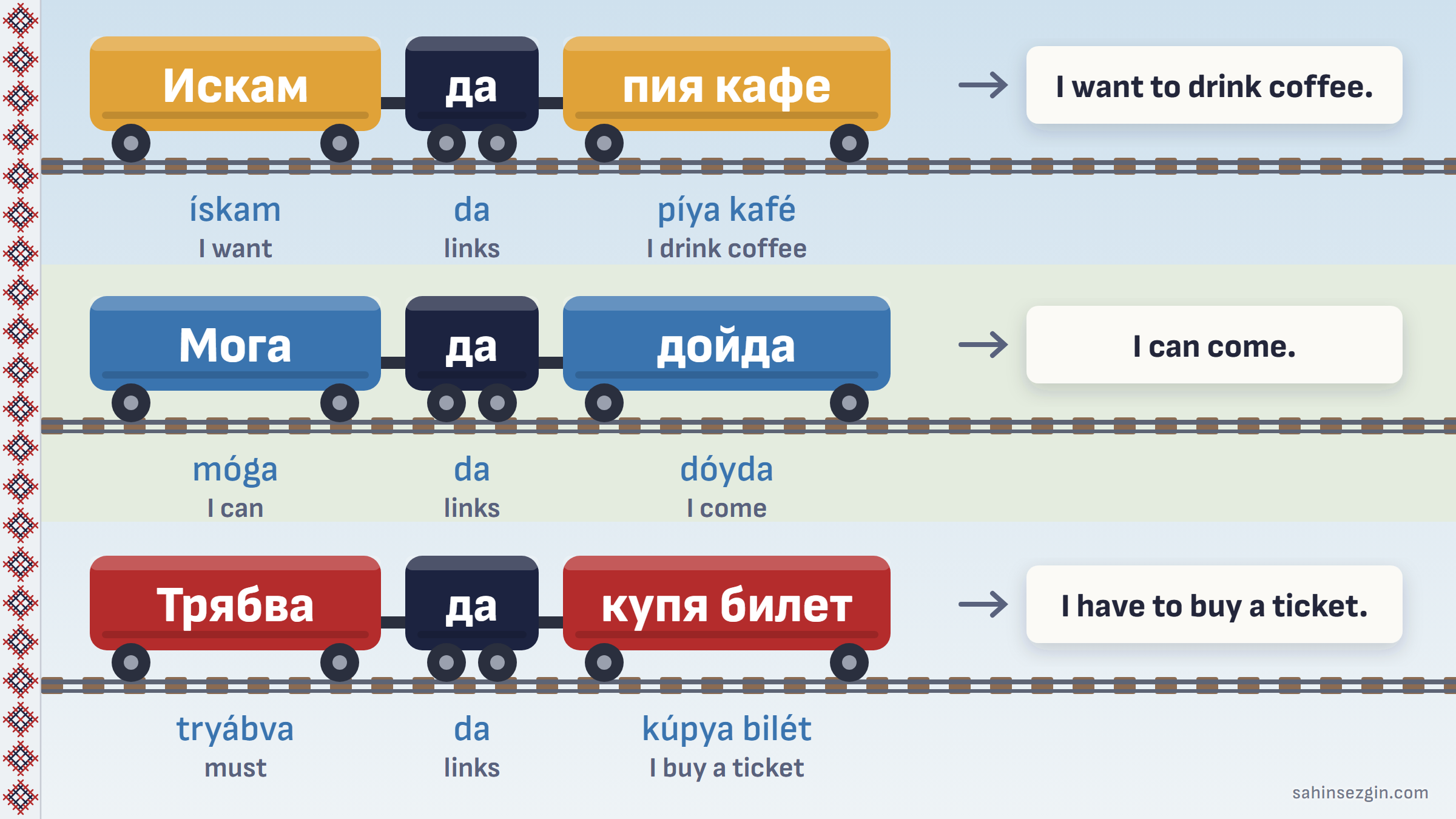
“I want” in Bulgarian is Искам (ískam). With a noun it is simple: Искам кафе (ískam kafé), “I want a coffee”. With an action the rule changes, because Bulgarian has no infinitive. English says “I want to drink coffee”; Bulgarian says “I want that I drink coffee”: Искам да пия кафе (ískam da píya kafé). The word да (da) links the verbs, and both carry a personal ending. The classic beginner mistake is dropping да (da) and leaving the second verb without its ending.
| Bulgarian | Pronunciation | English |
|---|---|---|
| Искам да пия кафе. | ískam da píya kafé. | I want to drink coffee. |
| Искам да дойдеш. | ískam da dóydesh. | I want you to come. |
Watch out: да (da) also means “yes”. Before a verb it is a linking word, close to “to”.
What do you want? Какво искаш? (kakvó ískash?) and its forms
“What do you want?” in Bulgarian is Какво искаш? (kakvó ískash?), or politely Какво искате? (kakvó ískate?). The ending changes with the person, something English shows only in “he wants”, while the stress stays on the first syllable. Bulgarians usually drop аз (as, I), because the ending already says who wants something. The pronouns in the table only show the pattern; in a café, Искам чай (ískam cháy) is enough.
| Bulgarian | Pronunciation | English |
|---|---|---|
| аз искам | as ískam | I want |
| ти искаш | ti ískash | you want |
| той / тя иска | tóy / tyá íska | he / she wants |
| ние искаме | níe ískame | we want |
| вие искате | víe ískate | you want (polite) |
| те искат | te ískat | they want |
Present tense endings after да (da): verbs in e and i
The verb after да (da) is conjugated too, so you need present tense endings. Bulgarian verbs form three groups, named after the vowel in the “you” form. Искам (ískam) is in the a group: искаш (ískash). Чета (chetắ, I read) is in the e group: четеш (chetésh). Говоря (govórya, I speak) is in the i group: говориш (govórish). The same vowel returns in the “we” form. Learn each new verb with its “you” form, because that form tells you the group.
| Bulgarian (e group · i group) | Pronunciation | English |
|---|---|---|
| аз чета · аз говоря | as chetắ · as govórya | I read · I speak |
| ти четеш · ти говориш | ti chetésh · ti govórish | you read · you speak |
| ние четем · ние говорим | níe chetém · níe govórim | we read · we speak |
| те четат · те говорят | te chetắt · te govóryat | they read · they speak |
5. Bulgarian modal verbs мога (móga) and може ли (mózhe li): I can, I can’t
“I can” in Bulgarian is Мога (móga), and “I can’t” is Не мога (ne móga). Unlike the English “can”, мога (móga) takes endings, and the next verb still needs да (da): Мога да дойда (móga da dóyda), “I can come”. The forms are slightly irregular, with г (g) in “I” and “they” and ж (zh) elsewhere: мога (móga), можеш (mózhesh), може (mózhe), можем (mózhem), можете (mózhete), могат (mógat). On its own, Не мога (ne móga) is a complete answer.
| Bulgarian | Pronunciation | English |
|---|---|---|
| Мога да дойда. | móga da dóyda. | I can come. |
| Не мога да разбера. | ne móga da razberắ. | I can’t understand it. |
Can you help me? Може ли да ми помогнете? (mózhe li da mi pomógnete?)
“Can you help me?” in Bulgarian, said politely, is Може ли да ми помогнете? (mózhe li da mi pomógnete?). Ми (mi) means “me”, is never stressed and leans on the verb after it. Start with it at a ticket machine, in a shop or in a pharmacy, and people will listen. In a real emergency one word is enough: Помощ! (pómosht!), “Help!”. Afterwards, say Благодаря за помощта! (blagodaryắ za pomoshtá!), “Thanks for the help!”.
| Bulgarian | Pronunciation | English |
|---|---|---|
| Може ли да ми помогнете? | mózhe li da mi pomógnete? | Can you help me? |
| Помощ! | pómosht! | Help! |
| Благодаря за помощта! | blagodaryắ za pomoshtá! | Thanks for the help! |
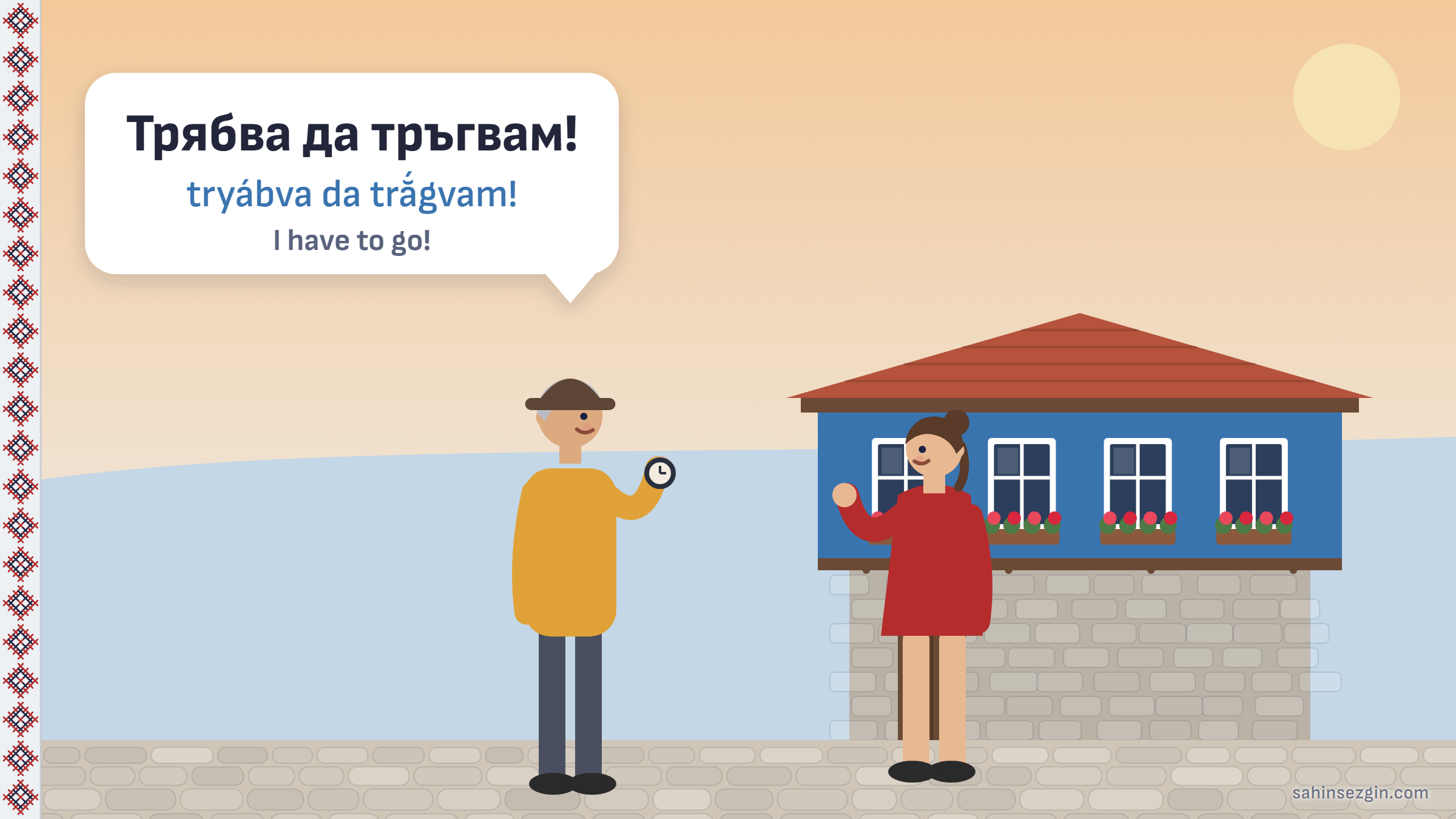
6. “I have to go” in Bulgarian: Трябва да (tryábva da)
“I have to go” in Bulgarian is Трябва да тръгвам (tryábva da trắgvam). Трябва (tryábva) means “must, have to”, and before a verb it never changes for the person, just like “must”. The verb after да (da) shows who: трябва да тръгваш (tryábva da trắgvash), “you have to go”. Тръгвам (trắgvam) is “I’m leaving”; Bulgarians say it when they stand up at the end of a visit. For a question, ли (li) follows трябва (tryábva): Трябва ли да платя? (tryábva li da platyắ?), “Do I have to pay?”.
| Bulgarian | Pronunciation | English |
|---|---|---|
| Трябва да тръгвам. | tryábva da trắgvam. | I have to go. |
| Трябва ли да платя? | tryábva li da platyắ? | Do I have to pay? |
PART 3 · PRACTICE
7. Bulgarian pharmacy dialogue: Alex explains what is wrong
Alex walks into an аптека (aptéka, pharmacy) in Plovdiv with a headache, and the pharmacist talks fast. The dialogue is fiction. Alex uses the rescue phrases in order: says “I don’t understand”, asks for a slower pace, asks about English, then explains with да (da). Главата ме боли (glaváta me bolí), literally “the head hurts me”, is a fixed phrase for “I have a headache”. In the pharmacist’s last line, пиете (píete) is the polite “you” form after трябва да (tryábva da).
| Bulgarian | Pronunciation | English |
|---|---|---|
| Pharmacist: Добър ден! Какво искате? | dobắr dén! kakvó ískate? | Hello! What would you like? |
| Alex: Главата ме боли. | glaváta me bolí. | I have a headache. |
| Pharmacist: Откога? Имате ли температура? | otkogá? ímate li temperatúra? | Since when? Any fever? |
| Alex: Извинете, не разбирам. Може ли по-бавно? | izvinéte, ne razbíram. mózhe li po-bávno? | Sorry, I don’t understand. Slower, please? |
| Pharmacist: Откога… имате ли температура? | otkogá… ímate li temperatúra? | Since when… any fever? (slowly) |
| Alex: Пак не разбрах. Говорите ли английски? | pák ne razbráh. govórite li anglíyski? | Still lost. Do you speak English? |
| Pharmacist: Съжалявам, не говоря английски. | săzhalyávam, ne govórya anglíyski. | Sorry, I don’t speak English. |
| Alex: Искам да купя нещо за главоболие. | ískam da kúpya néshto za glavobólie. | I want to buy something for a headache. |
| Pharmacist: Ето. Трябва да пиете една таблетка след ядене. | éto. tryábva da píete edná tablétka sled yádene. | Here. Take one tablet after a meal. |
| Alex: Разбирам. Благодаря за помощта! | razbíram. blagodaryắ za pomoshtá! | I understand. Thanks for the help! |
8. Bulgarian want, can and must quiz: test yourself with 10 questions
Ten questions to review the lesson: rescue phrases, the да (da) pattern, verb endings and polite forms. Pick an answer; the correct one is marked and a short explanation opens underneath. If you miss one, go back to the matching table and read the line aloud.
-
You understood a question but don’t know the answer. What do you say?
- Не разбирам. (ne razbíram.)
- Не знам. (ne znám.)
- Не мога. (ne móga.)
Answer
Не знам (ne znám) is “I don’t know”.
-
Which sentence says “I want to drink coffee”?
- Искам пия кафе. (ískam píya kafé.)
- Искам да пиеш кафе. (ískam da píesh kafé.)
- Искам да пия кафе. (ískam da píya kafé.)
Answer
Да (da) links the verbs; both are in the “I” form.
-
How do you politely ask a shop assistant if they speak English?
- Говорите ли английски? (govórite li anglíyski?)
- Говориш ли английски? (govórish li anglíyski?)
- Говоря английски. (govórya anglíyski.)
Answer
Strangers get the polite говорите (govórite).
-
What do you ask for with Може ли да говорите по-бавно? (mózhe li da govórite po-bávno?)
- A repetition
- Slower speech
- A written note
Answer
По-бавно (po-bávno) is “more slowly”.
-
Which is the “you” form of мога (móga)?
- могаш (mógash)
- мога (móga)
- можеш (mózhesh)
Answer
Only “I” and “they” keep г (g).
-
Which is true of трябва да (tryábva da)?
- Трябва (tryábva) changes for every person.
- Трябва (tryábva) stays the same; the verb after да (da) shows the person.
- No verb can follow it.
Answer
It works like the English “must”.
-
Which group does говоря (govórya) belong to?
- The a group
- The e group
- The i group
Answer
Its “you” form is говориш (govórish).
-
Which phrase asks for the Bulgarian word for something?
- Как се казва … на български? (kák se kázva … na bắlgarski?)
- Какво искаш? (kakvó ískash?)
- Трябва ли да платя? (tryábva li da platyắ?)
Answer
“How do you say … in Bulgarian?”
-
What does Искам да дойдеш. (ískam da dóydesh.) mean?
- I want to come.
- I want you to come.
- You can come.
Answer
Дойдеш (dóydesh) is the “you” form.
-
You stand up at the end of a visit. How do you say “I have to go”?
- Мога да тръгвам. (móga da trắgvam.)
- Не искам да тръгвам. (ne ískam da trắgvam.)
- Трябва да тръгвам. (tryábva da trắgvam.)
Answer
Obligation takes трябва да (tryábva da).
Frequently asked questions about saying “I don’t understand” in Bulgarian
How do you say “I don’t understand” in Bulgarian?
“I don’t understand” in Bulgarian is Не разбирам (ne razbíram); for the language itself, Не разбирам български (ne razbíram bắlgarski).
How do you say “do you speak English” in Bulgarian?
Politely, Говорите ли английски? (govórite li anglíyski?). With a friend, Говориш ли английски? (govórish li anglíyski?).
Does Bulgarian have an infinitive?
No. Where English uses “to” plus a verb, Bulgarian uses да (da) plus a verb with a personal ending.
Audio: Lingua Libre (Wikimedia Commons), speaker Kiril kovachev, licensed under CC BY-SA 4.0. Recordings were converted to MP3.
Write a comment