


Last updated
All drink typesAlcohol PricesTurkish wine is made mostly from grapes native to Turkey: the red Öküzgözü, Boğazkere and Kalecik Karası, and the white Narince and Emir. Turkey has the world’s fifth-largest vineyard area. Most of its grapes are eaten fresh or dried, though, so wine uses only a small share. This guide covers the grapes, the regions and the long-established producers.
In Turkey, selling alcohol to anyone under 18 is prohibited. Retail sales are not allowed between 22:00 and 06:00. This page gives information only and does not encourage drinking.
Native Turkish wine grapes and where they grow
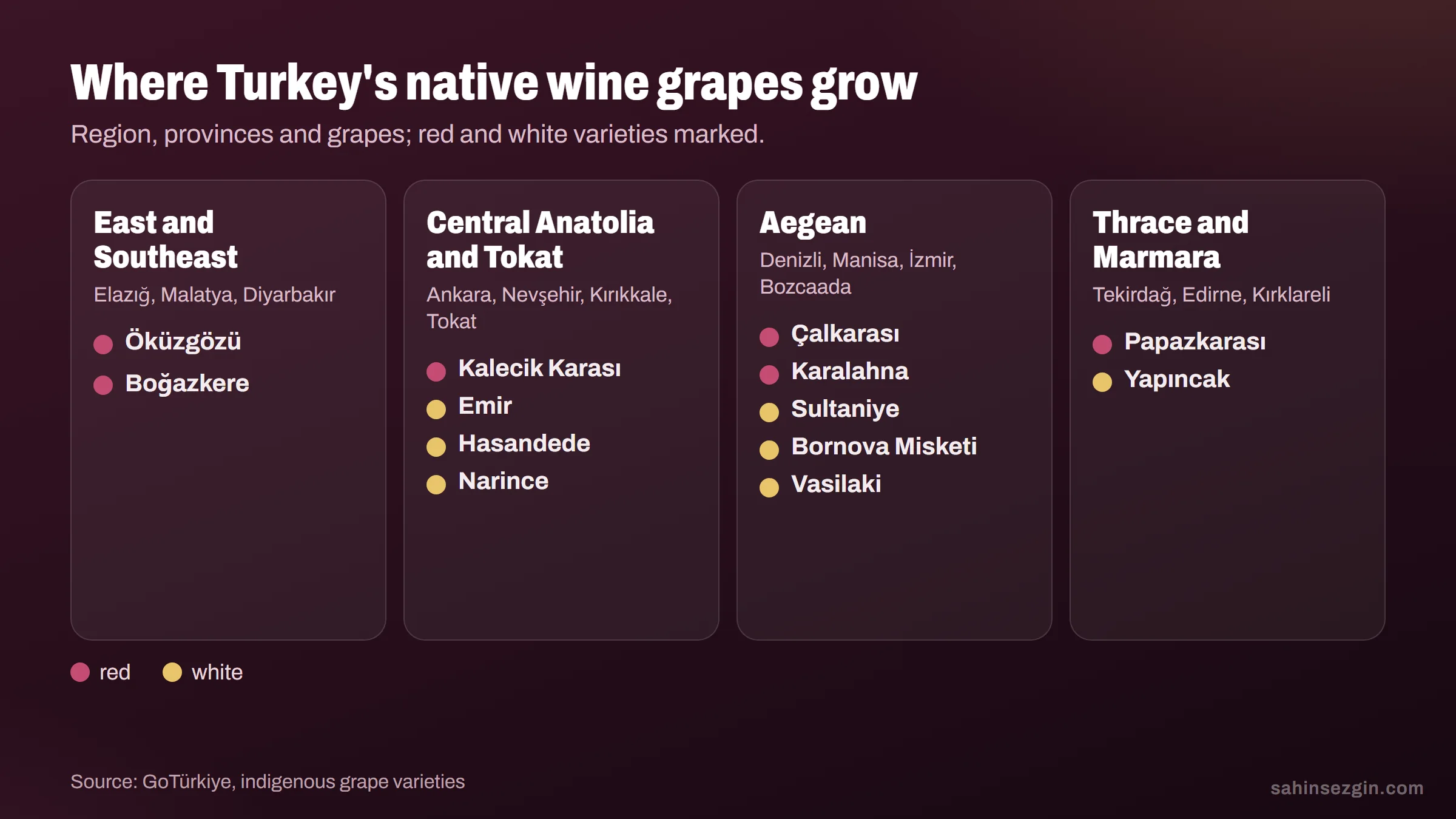
Turkey’s native wine grapes come from four broad areas. In the east, Elazığ, Malatya and Diyarbakır are home to Öküzgözü and Boğazkere. Central Anatolia grows Kalecik Karası around Kalecik near Ankara, Emir in Cappadocia and Hasandede in Kırıkkale. Narince grows in Tokat, along the Yeşilırmak river, just north of Central Anatolia.
In the Aegean, Denizli is the home of Çalkarası, and Sultaniye grows in Manisa, Denizli and İzmir. Bornova Misketi takes its name from Bornova in İzmir. The island of Bozcaada has Karalahna and Vasilaki, and Thrace grows Papazkarası and Yapıncak. The grape and region list follows GoTürkiye, the official tourism portal of Turkey. International varieties such as Cabernet Sauvignon, Merlot, Syrah and Chardonnay are planted too.
Red and white Turkish wine grapes compared
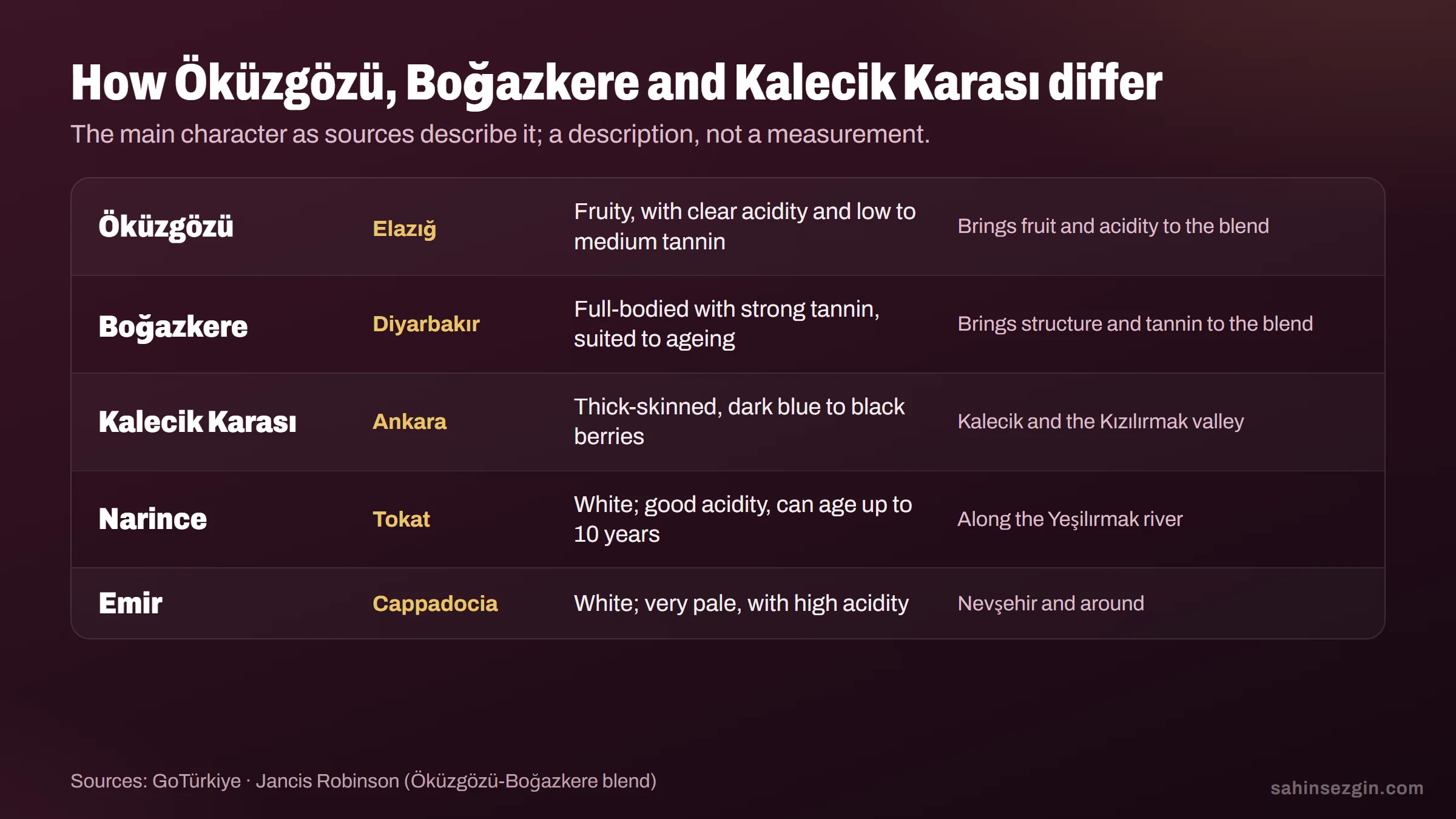
Öküzgözü (Okuzgozu) means “ox eye”, after its large berries, and Boğazkere (Bogazkere) means “throat burner”. Öküzgözü is the red grape of Elazığ and Malatya, grown in Elazığ at 850 to 1,000 metres. GoTürkiye describes its wine as balanced and low in tannin. Wikipedia notes its bright acidity and softer tannins than Boğazkere.
Boğazkere, mainly from Diyarbakır, gives a full-bodied wine with strong tannin. Jancis Robinson notes that this tannin softens when it is blended with Öküzgözü. The two are often combined: Öküzgözü brings fruit and acidity, Boğazkere brings structure. Kalecik Karası (Kalecik Karasi) grows in the Kızılırmak valley near Ankara, at around 1,000 metres. It is a thick-skinned grape with dark blue to black berries.
Among the whites, Narince from Tokat has good acidity and can age for up to ten years. Emir from Cappadocia makes a very pale wine with high acidity. The strength of wine and other drinks sold in Turkey is on the strength of wine and other drinks page.
Turkish vineyards in numbers
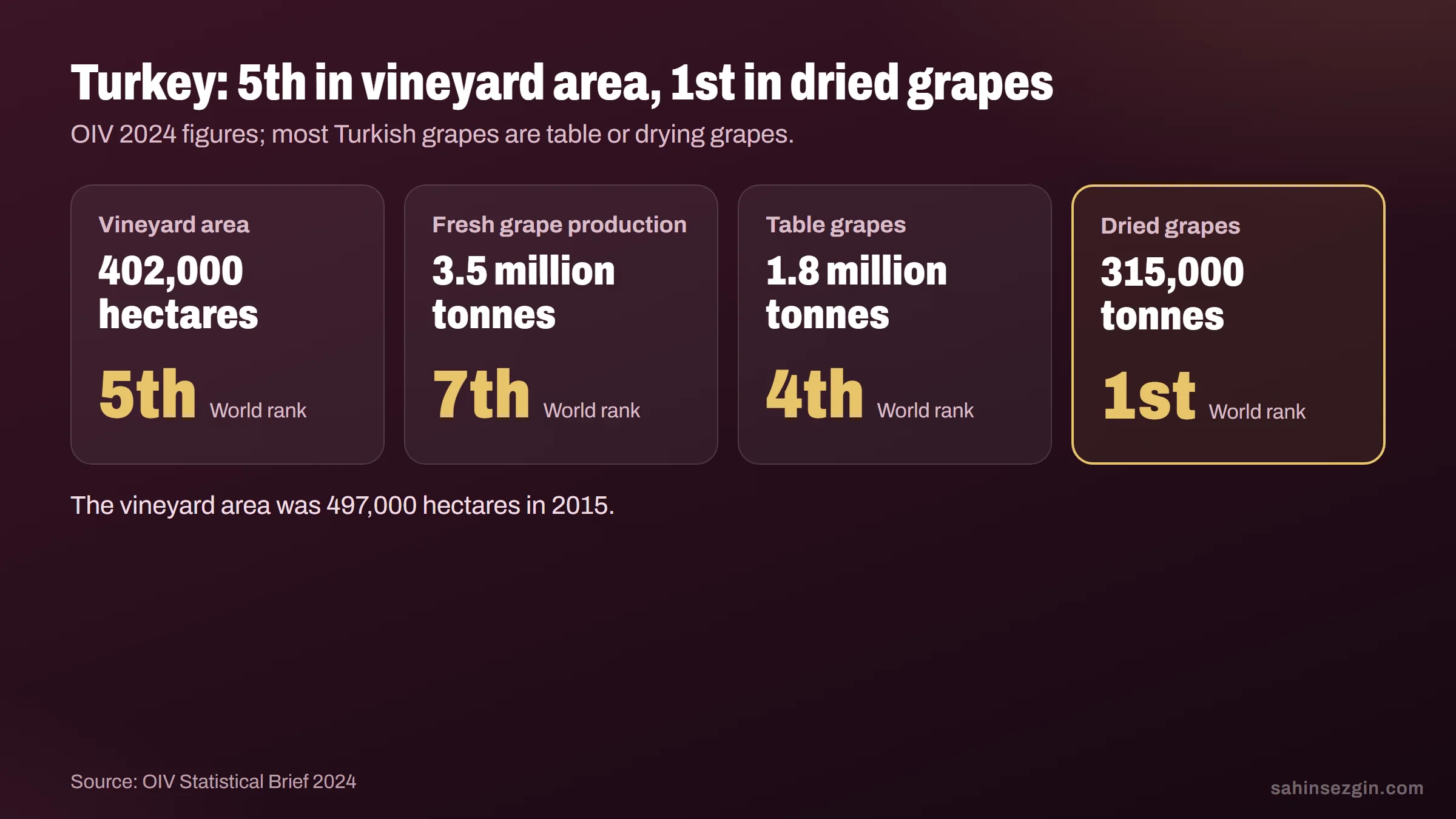
According to the International Organisation of Vine and Wine (OIV), Turkey had 402,000 hectares of vineyards in 2024. That is the fifth-largest area in the world, down from 497,000 hectares in 2015. Turkey produced 3.5 million tonnes of fresh grapes, seventh in the world, and 1.8 million tonnes of table grapes, fourth.
Turkey is also the world’s largest producer of dried grapes, with 315,000 tonnes in 2024. These figures explain why wine is a small part of Turkish grape growing: most of the harvest is sold as table grapes or dried as raisins. The Turkish Ministry of Agriculture lists Manisa, Mardin and Denizli as the leading vineyard provinces.
Long-established Turkish wine producers
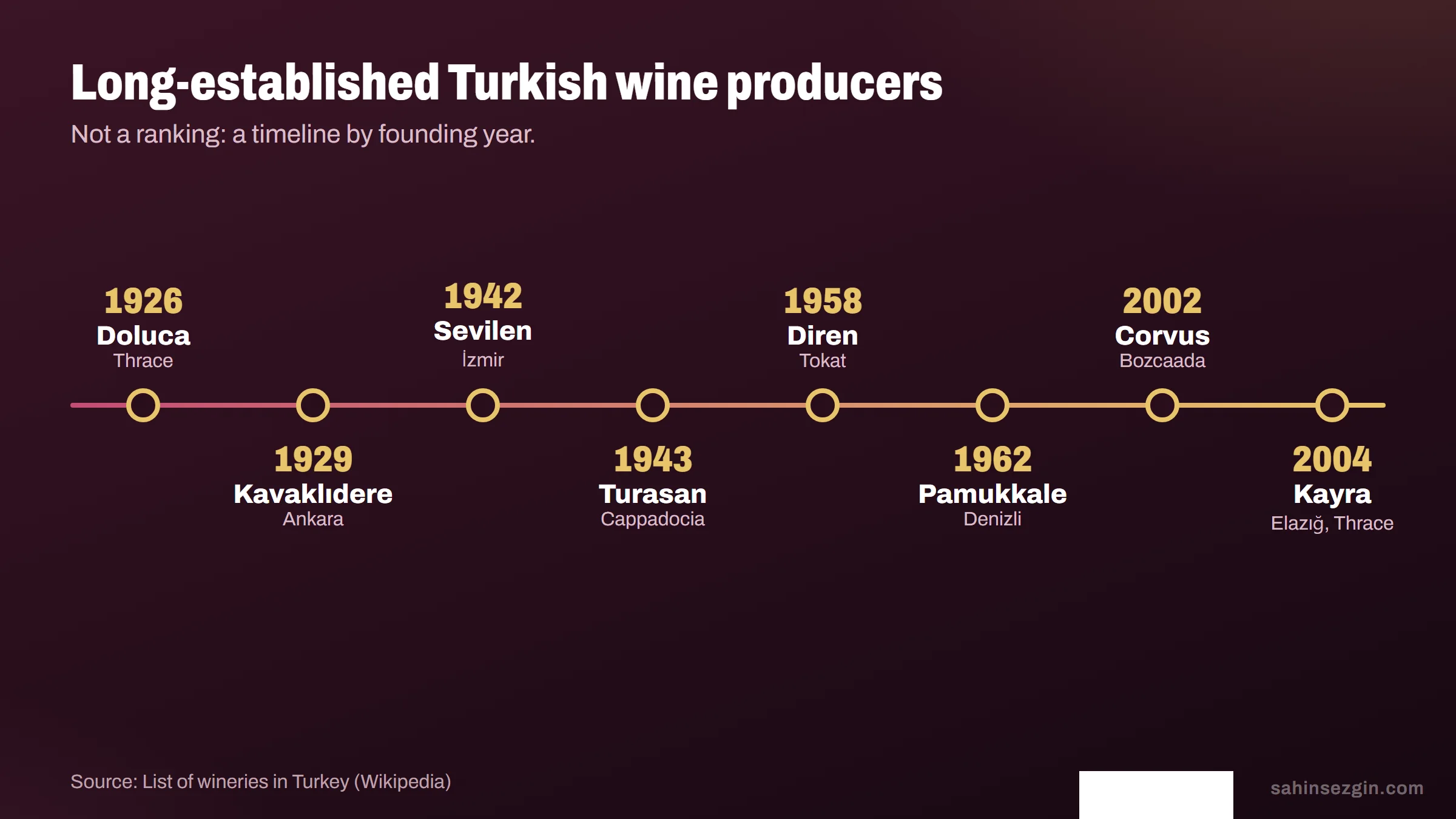
Several of Turkey’s wine producers are almost a century old. Doluca was founded in 1926 in Thrace and Kavaklıdere in 1929 in Ankara. Sevilen followed in 1942 in İzmir, Turasan in 1943 in Cappadocia, Diren in 1958 in Tokat and Pamukkale in 1962 in Denizli. Corvus on Bozcaada dates from 2002, and Kayra, with vineyards in Elazığ and Thrace, from 2004.
The list follows founding years and is not a ranking. Shop prices for wine in Turkey, with the date of each list, are in the wine section of the alcohol prices in Turkey page. Beer, rakı and spirits prices are collected under alcohol prices.
Turkish wine FAQ
The answers draw on the same sources as the sections above: GoTürkiye, the Turkish Ministry of Agriculture and OIV figures for 2024.
- What are the main Turkish wine grapes? The most widely known native reds are Öküzgözü from Elazığ, Boğazkere from Diyarbakır and Kalecik Karası from Ankara. The main native whites are Narince from Tokat and Emir from Cappadocia. Sultaniye and Bornova Misketi grow in the Aegean.
- What is the difference between Öküzgözü and Boğazkere? Öküzgözü is the fruitier grape, with bright acidity and soft tannin. Boğazkere, the “throat burner”, is full-bodied with strong tannin. Winemakers often blend them, so one wine gets fruit from Öküzgözü and structure from Boğazkere.
- Which Turkish wine producers are the oldest? Listed by founding year, not ranked: Doluca (1926), Kavaklıdere (1929), Sevilen (1942), Turasan (1943), Diren (1958) and Pamukkale (1962). Newer names include Corvus on Bozcaada (2002) and Kayra (2004).
- How big is wine production in Turkey? Turkey had 402,000 hectares of vineyards in 2024, the fifth-largest area in the world. Most grapes are eaten fresh or dried, and Turkey is the largest producer of dried grapes. Wine therefore uses only a small part of the harvest.







Write a comment